
Flames over North Dakota’s Bakken have burned 167 billion cubic meters of gas in a single year, and the trailer that drove up to a wellhead and did something no one thought possible with that wasted fire
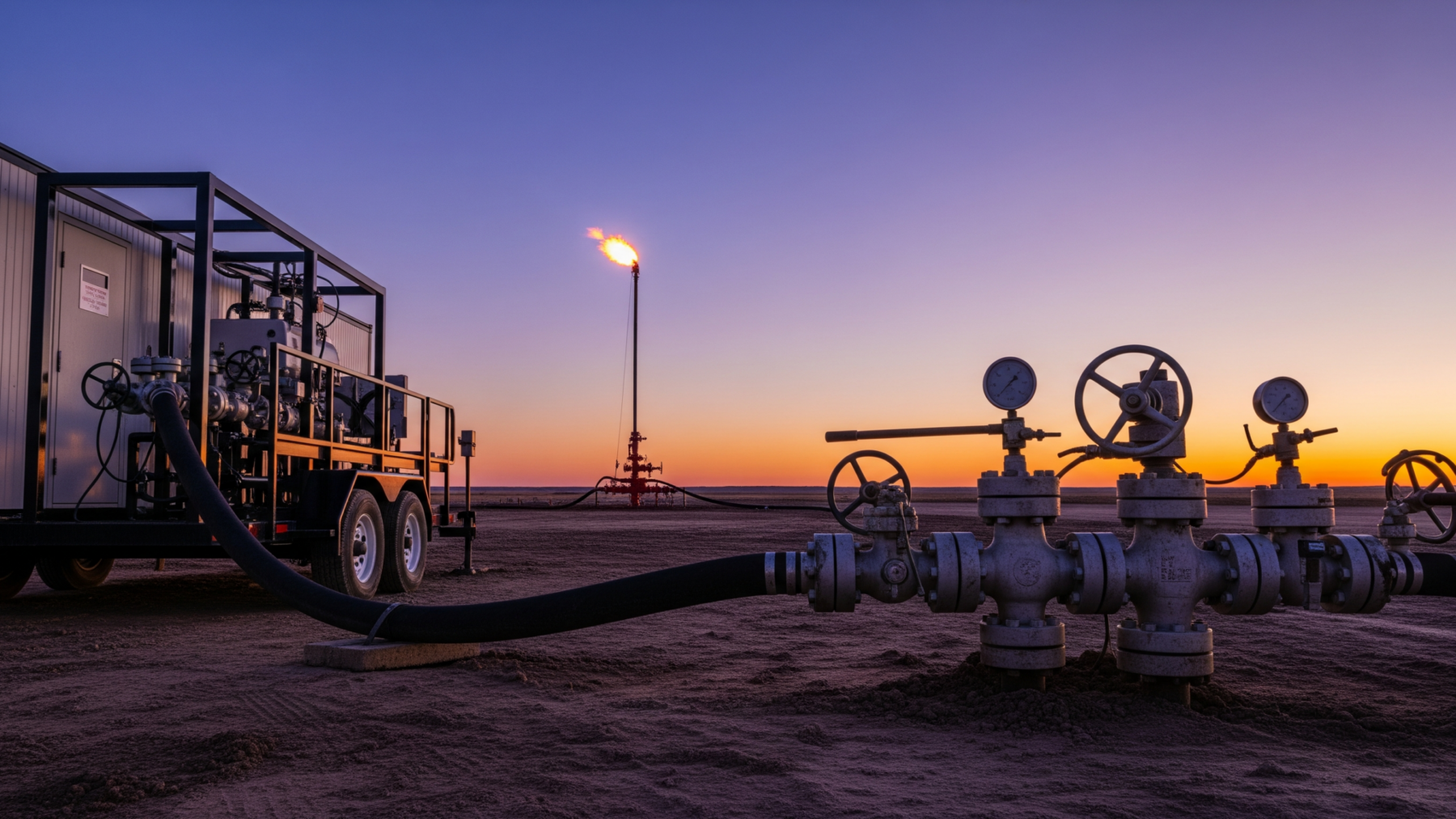
On a flat North Dakota oil pad, a flame burns night and day with no buyer and no pipeline to carry it anywhere.
It is flare gas, the methane that bubbles out of crude oil during extraction, an unwanted shadow of every barrel the Bakken produces.
For most of the industry’s history, that flame simply kept burning.
If successful, replacing flares with these modular plants could reduce local pollutant emissions and generate additional revenue for communities while creating jobs.
But a number released this summer by the World Bank changed the way that small, wasteful fire looks from a distance.
167 billion cubic meters of natural gas went up in flames worldwide in 2025 alone.
That single figure, patient and enormous, is the reason engineers started asking a different question entirely.
A number the size of a continent’s appetite
Global gas flaring rose for the third consecutive year, surging to 167 billion cubic meters in 2025 and wasting an estimated $54 billion worth of gas.
The report finds that the 167 bcm flared globally in 2025 exceeds the volume of LNG that transited the Persian Gulf that year, a stark measure of the energy value being wasted.
It also matches Africa’s entire annual gas consumption, a continent where energy poverty remains a grinding daily reality.
That comparison is not a footnote.
It means the world burned a resource larger than one of its most strategically watched trade flows and collected nothing in return.
Capturing this wasted gas could strengthen energy security, generate power, support economic activity key to job creation, and reduce emissions.
The tracker reinforced what engineers have long known: the problem is not physics.
The gas is right there.
Why the flame keeps burning anyway
Capturing associated gas from an oil well sounds simple in a boardroom.
On a remote pad in the Williston Basin, it is something else entirely.
The wells sit far from pipelines, the gas flows at unpredictable rates, and its chemical composition shifts from one hour to the next.
Conventional gas to liquids plants are enormous, built for refineries, not for a single lonely wellhead on the prairie.
Reinjecting gas into the reservoir costs money and requires infrastructure that most small operators do not have.
So the flare keeps burning, a quiet admission that no one has solved the last mile problem of stranded gas.
Until, as it turns out, someone did.
The machine that drove to the problem
The solution arrived not on a barge or a freight train but on a flatbed truck.
The M2X trailer-mounted, modular system was transported to North Dakota and deployed at a well site operated by Chord Energy.
The system was connected at a well and converted gas, which would otherwise have been flared, into methanol.
It required no new pipeline, no permanent foundation, no second crew.
Instead of burning waste gas, the system reroutes it into an engine reformer where a fuel rich partial oxidation process turns the gas into synthesis gas, a mixture of hydrogen and carbon monoxide.
That synthesis gas is then converted into methanol, a building block of fuels, plastics, and adhesives, and a growing marine shipping fuel with demand rising across Asia and Europe.
What the Williston Basin actually proved
The field demonstration confirmed something the energy industry had not seen before.
M2X became the first company to demonstrate that low carbon methanol can be produced at relevant scale using flare gas as a feedstock.
The DOE has since selected M2X for a commercial scale deployment, backing the project with nearly $10 million in federal funding to install the next generation plant at a Williston Basin well site.
The GTM modular plant employs a noncatalytic, internal combustion engine-based, partial-oxidation reformer technology that allows the process to be compact, transportable, and tolerant of variations in gas flow and composition.
Computational optimization lowered the cost of methanol production by more than 10 percent.
For a natural gas sector watching margins shift with every quarterly report, that cost reduction matters.
If successful, replacing flares with these modular plants could reduce local pollutant emissions and generate additional revenue for communities while creating jobs.
A wellhead, a truck, and a cleaner ledger
The methanol that rolls off this system does not announce itself.
It loads into a tank truck, joins the broader chemical supply chain, and eventually ends up in a factory or a ship’s fuel tank.
The Bakken alone has hundreds of well sites that still flare routinely, and the DOE investment is designed to prove the model can scale well beyond a single demonstration pad.
There is a genuine caveat: methanol is still a carbon containing fuel, and the climate benefit depends on how tightly methane leaks are controlled at each deployment site.
M2X and the DOE have not yet published full lifecycle emissions data for the commercial units.
Independent verification will matter before the industry scales this broadly.
But for now, on a patch of North Dakota prairie where a flame once burned from dusk to dawn and back again, the flare stack has something new competing for its gas.
A trailer sized machine that turns waste into a product the world actually needs, one wellhead at a time.
Hugo is an engineer with strong technical expertise. Multilingual from an early age, his writing combines technical clarity with a strong interest in science and energy.
