
Paramount Resources raises 2026 production guidance and sets Alberta Montney test-rate records after strong second-quarter results
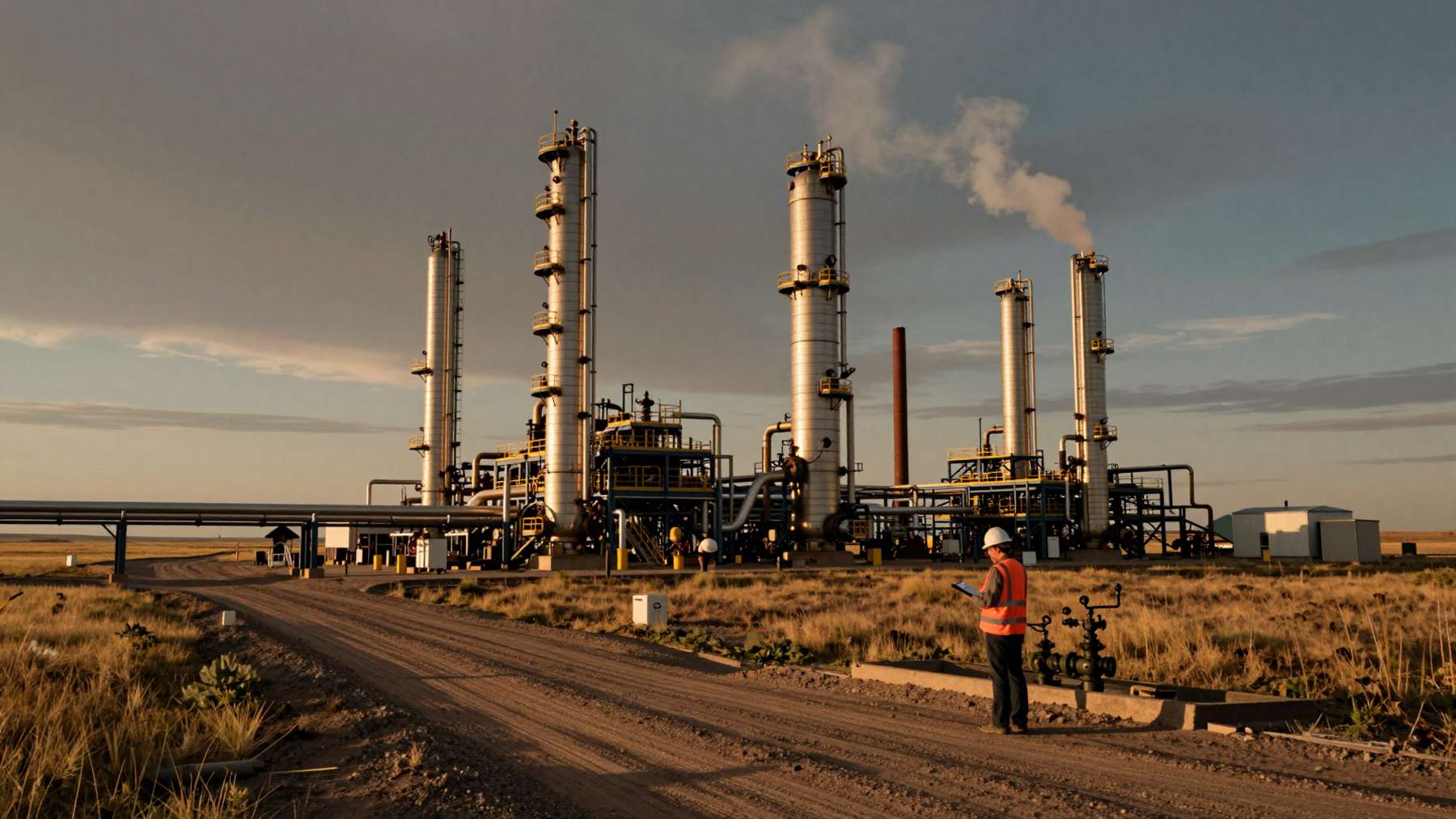 Image generated with artificial intelligence
Calgary-based Paramount Resources (TSX: POU) reported its second-quarter 2026 results on August 6, posting sales volumes of 47,279 Boe/d and adjusted funds flow of CAD $176 million—strong enough to push the company to raise its full-year production guidance.
The results came alongside a separate milestone at Sinclair: appraisal wells on the Alberta Montney formation recorded what Paramount says are the highest publicly documented test rates ever achieved in the play’s dry gas area, across both the upper and lower benches.
Q2 2026 results at a glance
Paramount’s second quarter was a clear step up from both the prior quarter and a year ago. Net income came in at CAD $68.3 million, compared with CAD $53.2 million in Q1 2026 and just $4.2 million in Q2 2025. Adjusted funds flow reached CAD $176 million ($1.21 per basic share), while cash from operating activities was $144 million.
The company held CAD $449 million in cash and equivalents at June 30, 2026, alongside $750 million in undrawn credit facilities and no long-term debt on the books.
Sales volumes averaged 47,279 Boe/d, with 49% liquids. Willesden Green contributed 27,466 Boe/d; Kaybob added 19,413 Boe/d.
The cleanest win in the quarter was on costs. Operating expenses fell to CAD $8.66/Boe—down from CAD $9.81/Boe the prior quarter and $12.39/Boe in Q2 2025. Five consecutive quarters of declining unit operating expenses, a trend that’s meaningfully widening margins as production scales up.
Why results beat expectations: Alhambra Plant expansion and well outperformance
The biggest driver of outperformance was the Alhambra Plant’s second phase coming online in early June. That expansion doubled the facility’s designed raw handling capacity to 100 MMcf/d of natural gas and 20,000 Bbl/d of liquids—a significant jump in throughput capability.
What surprised even Paramount was how fast the ramp-up went. Natural gas volumes reached the facility’s inlet capacity within the second half of June, faster than the company had forecast.
Ten additional Duvernay wells were brought on production through Alhambra on a staggered basis following the expansion, bringing the total to 26 wells flowing through the facility. Plant runtime, both before and after the phase-two start-up, exceeded expectations. The cumulative effect showed up clearly in the half-year numbers: H1 2026 average sales volumes of 47,765 Boe/d surpassed the upper end of prior guidance, which had been set at 46,000 Boe/d. That outperformance gave Paramount the confidence to revise its full-year outlook upward.
Record Sinclair Montney test rates and expanded land position
The Sinclair results deserve their own look. Paramount completed and flow-tested its second two-well appraisal pad during the quarter, targeting both the Upper and Lower benches of the Montney formation.
The Upper Montney well hit an average raw production rate of 34 MMcf/d of dry natural gas over the final three days of stabilized testing. The Lower Montney well reached 25 MMcf/d over the same window. According to Paramount’s comparison of public data—limited to wells completed after 2017 with lateral lengths exceeding 9,843 feet in the Montney dry gas area—these are the highest publicly recorded test rates for each respective bench in Alberta.
Those are preliminary test rates, not long-term production figures. Paramount notes that comparability can be affected by flowback conditions, completions design, and well length. Even so, the improvement over the first appraisal pad is hard to ignore: a 42% increase for the Upper Montney and a 56% increase for the Lower Montney, compared with the 24 MMcf/d and 16 MMcf/d recorded at that earlier pad in Q1 2025.
Paramount’s Sinclair land position now exceeds 170,000 net acres following recent acquisitions, including a contiguous block in British Columbia. The expanded footprint, the company says, gives it flexibility to increase targeted plateau production further out.
Revised 2026 guidance and 2027 outlook
Paramount raised its full-year 2026 production guidance to 51,000–53,000 Boe/d (49% liquids), a 2,000 Boe/d increase at the midpoint versus prior guidance. The revision reflects continued well outperformance, the faster-than-expected Alhambra ramp-up, and strong forecast runtime at Willesden Green.
Q3 2026 guidance sits at 50,000–53,000 Boe/d, with Q4 stepping up to 60,000–63,000 Boe/d as additional wells come on production through the back half of the year. Capital expenditure guidance for 2026 stays unchanged at CAD $1,000–$1,100 million.
For 2027, Paramount continues to expect annual volumes of 60,000–65,000 Boe/d, with a year-end exit rate above 100,000 Boe/d—roughly double the forecast 2026 average. The company is also evaluating a potential third-phase expansion of the Alhambra Plant, with a possible final investment decision as early as Q4 2026 and a potential accelerated start-up in H2 2028.
Balance sheet, dividends, and strategic context
Paramount’s financial position at quarter-end was notably clean. The company held CAD $449 million in cash and equivalents at June 30, 2026, alongside $750 million in undrawn credit facilities and no long-term debt on the books.
On June 30, Paramount Resources closed the sale of its Fox Drilling subsidiary to AKITA Drilling for approximately 19.3 million AKITA common shares and CAD $3 million in cash. Those AKITA shares were then distributed as a dividend in kind to Paramount shareholders on July 16. The Board also declared a CAD $0.05 per share cash dividend payable August 31, 2026.
Paramount beat its own H1 production guidance, raised its full-year outlook by 2,000 Boe/d at the midpoint, and posted its fifth straight quarter of falling unit operating costs. At Sinclair, it recorded what it says are the highest publicly documented Montney test rates in Alberta. No long-term debt, significant liquidity, and a production exit rate target above 100,000 Boe/d by end of 2027—roughly double where it expects to average out this year.
Kelly is an experienced writer with 15 years of experience exploring the big stories that shape our world, from tech breakthroughs and space exploration to climate, energy, and the fascinating quirks of science. She has a talent for turning complex ideas into sharp, memorable insights that stay with readers long after they’ve finished reading.
