
A Scottish startup thinks AI’s runaway energy problem could be solved by floating data centers powered entirely by ocean waves
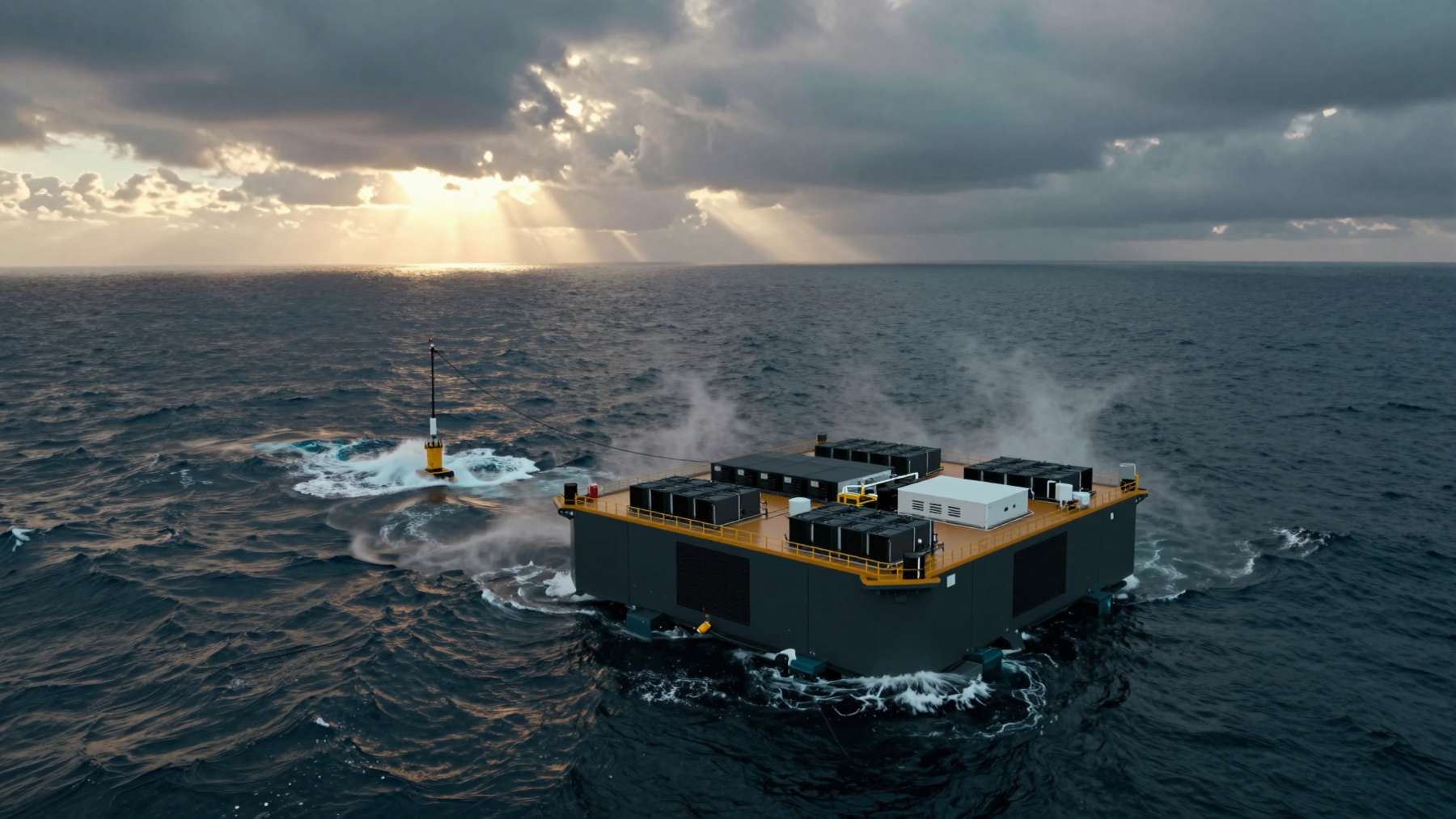 Image generated with artificial intelligence
AI data centers are projected to consume 1,200 terawatt-hours of electricity per year by 2035, driven by a quadrupling demand for AI-optimized computing.
With onshore land running out, local communities fiercely opposing new facilities, and overburdened power grids struggling to keep pace, tech giants are facing a severe bottleneck.
Edinburgh-based Mocean Energy believes the solution lies off the coast: modular, floating data centers powered by ocean waves, offshore solar, and battery storage designed to bypass land, freshwater, and grid constraints entirely.
By utilizing seawater in a closed loop, Blue Core eliminates freshwater depletion entirely, while cutting CO2 emissions by 14.3 million short tons annually by 2035.
An AI infrastructure crisis hiding in plain sight
The sheer numbers illustrate the scale of the impending energy crunch.
Global demand for AI hardware is skyrocketing, and data centers could soon consume as much power as 30% of total U.S. annual electricity generation.
Energy costs remain the single largest operational expense for data centers, where even minor inefficiencies bleed billions of dollars.
Yet energy availability is only half the battle. Rural and suburban communities are actively blocking new developments, suitable industrial land has grown scarce, and utility companies often require five to seven years just to deliver grid connections.
These compounding pressures are forcing the AI industry to seek radical alternatives.
Blue Core: Taking the data center out to sea
Mocean Energy’s response is to move computing infrastructure into deep water.
Its “Blue Core” system adapts the company’s Blue Star wave-power platform, which logged 18 months of rigorous testing in harsh North Sea conditions alongside international energy majors.
Each self-contained Blue Core platform generates between 500 kilowatts and 1 megawatt of clean power using a hybrid system of wave energy converters, solar panels, and integrated battery storage.
Designed for modular assembly, individual units can be linked into offshore server farms or retrieved for routine maintenance without causing farm-wide downtime.
Cooling at sea: A dramatic efficiency advantage
Onshore data centers spend 15% to 35% of their total energy budget simply running air conditioning and cooling chillers.
At sea, Blue Core uses a closed-loop system that exchanges heat directly with cold ocean water, slashing cooling power consumption down to just 5%.
Traditional onshore facilities also consume millions of gallons of local drinking water daily—a primary trigger for community protests.
By utilizing seawater in a closed loop, Blue Core eliminates freshwater depletion entirely, while cutting CO2 emissions by 14.3 million short tons annually by 2035.
Once built, the ocean provides virtually free, continuous renewable power for the lifespan of the asset.
A growing field: other players already testing floating data centers
Mocean Energy joins a rapidly accelerating global push toward ocean-based compute.
Microsoft pioneered subsea infrastructure with its Project Natick, proving underwater pods were eight times more reliable than an identical onshore setup before shelving commercial rollout in 2024.
Meanwhile, Nautilus Data Technologies has operated its Stockton 1 barge on California’s San Joaquin River since 2021, and a Japanese consortium led by NTT Facilities launched a floating pier demonstration in Yokohama in early 2026.
Venture backers are taking notice: Y Combinator recently listed “Compute at Sea” as a top startup priority, while floating concept Panthalassa raised $140 million.
What comes next for Blue Core
Mocean Energy is currently raising $6.5 million in pre-Series A funding to advance Blue Core toward its 2030 commercial debut, targeting 6 gigawatts of deployed offshore capacity by 2035.
Managing Director Cameron McNatt emphasizes that the platform isn’t just another data center, but a way to eliminate power and land barriers entirely.
Yet one critical question remained: how can an isolated ocean platform handle data without massive subsea fiber cables?
That brings us to the project’s true secret weapon.
Blue Core is engineered specifically for AI inference—the query execution and model processing that doesn’t require ultra-low latency.
By relying entirely on high-bandwidth low-Earth orbit satellite links, Blue Core operates completely untethered from terrestrial fiber networks, proving that the future of AI compute doesn’t need to touch land at all.
Kelly is an experienced writer with 15 years of experience exploring the big stories that shape our world, from tech breakthroughs and space exploration to climate, energy, and the fascinating quirks of science. She has a talent for turning complex ideas into sharp, memorable insights that stay with readers long after they’ve finished reading.
