
Montana’s proposed Gordon Butte plant would pump water 1,025 feet uphill, then release it to generate 400 MW
 Absaroka Energy
Just three miles from Martinsdale, Montana, which has a population of about 60, Gordon Butte stands flat-topped across the prairie as if begging for a use. It has found one.
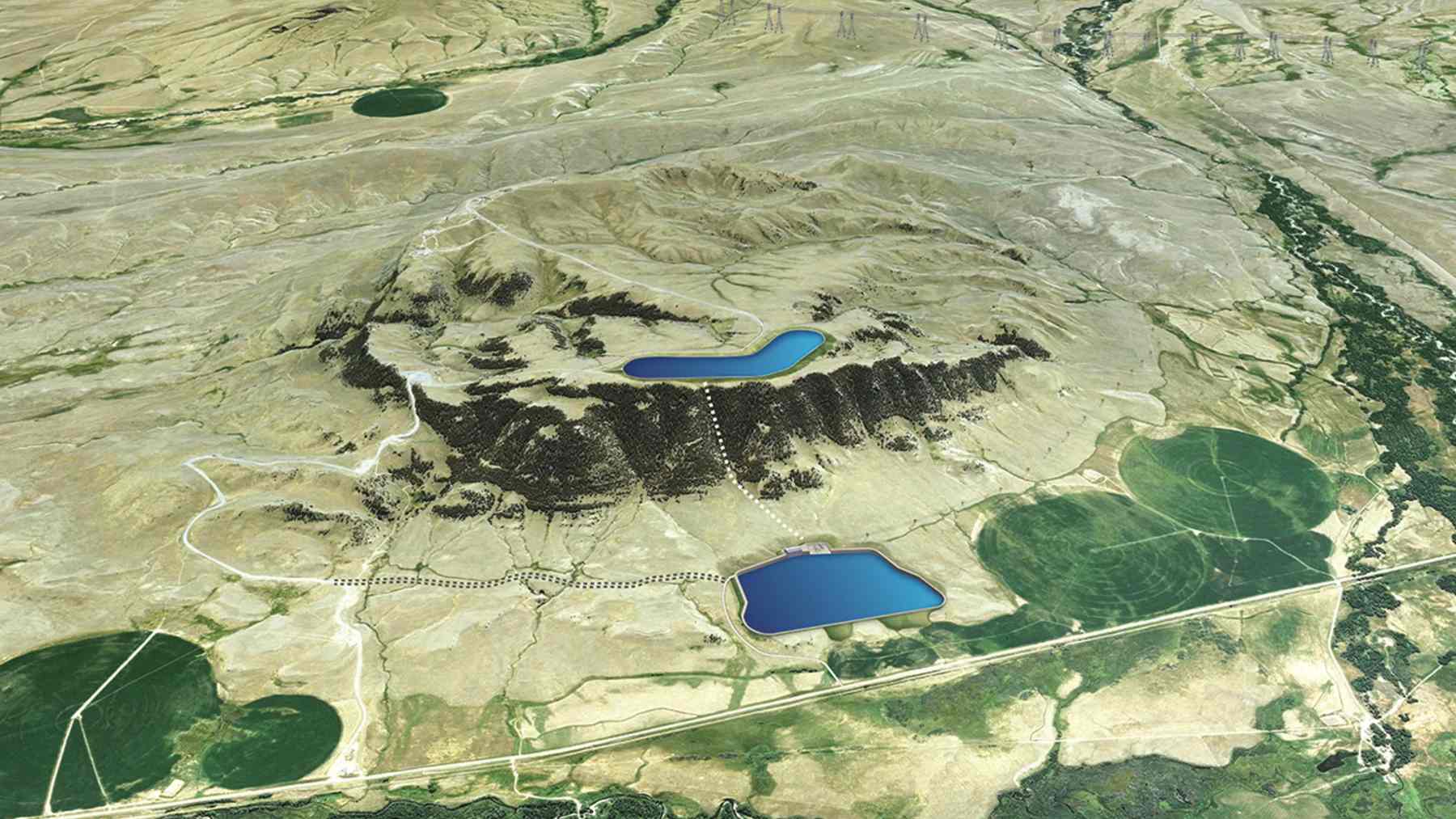
The idea is to lift water to a reservoir at the top of the butte, 1,025 feet up, and then let it fall again through turbines below ground level when electricity is needed. There will be no rivers dammed. There will be no watersheds affected. Just water doing the job that batteries and fuel cells do elsewhere.
The real issue here is what such a system could mean for a landscape like this—and why central Montana might be just the place to store the region’s energy future.
Renewable sources are intermittent by nature, though—the wind doesn’t blow on demand, and the sun sets every evening regardless of what the grid requires.
A butte with a secret advantage
Gordon Butte sure isn’t spectacular. Well, at least, not at first glance. It’s one of the myriad tabletop formations found all around central Montana’s wide-open rangeland. But what’s interesting here is its geometrical form. This large, flat-topped formation towers high above the valley floor below it, creating an elevation difference that engineers typically have to construct.
The project site consists exclusively of private ranch lands in Meagher County, developed beyond any existing watershed system—a closed-loop system that does not interact with local rivers, streams, or riparian zones. No valleys flood. No migration routes for fish get obstructed.
This is where the important distinction lies. Typical hydropower is reliant on the construction of dams on rivers, which alter habitats and force population relocations. Gordon Butte avoids all this through simple use of its geometric form.
How pumped storage actually works
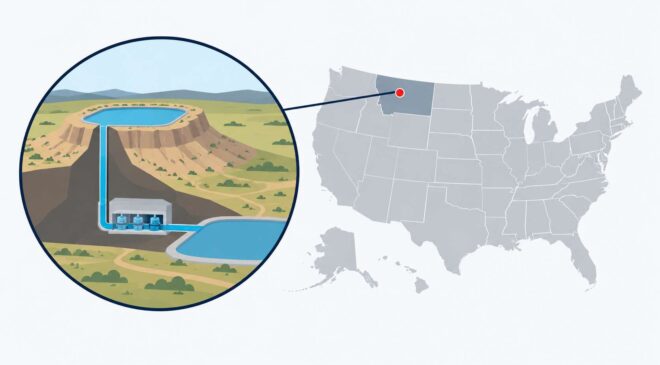
It is not as complicated as it may seem. Whenever there is too much energy in the grid—for example, during windy nights when turbines are spinning but the demand for energy is low—this excess energy is used to run the pumps that raise the water from the lower reservoir up 1,025 feet to the upper reservoir on top of the butte. And then you have stored the energy by storing the water.
Whenever the demand is high, the process works the other way around. The water flows back down through a concrete-and-steel-lined hydraulic shaft underground and turns the three reversible turbine-generators to generate up to 400 MW of power. The powerhouse itself is located underground to make the impact on the landscape minimal.
Each of the reservoirs is about 4,000 feet long, 1,000 feet wide, and 50 to 75 feet deep. You can picture the entire system as a huge rechargeable battery.
Why Montana needs a battery this big
Montana and the broader Northern Rocky Mountain region are building out significant wind and solar capacity. Renewable sources are intermittent by nature, though—the wind doesn’t blow on demand, and the sun sets every evening regardless of what the grid requires.
That’s where Gordon Butte becomes strategically important. The project’s estimated annual generation of 1,300 gigawatt-hours isn’t just an impressive number; it represents real capacity to absorb excess renewable energy and return it precisely when demand peaks. The project is designed explicitly to provide “ancillary and balancing” capabilities to Montana’s emerging renewable industry.
It is not an independent effort. The company is also working on the Loco Falls Greenline, which is a transmission project that links up two of the largest wind resource zones, and the Boreas Intertie, which will work to integrate renewables in Montana and the Northern Rockies. The Gordon Butte facility is part of a broader regional strategy.
Ten years of permits, consultations, and one 50-year license
None of this happened overnight. Gordon Butte Energy Park received its preliminary permit from the Federal Energy Regulatory Commission in 2013, thus kicking off an extended period of consultations that would include state and federal agencies, environmental organizations, local landowners, and other parties.
The Final License Application was submitted to FERC on October 1, 2015, and FERC accepted it as complete on November 16, 2015. FERC released its Environmental Analysis with Finding of No Significant Impacts on September 27, 2016, which is a significant milestone for such a project. Finally, on December 14, 2016, GBEP received its original license for 50 years of operation.
The fifty-year timeframe goes beyond the business logic. It speaks to the fact that energy infrastructure on this level is intergenerational.
What it means for the land and the people nearby
For Martinsdale, an isolated town of around 60 residents set among the open prairies of ranch land, having infrastructure that is significant on a national energy scale becomes a matter of subtle gravity. The nature of the project is not one of a grandiose nature; rather, its off-stream, closed-loop system was designed with the intention of leaving local water bodies and their ecosystems untouched.
The wider portfolio of Absaroka Energy, which includes modular pumped storage, plasma arc gasification technology from its 4th Phase project, and transmission lines, all seem to be projects that are tailored to fit into the unique geography of the Northern Rockies. It is for this reason that you find yourself coming back, eventually, to the butte itself.
From the road west of Martinsdale, it appears no different than it always did—flat-topped, unrushed, and overlooking the prairie and wind. No matter what goes on under and inside of it, the surface remains unchanged. Just a butte being a butte.
Kelly is an experienced writer with 15 years of experience exploring the big stories that shape our world, from tech breakthroughs and space exploration to climate, energy, and the fascinating quirks of science. She has a talent for turning complex ideas into sharp, memorable insights that stay with readers long after they’ve finished reading.
