
Sliding five at a time from an Edinburgh port, 54 steel cylinders each weighing 2,300 tons are now standing on the Scottish seabed, and the creature moving between them was the last thing anyone wrote into the construction plan
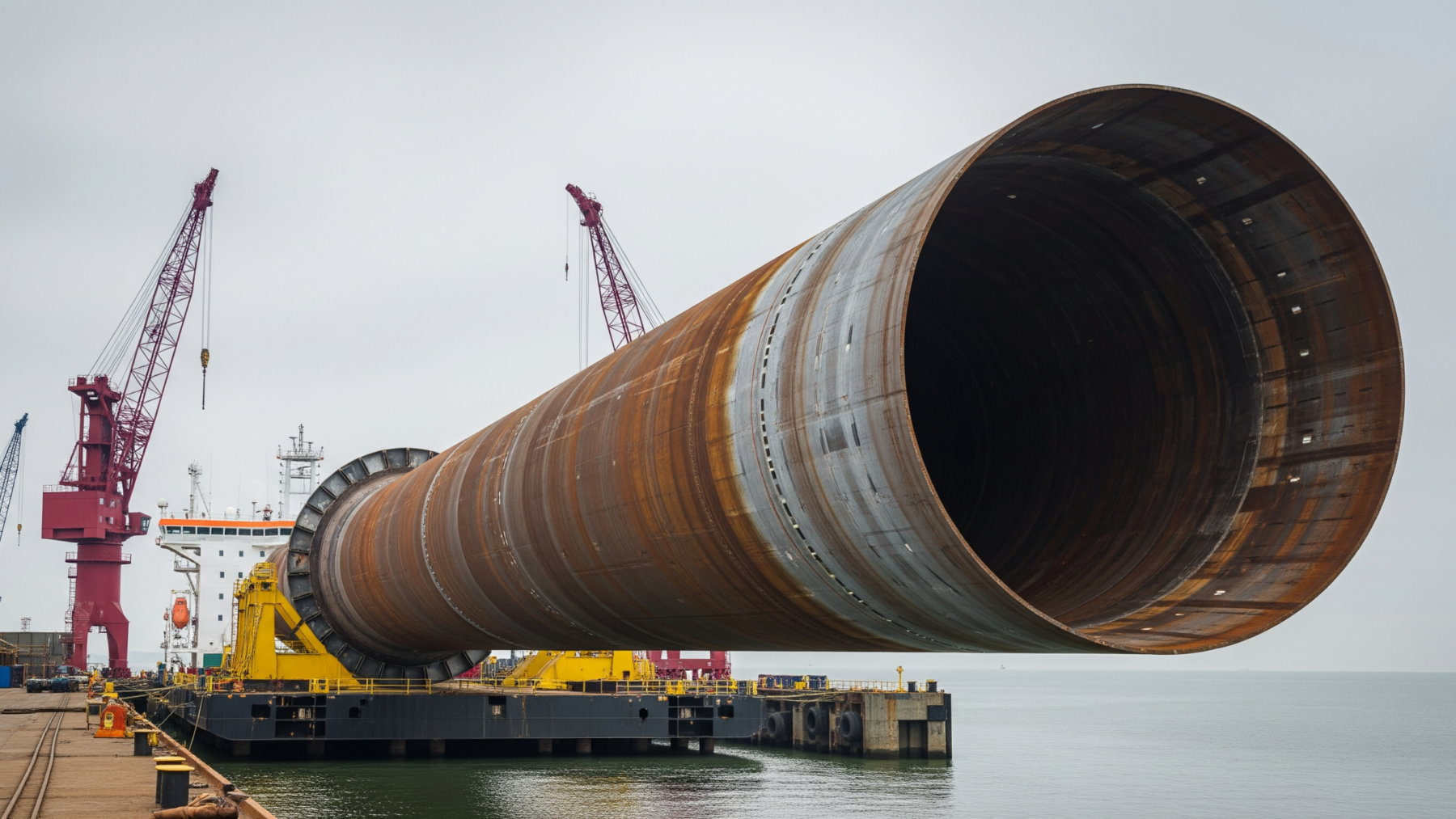
Something enormous is happening fifteen kilometers off the Angus coast, and most people driving along the Scottish shoreline have no idea it is there. A ship the size of a small office building has been making the same run again and again since December, loading five steel cylinders at a time from an Edinburgh port and carrying them out to sea. Each cylinder weighs roughly 2,300 tons. Each one has to be lowered, aligned, and driven into rock so precisely that a 72-turbine wind farm will one day balance on top of it. And into the water around each one, uninvited, something else has started to appear.
A port rebuilt for objects that barely fit inside it
The Port of Leith was not always ready for this. Forth Ports spent £150 million transforming the Edinburgh harbor into a top-tier renewables hub, including a dedicated quayside built specifically to take the weight of vessels carrying the world’s largest offshore energy components. The Charles Hammond Berth can bear up to 100 tons per square meter, a figure that sounds abstract until you stand next to one of the monopiles it was designed to hold.
The first XXL monopiles to arrive at Leith measured up to 103 meters in length and carried diameters of 11.5 meters, roughly as wide as a four-lane highway and as tall as a 25-story building laid on its side. Derek Knox, Regional Director for Scotland at Forth Ports, described the arrival as a momentous day, saying the team had transformed Leith into “a world class renewables hub.” The berth was not a renovation. It was a reinvention, paid for in part because of this single project.
The foundation bases also act as artificial reefs almost immediately, providing habitat for oysters, lobsters, and seals where flat sandy bottom offered nothing.
The crane that runs at the edge of what steel can do
The vessel making each five-monopile run is Jan De Nul’s Les Alizés, a heavy lift ship fitted with a crane rated to 5,000 tons. The installation campaign used that crane together with specialized lifting and piling equipment supplied by IQIP. To picture it at full reach is to picture something that defies ordinary scale: a hook hanging 160 meters above the water, holding an object heavier than the Eiffel Tower, swinging it over the open North Sea.
Les Alizés used a hydraulic impact hammer to drive the monopiles into the seabed, with geotechnical support from Cathie. The seabed off Angus does not cooperate easily. Sand, gravel, and harder substrates vary across the site, meaning each monopile requires its own careful calculation before the hammer ever touches steel.
Five per voyage, fifty-four in total
Since the first installation in December 2025, Les Alizés has been transiting to and from the Port of Leith, collecting five monopiles per voyage and steadily placing them across the site. That rhythm, load, transit, install, return, repeated until there were no monopiles left to place, took roughly six months from first pile to last, a pace that demanded everything from the supply chain, the port, and the crew.
When the turbines eventually spin, power will travel 85 kilometers to shore via two 220 kV cables, making landfall at the site of the former Cockenzie power station in East Lothian. A coal plant’s ghost, replaced by the North Sea’s wind.
What 54 steel towers mean for the Inch Cape seabed
Inch Cape Project Director John Hill said the installation of all monopiles was “a huge achievement for the Inch Cape team and confirmation of the project’s momentum,” adding that “the scale of Inch Cape’s monopiles is leading edge for the industry.” The monopiles feature diameters of 11.5 meters and lengths of up to 102 meters, among the largest installed to date in the offshore wind industry.
What happens to the seabed around each tower is where the story takes an unexpected turn. Research by scientists from Wageningen University found DNA evidence of thornback rays, basking sharks, spotted rays, and starry smooth hounds in water samples taken near four wind farms in the Dutch North Sea. The mechanism is not the turbines themselves but what they prevent: a trawling ban, put in place to protect undersea cables, leaves the sea floor undisturbed and open to natural recovery.
The foundation bases also act as artificial reefs almost immediately, providing habitat for oysters, lobsters, and seals where flat sandy bottom offered nothing. A wind farm that blocks one creature can open a door for dozens of others, and Inch Cape’s monopiles are among the biggest ever planted.
Steel in the ground, electricity still to come
The monopile milestone is only the beginning of a crowded construction schedule. Inch Cape will feature 72 Vestas V236-15.0 MW turbines on a combination of 54 monopile and 18 jacket foundations, and offshore work this year will still include transition pieces, inter-array cables, and the first turbines. The weather window off Angus is unforgiving in autumn, and the calendar is already tight.
There is also the question of what the trawling ban will mean over time. Wageningen researcher Annemiek Hermans has framed it plainly: “We’re trying to understand whether these animals are actually using the wind farms as habitat, or whether they’re being displaced by them.” The science is still catching up to the infrastructure, and Inch Cape’s foundations will be part of that answer. Marine ecologists argue that the seabed needs connectivity across large areas, not just isolated pockets of protection, for wildlife to truly recover.
For now, fifty-four steel cylinders stand in rows on the Scottish seabed, each one heavier than a fully loaded Boeing 747 stack. The basking sharks, if the Dutch pattern holds, will find them. Inch Cape’s developers will spend the next year bolting a gigawatt of turbines to the top of those cylinders, and first power is due before winter.

Hugo is an engineer with strong technical expertise. Multilingual from an early age, his writing combines technical clarity with a strong interest in science and energy.
