
A 20-turbine wind farm on Maui asked how to keep Hawaiian geese away, and the state suggested airport-style dogs while pheromones remain on the list of ideas
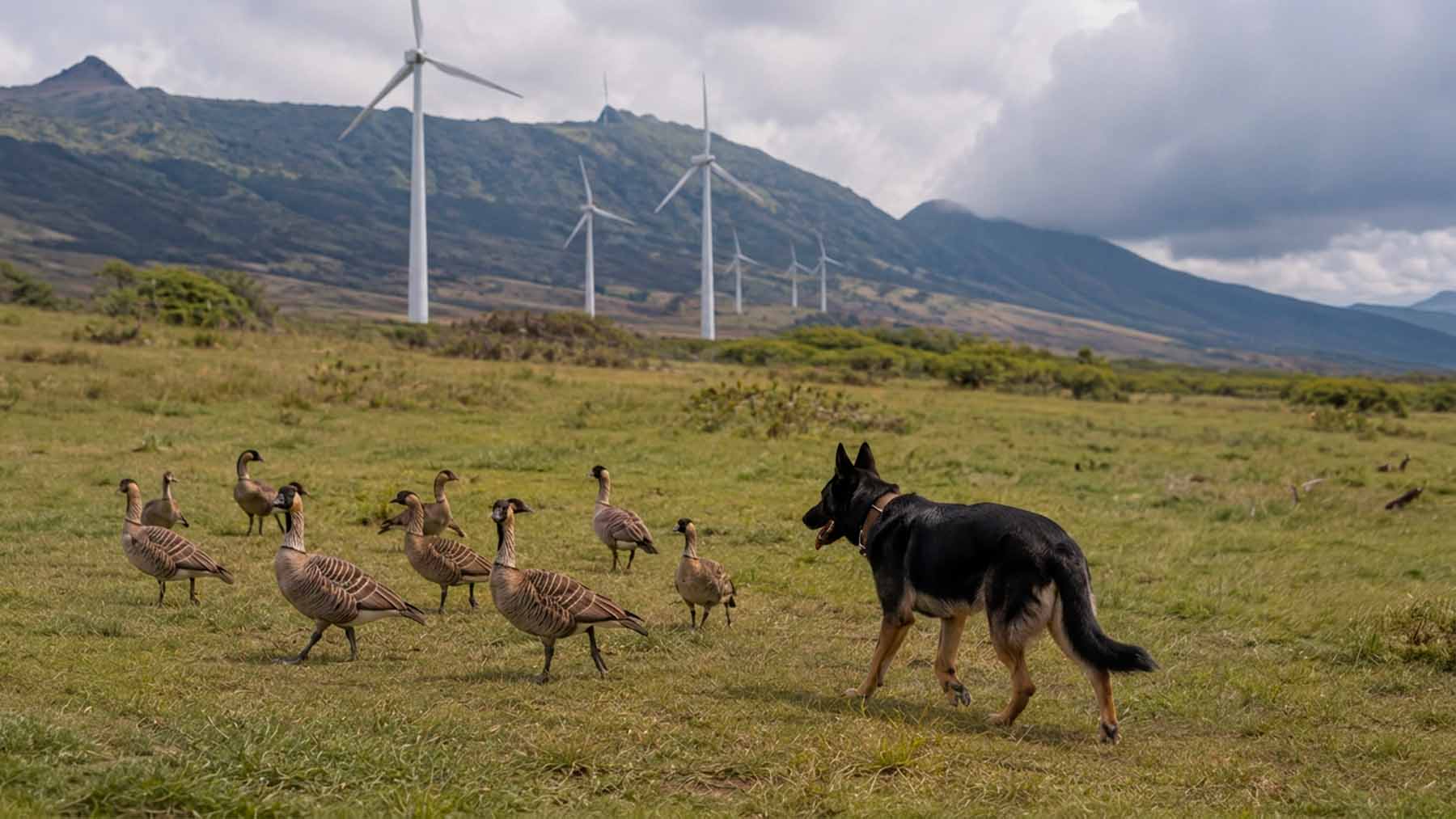 Image generated with artificial intelligence
A wind farm on Maui is addressing risks to native wildlife using innovative deterrents.
Globally, island nations are rapidly expanding wind power capacity to meet rising clean energy demands.
However, both onshore and offshore installations often directly overlap with wildlife migratory pathways, threatening endangered fauna.
However, the Hawai’i Department of Land and Natural Resources had to change the project’s permitted take limits for protected species.
Hawaiian wildlife authorities are trying to minimize fatal interactions by deploying dogs, among other things.
Will these unique and experimental interventions help protect vulnerable native species?
How several island nations remain carbon-intensive
Globally, fossil fuels are being replaced with renewables to meet international climate regulations.
Yet, many island nations remain highly carbon-intensive per capita.
Despite generating less than 1% of the world’s total greenhouse gas emissions, these carbon footprints remain concerningly high.
This is driven by a high dependence on fossil fuel imports to operate domestic power grids.
Pacific island states spend up to 13% of their national gross domestic product on these imports.
The expenses are high as the fuel must be transported from far across the open ocean.
Imported diesel combustion increases electricity prices up to three times higher than mainland averages.
Furthermore, remote microgrids lack interconnections to neighboring grids for emergency backup power.
These geographic limitations highlight the importance of localized clean energy generation.
Maui is a key demonstration of this urgent need to transition.
Hawai’i still produces almost 60% of its electricity from imported oil, which is why expanding high-capacity wind is vital.
The importance of wind power for island grids
When it comes to the global climate crisis, island nations are the most vulnerable.
The major rise in Earth’s temperature has had significant consequences.
Small islands are directly threatened by the accelerated melting of ice sheets, driving sea levels to rise.
The risks tied to this include affected freshwater aquifers, low-lying coastal infrastructure, and island habitats.
This highlights the importance of prioritizing rapid decarbonization.
The burning of fossil fuels must be eliminated to aid in slowing global warming.
Large-scale wind power plays an essential role in quickly replacing massive volumes of imported oil.
The power source can produce around-the-clock electricity and has a substantially high energy density.
Projects like the 30-MW Kaheawa Wind Power 1 facility in Maui exemplify this.
The project will help Hawai’i meet its target of 100% renewable energy by 2045.
However, the Hawai’i Department of Land and Natural Resources had to change the project’s permitted take limits for protected species.
Addressing the impacts on local wildlife
As time passed, the fatality rates for birds and bats exceeded early projections used in the original permitted take limits.
High-elevation winds and foraging behaviors brought protected nēnē geese and Hawaiian hoary bats much closer to the moving blades.
State regulatory reviews mandated revised limit calculations and mitigation.
Data modeling and Interim Direct Environmental Measures (IDEM) were evaluated to determine combined impacts.
Active deterrents were suggested to lower ongoing fatalities.
Recruiting dogs for hazing and other interventions
The Hawaiʻi Department of Land and Natural Resources suggested trained airport-style hazing dogs to scare off foraging geese.
Other non-lethal technologies were advised, but remain on the list of potential mitigations.
The list includes:
- Visual scare devices
- Low-frequency acoustic deterrents
- Bio-based chemical repellents, such as pheromones
The combination of active dog hazing with multi-sensory deterrents will help keep protected geese away while maintaining vital wind production.
Despite ecological challenges, the wind farm on Maui remains fully operational under a renewed long-term lease.
The 30 MW facility plays a vital role in the island community.
It supplies clean electricity to roughly 17,000 homes annually, while offsetting almost 77,000 tons of emissions every year.
As wind capacity expands globally, understanding local ecological needs is key to designing adaptive deterrents.
Ultimately, implementing interventions based on native environments is essential in balancing endangered species protection with renewable growth.
Anke Maree is a writer with a clear and engaging editorial style. Her work focuses on making complex topics accessible, informative, and relevant for readers across different areas of interest.
