
An Ohio wind farm had to shut down every time bats approached, so it tried scaring them away with ultrasound before discovering one species reacted very differently
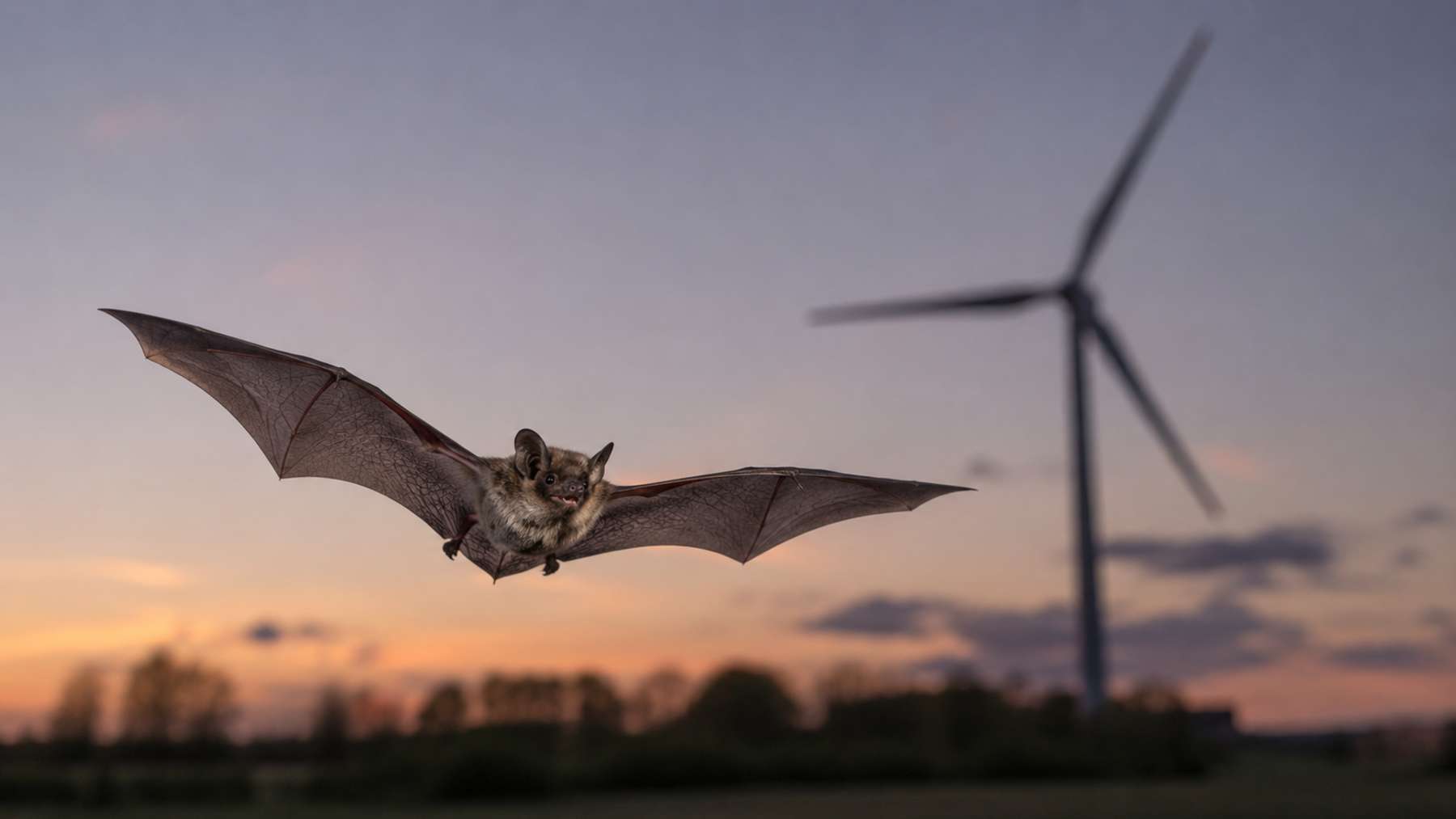 Image generated with artificial intelligence
Among all collision mitigation strategies at a wind farm in Ohio, one delivered the most unexpected result.
The longest challenge that turbines worldwide have endured is blade collisions with flying species.
Bats are among those with the highest mortality rates globally and require immediate intervention.
As the world’s electricity consumption continues to increase at a rapid rate, the technology’s role becomes more crucial than ever.
The Ohio wind farm study explored four distinct approaches to lower collision risks, but one species reacted differently.
Which bat species showcased alternative results, and why?
How turbines are rising as key sources of clean electricity
Nations worldwide are under pressure to meet fast-approaching climate target deadlines.
The race to decarbonize becomes more strenuous as the effects of global warming worsen.
Under the Paris Agreement, the goal is to limit the Earth’s warming to 2.7 degrees Fahrenheit above pre-industrial levels.
This can be achieved by lowering greenhouse gas emissions by 50% by 2030.
Additionally, renewable energy capacity must rise to achieve zero emissions by 2050.
As ambitious as it may sound, green infrastructure has reached significant highs in recent years.
Solar and wind power are leading this global transition, but wind is favored for its high capacity and scalability.
Modern turbines have become more energy-efficient, as they reach significant heights to capture stronger, more consistent wind.
They also require a relatively small physical footprint.
As the world’s electricity consumption continues to increase at a rapid rate, the technology’s role becomes more crucial than ever.
Bridging the gap caused by unprecedented modernization
Globally, independent operations are implementing digitization to increase efficiency.
This, along with widespread electrification, is driving the world’s power demand to historic levels.
In the United States, this demand roughly increases by 2% each year.
Total demand is currently approximately 4,430 terawatt-hours, primarily driven by AI data centers.
AI requires a vast amount of electricity to remain operational, which is why grids require fast-deployable, high-capacity generation.
This is where turbines come in to bridge the growing supply gap.
Turbines already generate over 10% of the total U.S. electricity.
Land-based wind farms are heavily relied on, as they offer high-capacity generation at low operational costs.
However, as turbines scale to meet rising demands, they increasingly overlap with local wildlife.
Larger turbines and blades reach high-wind corridors, increasing the risk to flying species such as bats.
Consequently, the United States Geological Survey conducted a study to determine the best ways to boost protection.
Collision mitigation strategies at Blue Creek Wind Energy Facility
The study monitored 16 experimental turbines at the facility in Ohio.
Four approaches to lower bat-and-blade collisions were analyzed.
Testing the effectiveness of four operational treatments
The testing conditions included turbines that:
- Operated normally as a control;
- Were curtailed at wind speeds below 5 m/s (11 mph);
- Only emitted high-frequency deterrents (50-120 kHz) at nacelle height; or
- Combined curtailments and noise deterrents
It was found that the combination offered zero reduction in bat mortality compared to curtailment alone.
Meanwhile, the noise deterrent had species-specific variations.
High-frequency calling species, such as eastern red bats, had double the fatalities near active deterrents compared to control turbines.
Furthermore, low-frequency echolocating species showed minimal response to the ultrasound. This included big brown, silver-haired, and hoary bats.
Low-wind curtailment was found to be the only consistent approach to lower bat mortality rates.
This is because bat mortality depended on blade rotation, and not wind speed itself.
As both American and global electricity demand continues to rise, increasing wind capacity becomes fundamental.
However, this growth must occur in line with wildlife conservation.
The Blue Creek field study proves that the latest technological fixes can have varying results.
As a result, developers must understand species-specific behaviors and potential impacts.
Ultimately, the latest bat deterrence technologies require rigorous ecological testing before being deployed.
You can read more about these findings at Clerc, J., Huso, M., Schirmacher, M., Whitby, M., & Hein, C. (2025). Ultrasonic deterrents provide no additional benefit over curtailment in reducing bat fatalities at an Ohio wind energy facility. Plos one, 20(5), e0318451.
Anke Maree is a writer with a clear and engaging editorial style. Her work focuses on making complex topics accessible, informative, and relevant for readers across different areas of interest.
