
Virginia farmers are growing kale and broccoli in the shadow of solar panels and turning their fields into tiny power plants
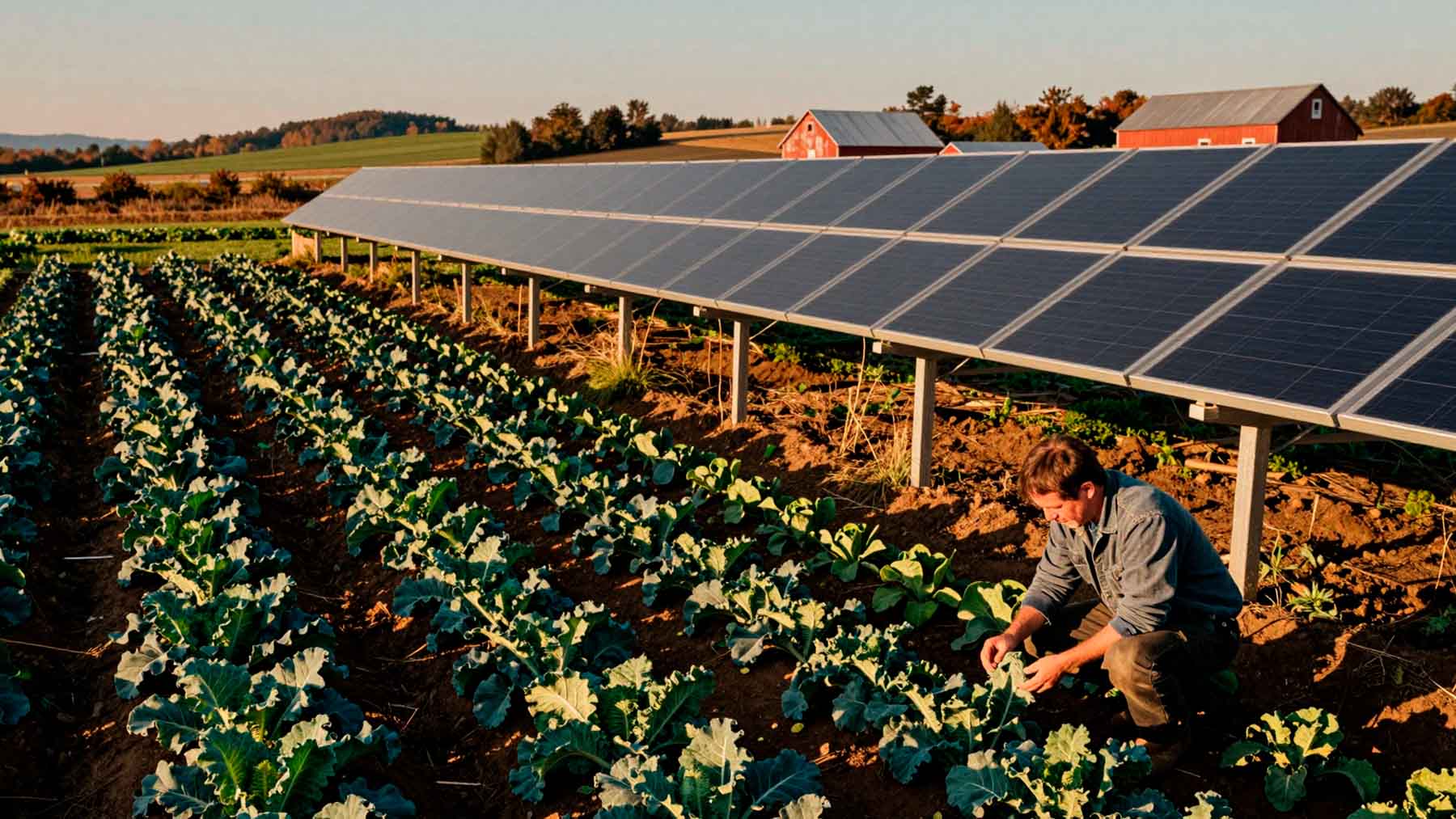 Image generated with artificial intelligence
For American farmers, the financial math has been brutal for years: rising fuel costs, soaring fertilizer prices, and real estate developers circling fields that families have worked for generations. Selling land to a solar company often felt like just another version of the same bittersweet loss—trading traditional crops for industrial infrastructure and fertile ground for lease payments.
Yet at a small farm in Virginia, kale, broccoli, and garlic are thriving directly in the shade of elevated solar panels. It looks like a modest experiment in shared land use, but it represents a fundamental shift in how agriculture and clean energy can coexist.
A farm under pressure—and a possible way out
The financial pressure on American farmers has been building for years. Fuel costs, fertilizer prices, and tariff uncertainty have steadily eroded profit margins that were already razor-thin. Developers and data center builders are moving into rural counties, offering cash for land worked for generations—creating offers genuinely hard to refuse.
Projects must complement an existing farm business, and agricultural productivity must be prioritized over the 25-to-30-year life of the solar array.
The real problem is permanence. Once prime farmland is paved over or built upon, it rarely comes back. It is not resting or lying fallow; it is removed from agricultural production for good.
Agrivoltaics offers a different path. Instead of forcing an all-or-nothing choice between farming and solar, landowners can do both on the same footprint, generating reliable energy income while continuing to grow food.
What agrivoltaics actually means—and why crops are the hard part
Agrivoltaics is formally defined as the intentional co-location of agricultural production and solar energy generation on the same land. Solar panels go up overhead while active farming continues underneath.
Across the United States, most agrivoltaic projects have been limited to sheep grazing. Sheep keep vegetation from shading panels, cut site maintenance costs, and gently condition soil—a relatively simple arrangement. Growing edible crops alongside solar arrays is something else entirely.
Balancing sunlight, spacing, and land use between panels and food requires careful architectural planning. That complexity is what makes the Community Farm at Roundabout Meadows so significant. As Virginia’s first crop-based agrivoltaic system, kale, lettuce, beets, broccoli, and garlic grow directly alongside solar panels.
Virginia’s new law: What SB 340/HB 508 actually does
Passed with strong bipartisan support, legislation known as SB 340/HB 508 officially defines agrivoltaics in Virginia state code for the first time. This statutory framework gives farmers, developers, and regulators clear standards for dual-use projects.
Specific requirements are built into the bill. Projects must complement an existing farm business, and agricultural productivity must be prioritized over the 25-to-30-year life of the solar array. Systems must also remain flexible so farmers can adapt as markets shift.
Signing the bill into law, Governor Abigail Spanberger emphasized its protective purpose: “By establishing clear, enforceable definitions of agrivoltaics in code, we are protecting farmers and keeping land in active production.”
The organization that helped make it happen
The Piedmont Environmental Council (PEC) played a central role in shaping the legislation. Working alongside the Virginia Farm Bureau, PEC helped develop the official definition to ensure dual-use projects follow strict agricultural best management practices.
The law is part of a broader package of 12 energy bills signed with PEC support during the legislative session. The expanded code also covers on-farm energy storage and virtual power plants—a decentralized model where farmers store solar energy and earn revenue by collaborating with local utilities, adding income without leaving the land.
A living model: Zero electricity bills and a blueprint for replication
The Community Farm at Roundabout Meadows is a working demonstration of what the legislation scales, with solar panels, battery storage, and food crops operating together.
So far in 2026, the farm has recorded a zero electricity bill. Its solar-plus-storage system keeps operations running independently during grid outages. When multiple farms store energy collectively, they function as a decentralized virtual power plant.
With a clear legal framework now in place, farmers across the state have a practical path to co-locate crops and solar without sacrificing farmland.
Which reveals the ultimate significance of this project: what started as a quiet experiment in shared land use on a small Virginia farm has just helped rewrite state law.
Kelly is an experienced writer with 15 years of experience exploring the big stories that shape our world, from tech breakthroughs and space exploration to climate, energy, and the fascinating quirks of science. She has a talent for turning complex ideas into sharp, memorable insights that stay with readers long after they’ve finished reading.
