
Offshore wind turbines built for storms may be designed using forecasts that never truly “spoke the same language” until now
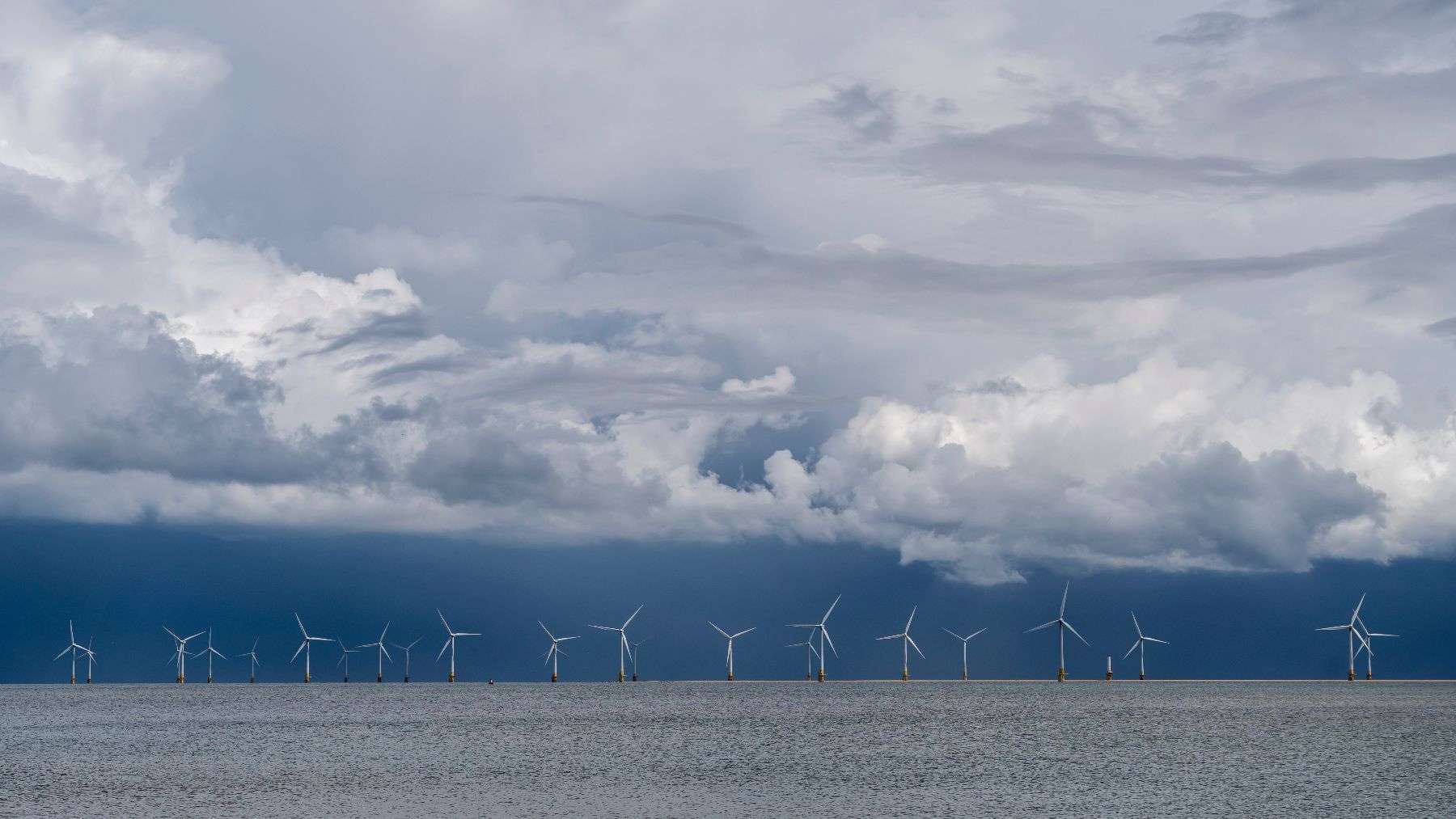
Offshore wind turbines planted in hurricane-prone waters are engineered to endure the most violent storms on earth. But for years, the wind models and wave models used to define those extremes have been developed separately — producing design conditions that don’t necessarily reflect the same storm, or even the same physics.
As the industry pushes deeper into cyclone-exposed regions, that disconnect carries real consequences. Turbine structures sized against inconsistent data may be overbuilt in some directions and underbuilt in others — a problem that grows harder to ignore as installations multiply across the Atlantic and Pacific.
When wind models and wave models don’t agree
Engineers designing offshore turbine structures need to know the worst wind speeds and wave heights a site might see over 50 or 100 years. Historically, those estimates have come from separate analyses — one for wind, one for waves — built on different datasets and different statistical assumptions. The result is design conditions that may not reflect the same physical storm event at all.
Pulling together tropical cyclone winds and waves, remote swell, and extratropical contributions produces a joint estimate that holds together physically throughout.
That inconsistency has structural consequences. If the wind extreme and the wave extreme come from different imaginary storms, the combined load on a turbine foundation or mooring system may be either overstated or understated. One wastes money; the other risks failure.
Short observational records compound the problem. Most offshore buoys have operated for only a few decades — far too brief to capture rare, high-intensity cyclones. Estimating a 100-year storm from 30 years of data requires extrapolation with wide uncertainty bands, and the stakes rise sharply as offshore wind expands into the western North Atlantic, the Gulf of Mexico, and Southeast Asia, where tropical cyclones are routine hazards.
Building a storm library with Monte Carlo simulation
The new methodology centers on a Monte Carlo simulation framework — a technique that generates thousands of synthetic but physically realistic scenarios to explore outcomes that real-world records are too short to capture. Rather than relying solely on storms that happened to pass a given buoy, the framework builds a vast library of plausible events.
To populate that library, the team draws on the STORM database developed by Bloemendaal et al. in 2020. STORM provides synthetic tropical cyclone tracks derived from climate model output, offering a statistically consistent catalog of storm paths across ocean basins. Each synthetic track is fed into the Vinour et al. (2026) parametric wind model, which converts track intensity and geometry into realistic wind fields over the ocean surface. This ensemble approach effectively stretches a short observational record into a statistically robust dataset, making rare, high-return-period events estimable.
Waves, swells, and the full picture of a cyclone’s reach
Those wind fields are coupled to a tropical-cyclone-adapted configuration of WAVEWATCH III — a well-established ocean wave model — to simulate the wave conditions each synthetic storm would produce at a given site. The coupling links wind and wave extremes to the same physical event rather than separate ones.
A real offshore site doesn’t experience only locally generated waves, though. Swell — long-period waves from distant storms — can arrive simultaneously, adding to the total sea state. The methodology introduces a separate statistical treatment for these remotely generated swell systems, while extratropical cyclones contribute their own extremes through annual maxima statistics derived from the ERA5 climate reanalysis dataset. Pulling together tropical cyclone winds and waves, remote swell, and extratropical contributions produces a joint estimate that holds together physically throughout.
Testing the method against decades of real ocean data
The framework was applied at NDBC buoy 41002, located in the western North Atlantic. The buoy holds long-term records of both wind speed and wave height, including observations from multiple historical tropical cyclone events — making it a meaningful test case.
Results showed that the coupled modeling framework agrees reasonably well with historical tropical cyclone extreme statistics recorded at the buoy. Engineers can use the method’s output to construct environmental contours — curves in wind–wave space that define combinations of conditions with a given return period — identifying the specific wind and wave pairings a structure must be built to survive. Agreement with observations at a data-rich site builds confidence for applying the method where long records don’t exist, which describes most proposed offshore wind locations in cyclone-prone regions.
What this means for building the next generation of offshore wind farms
For engineers, the practical implications are direct. Turbine foundations, tower structures, and mooring systems are all sized against design load cases derived from extreme environmental conditions. When those conditions are physically inconsistent, the resulting structures carry hidden uncertainty — either in excess material or in unrecognized vulnerability.
Physically consistent joint wind–wave design conditions could reduce both risks simultaneously. Structures designed against realistic combined loads may be more efficiently engineered, lowering costs without eroding safety margins.
Challenges remain. The approach still relies on parametric storm models and synthetic track databases, each carrying their own assumptions and uncertainties. Validation at additional buoy sites across different ocean basins would strengthen confidence in the method’s generalizability — work worth watching as the industry moves into waters where design margins matter most.
The complete, in-review version of the study is available here: Filipot, J.-F., Renaud, P., Prevosto, M., Leckler, F., Pouplin, C., and Raillard, N.: A method to assess wind and wave extreme statistics at offshore wind farms exposed to tropical and extratropical cyclones, Wind Energ. Sci. Discuss. [preprint], https://doi.org/10.5194/wes-2026-162, in review, 2026.
Daniel García is an Editor-in-Chief with strong expertise in structural work and engineering principles. He combines this technical foundation with deep knowledge of energy, spatial design, and emerging technologies, bringing a forward-thinking and analytical approach to editorial leadership.
