
Washington’s Ice Harbor Dam tested fish-friendly turbine fins, raising juvenile salmon survival from roughly 90% to 98% while improving efficiency

Washington is balancing clean power generation and aquatic ecosystem health by testing unique turbine blades at Ice Harbor Dam.
The state’s vast river networks have historically played an essential role in generating clean, carbon-free hydropower.
Today, these legacy installations remain relevant by providing relief to the strained regional energy grid.
Through this technology, the agencies aim to revolutionize hydropower turbine engineering without compromising critical electricity generation capacity.
However, they also present a persistent engineering challenge for environmental conservationists.
Can using new turbine designs help improve the preservation of local migrating aquatic species?
How clean, carbon-free power is now more vital than ever
Hydropower has historically been the core pillar of Washington state’s energy supply.
Vast natural systems like the Columbia and Snake rivers were harnessed by early engineers to build extensive dam networks.
Throughout the 20th century, urbanization accelerated and local industries modernized.
As a result, electricity demand across the Pacific Northwest began to surge.
Generation capacities had to progressively expand to supply power for growing industrial centers and residential communities.
Today, over 60% of Washington’s total electricity production is credited to hydroelectric power generation.
Furthermore, hydropower is responsible for almost 29% of all American renewable energy generation.
Now, as the state adopts more digital and electric infrastructure and networks, these legacy installations are more relevant than ever.
Major dam facilities deliver rapid-response baseload electricity to maintain regional grid stability during higher consumption.
They are also essential in balancing intermittent power supplies from regional wind and solar farms.
Unfortunately, there are also major aquatic ecosystem costs to consider.
The environmental risks tied to high-capacity hydropower generation
Dam construction along natural waterways has a significant impact on native river dynamics and fish habitats.
More specifically, these concrete barriers affect migration behaviors by blocking historical routes.
This, in turn, affects population numbers by making it difficult for fish to access crucial spawning areas.
But local juvenile salmon specifically face severe physical hazards when migrating downstream through traditional hydropower dams.
Standard turbine designs create sudden pressure drops, extreme hydraulic pressure, and increase the risk of direct blade strikes.
These factors combined have historically driven a survival rate of roughly 90% through turbine routes.
To overcome these relentless ecological barriers, federal agencies began comprehensive restoration and design programs.
The U.S. Army Corps of Engineers developed and tested more ecologically friendly, modern dam infrastructure.
Washington’s Ice Harbor Dam served as a vital testing ground for the turbine innovation.
Crucial research funding and technical oversight for advanced fish-friendly technologies were provided by the U.S. Department of Energy.
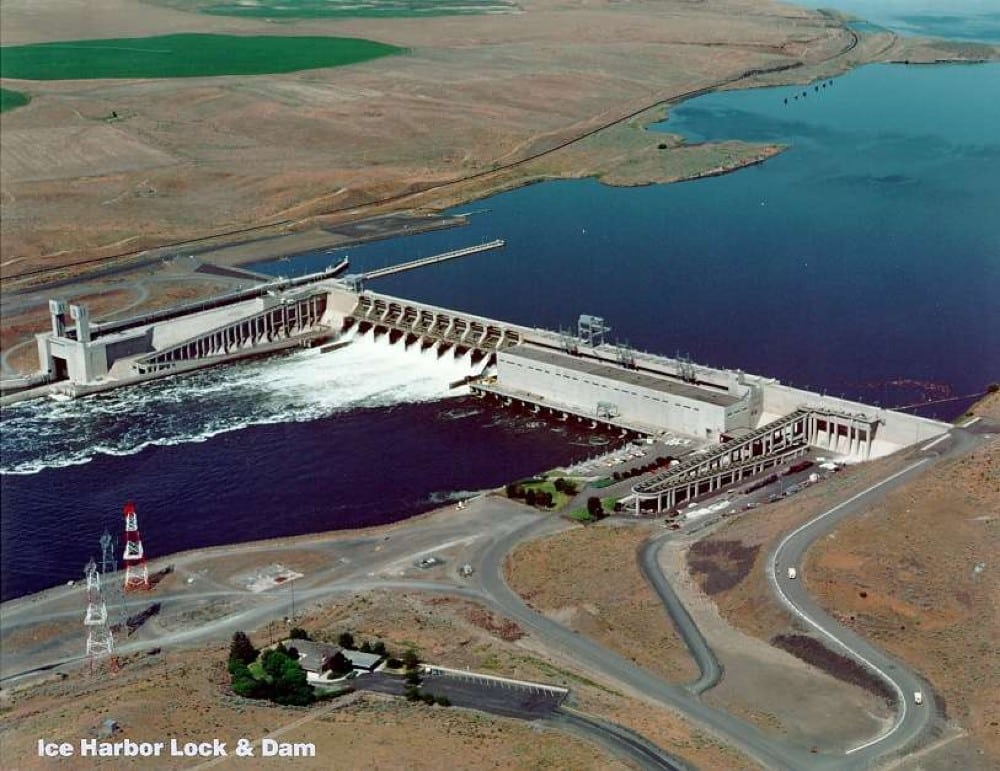
Testing fixed-blade turbine design at Ice Harbor Dam
The U.S. boasts an impressive fleet of hydropower dams, making overlap with major fish migration corridors inevitable.
Ice Harbor Dam on the Snake River is a key example. That is why it was chosen as the primary testing ground for the new turbine design.
Through this technology, the agencies aim to revolutionize hydropower turbine engineering without compromising critical electricity generation capacity.
Replacing outdated, legacy generating units
The advanced turbine features:
- A forward-slanted geometry
- Thicker blade edges
- Optimized water flow paths
Together, these features are meant to minimize physical impacts.
The design specifically lowers violent shear stress, hazardous internal turbulence, and severe pressure drops.
An autonomous “sensor fish” packed with miniature data collectors was deployed through the turbine passage to evaluate unit performance.
Biological test results confirmed an increase from the historical 90% benchmark.
Migrating juvenile salmon now had a 98.25% direct survival rate.
However, the advanced turbine engineering did more than dramatically improve wildlife safety.
The new fixed-blade runner also increased turbine power generation efficiency by 4%, maximizing output.
Following this success, Ice Harbor Dam is now replacing all remaining turbine units with the advanced technology.
Ultimately, upgrading legacy hydropower dam infrastructure is key to boosting efficiency and wildlife survival metrics.
Anke Maree is a writer with a clear and engaging editorial style. Her work focuses on making complex topics accessible, informative, and relevant for readers across different areas of interest.
