
October review finds no major impacts from proposed 28.5-MW hydropower addition at West Virginia’s Byrd Dam with safeguards

West Virginia plans to retrofit its existing dam infrastructure with a hydropower plant.
The state’s power production is currently dominated by fossil fuels, which conflicts with national climate targets.
Rapidly expanding hydroelectricity beyond localized generation is essential to advancing its clean energy goals.
Ultimately, modernizing existing major dam infrastructure will significantly accelerate decarbonization across the state while protecting natural resources.
However, concerns about the impact of construction and operation on the environment had to be evaluated first.
Will implementing environmental safeguards help conserve local lands and water resources?
How fossil fuels continue to dominate despite strict climate regulations
Worldwide, nations are rushing to slash economy-wide greenhouse gas emissions.
In the United States, binding federal climate mandates guide this mission.
An interim goal is to reduce emissions by 50% to 52% below 2005 levels by 2030.
This accompanies the long-term goal of achieving net-zero emissions by 2050.
These federal regulations spearhead widespread decarbonization across national power markets.
Yet, many regions struggle to keep up.
In West Virginia, the majority of its electricity generation is produced by fossil fuels.
Coal accounts for approximately 87% of total power, producing 46,636 gigawatt-hours annually.
Natural gas contributed another 6.2% of the state’s total electricity.
Conversely, low-carbon sources produce under 6%, with hydropower accounting for even less.
The state is now under mounting economic pressure to break this deep-rooted reliance and diversify its energy mix.
Tightening federal emissions standards and shifting national markets are behind this pressure.
That is why developers are now planning to integrate low-carbon alternatives like hydropower.
The hurdles to expanding West Virginia’s hydroelectric energy capacity
Hydropower supplies reliable baseload electricity, which is key to maintaining West Virginia’s grid stability.
Expanding this power source will make it easier for the state to meet strict federal climate targets.
Furthermore, several non-powered dams along major rivers offer clean energy potential.
This eliminates the need to construct new dams.
Yet, scaling up the state’s hydropower is more challenging than anticipated.
Financing and permit approvals can take several years, while upfront construction costs are very high.
Developers are also tasked with conserving water quality, aquatic life, and local river habitats.
Since West Virginia aims to boost hydropower generation, it is vital that these ecological concerns are addressed.
Additionally, they require comprehensive regulatory oversight, with each proposal undergoing environmental assessment before construction.
That is where the Federal Energy Regulatory Commission (FERC) comes in. FERC evaluates project safety and environmental impacts.
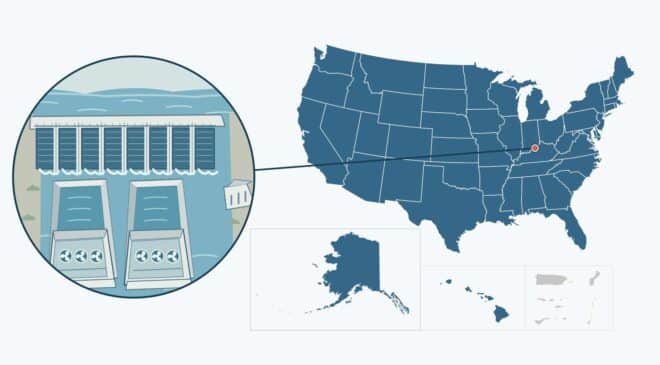
Recently, it released a review of proposed hydropower additions to the Robert C. Byrd Locks and Dam.
The planned hydropower expansion to the Byrd Dam
To unlock additional hydropower capacity, existing infrastructure is being modernized.
Ohio Power and Light, LLC, has proposed a new hydroelectric facility for the Robert C. Byrd Locks and Dam.
The goal is to harness untapped water flow from the Ohio River and boost regional clean power production.
The project entails constructing a 28.5-megawatt hydropower station, occupying 18.3 acres of federal land.
The land is managed by the U.S. Army Corps of Engineers in Mason County, West Virginia.
The verdict of FERC’s environmental assessment
The project’s potential impacts were evaluated by FERC.
Staff concluded that licensing the plant with proper environmental safeguards will not have a significant impact on the surrounding environment.
The public had time to comment on the assessment until October 28, 2026.
Now, the commission will review stakeholder feedback before assigning final license approval.
This proposed project offers distinct regional benefits beyond environmental compliance.
Upgrading the Byrd Dam will deliver an annual clean baseload electricity production of roughly 190,000 megawatt-hours.
This output is enough to power 18,000 homes, while fueling economic growth and local job creation.
Prioritizing additional non-powered dams along major rivers in West Virginia proves to be a dependable, low-impact strategy.
Ultimately, modernizing existing major dam infrastructure will significantly accelerate decarbonization across the state while protecting natural resources.

Anke Maree is a writer with a clear and engaging editorial style. Her work focuses on making complex topics accessible, informative, and relevant for readers across different areas of interest.
