
Scientists suspend four electronic sensors beneath a French floating wind turbine to track plankton and small fish around the clock
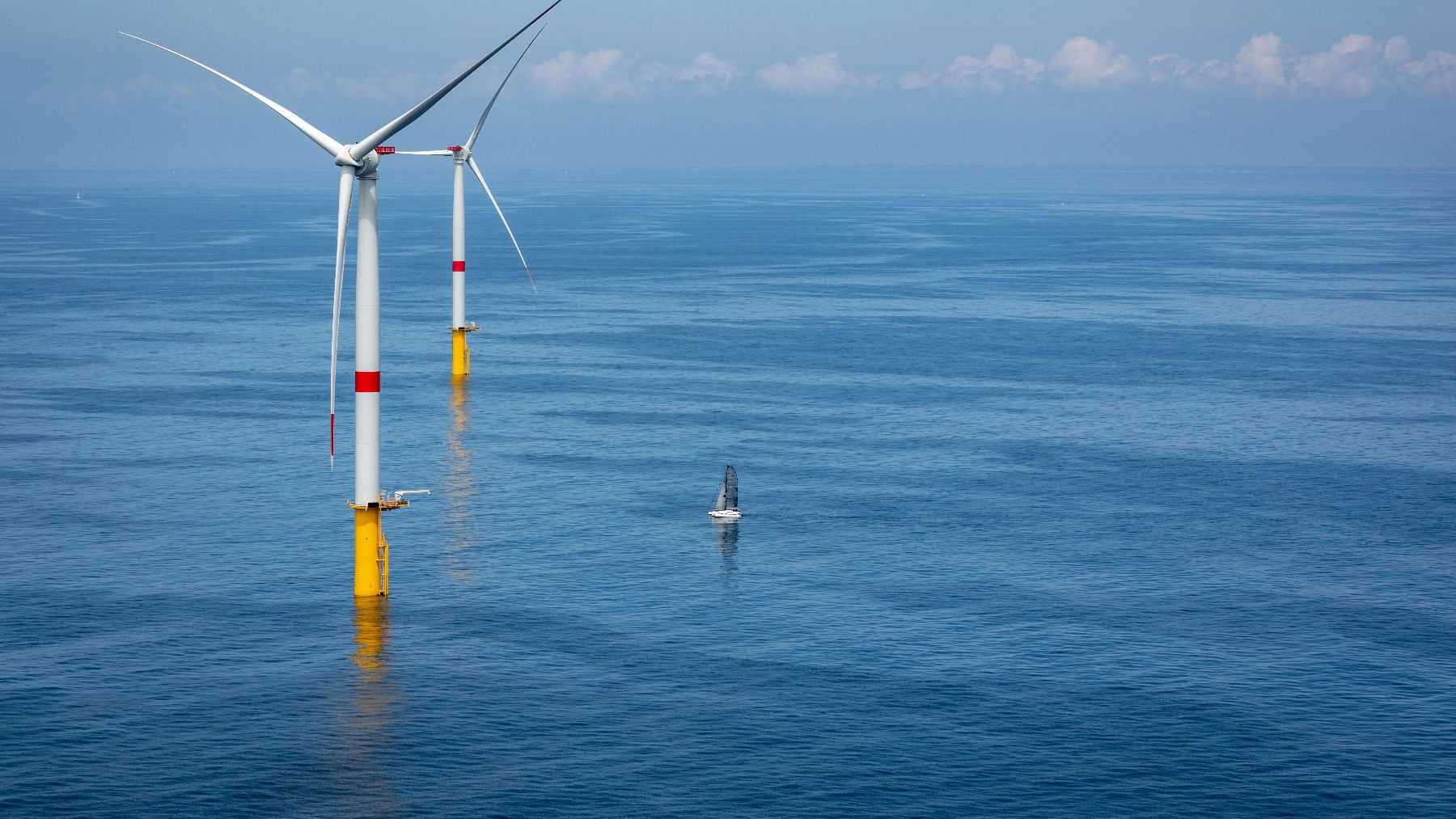
A specialized underwater observatory was developed to track marine life beneath floating wind turbines.
Nations worldwide are turning to offshore clean power generation to overcome spatial barriers and meet rising energy demand.
As the technology expands into deeper waters, comprehending its long-term environmental impact has become a top priority.
The country prioritizes agriculture, local conservation, and urban infrastructure over large-scale energy developments, such as wind projects.
This is because the floating structures directly interact with complex coastal ecosystems.
How will this new observatory help researchers monitor floating turbines’ effect on marine biodiversity?
How land-based barriers and rising demand led to offshore deployment
The rise of digital and electric networks and infrastructure has driven major surges in electricity demand worldwide.
To satisfy the rising global energy consumption while progressing toward net-zero climate targets, low-carbon power must expand rapidly.
In France, climate mandates target increasing decarbonized generation up to almost 700 TWh by 2035.
However, this nation exemplifies the strict land constraints and spatial bottlenecks several other countries face.
The country prioritizes agriculture, local conservation, and urban infrastructure over large-scale energy developments, such as wind projects.
This severely limits the available land footprint to boost green power capacity.
Fortunately, energy planners have shifted focus offshore to overcome these constraints.
Sites over the open oceans offer stronger, more reliable wind resources than land-based sites.
In fact, offshore wind power has become part of France’s interim climate goals.
The nation aims to deploy 15 GW of offshore wind capacity by 2035, and scale up to 40 GW by 2050.
While offshore wind avoids potential disputes, it is not without risk
As France’s offshore wind generation scaled up, developers soon realized that deploying floating turbines offers more benefits.
Floating turbines enable development in deeper waters far beyond visible shorelines.
This overcomes heavy marine traffic in shallow waters, prevents potential visual disruption, and increases output capacity.
However, even as France achieves clean electricity from floating offshore wind deployment, the technology itself faces ecological risks.
Deep-sea deployment usually requires suspended mooring lines, giant floating hulls, and dynamic subsea cables.
These new physical structures in open pelagic zones carry potential risks.
But the precise long-term effects of these floating turbines and artificial underwater installations on marine life remain largely unknown.
To bridge this vital research gap, the French R&D initiative VELELLA was launched.
The public energy agency ADEME backed this multi-year collaborative project.
It is led by floating wind pioneer BW Ideol and research entities such as Ifremer and Fondation OPEN-C.
Tracking pelagic ecosystems around the clock using innovative methods
Understanding the effect of floating wind turbines on underwater biological communities is vital.
The Velella project specifically focuses on the pelagic ecology in the water column surrounding floating platforms.
The research is conducted at the SEM-REV offshore test site off Le Croisic, France, and focuses on Floatgen.
Floatgen is a 2 MW floating turbine deployed by BW Ideol.
The custom underwater observatory for continuous subsea monitoring
After two years of design, engineers suspended the custom observatory beneath the Floatgen turbine.
The system features four specialized electronic echosounders and multi-parameter probes.
The echosounders use distinct frequencies to monitor marine organisms of varying sizes.
The sensors track everything from zooplankton to micronecton and small fish like sardines.
The project itself is currently in the active data-collection phase. Fish-concentrating effects and population changes around the turbines are now being evaluated.
Thanks to the underwater observatory, continuous long-term monitoring is enabled across changing seasons and 24-hour cycles.
The automated tracking also complements periodic oceanographic ship surveys.
The Velella project will be conducted over four years and will be completed in 2027.
Empirical data from the research will establish important environmental benchmarks for future floating wind installations. Ultimately, the findings will help developers to balance offshore renewable energy generation with ecosystem conservation.

Anke Maree is a writer with a clear and engaging editorial style. Her work focuses on making complex topics accessible, informative, and relevant for readers across different areas of interest.
