
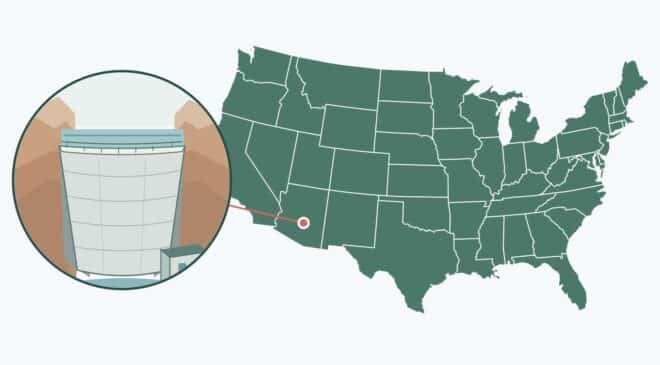
Arizona’s Canyon Lake is dropping 54 feet for once-in-20-years inspections of Mormon Flat Dam’s submerged machinery

Major dams in Arizona are undergoing a rare, once-in-20-years safety protocol.
Water storage infrastructure is highly critical to this arid region’s economy and long-term climate resilience.
That is why submerged equipment must be inspected every two decades.
This rare and carefully executed process restores normal lake levels while guaranteeing the dam’s operational integrity for another twenty years.
As a result, the Canyon Lake must be lowered by 54 feet temporarily to provide access.
But how does draining millions of gallons of water protect the future water supply for millions of desert communities?
How dams have brought resilience to desert regions
Across several of America’s arid desert regions, modern growth was driven directly by controlling unpredictable river systems.
Arizona’s expansion exemplifies this strategy.
Over a century ago, the 280-foot Roosevelt Dam was constructed.
It was completed in 1911, followed by the Mormon Flat Dam in 1925.
These early engineering accomplishments enabled the capture of volatile seasonal runoff along the Salt River.
As a result, the arid valley began transforming into a booming metropolitan hub.
Today, over 3.2 million acre-feet of water capacity is held by the Salt and Verde River reservoir systems.
For Arizona, this infrastructure remains crucial, as the state often faces extreme heat and prolonged droughts.
These reservoirs provide drinking water to more than 5 million residents.
They also support critical high-tech manufacturing sectors.
Furthermore, these systems shield the state against erratic climatic events by capturing intense monsoon floods and storing emergency reserves.
That is why maintaining these historic dams is vital to the state’s overall stability.
The risks of not conducting regular inspection and maintenance
Dam safety inspections are a mandatory process, and failure to conduct them regularly presents catastrophic risks.
Gradually, submerged mechanical components suffer continuous wear from water pressure, sediment buildup, and corrosion.
These components include pressure valves, giant spillway gates, and heavy hoist cables.
If this structural degradation goes undetected, it can cause uncontrolled water releases, dam breach hazards, and gate failures.
For a desert region reliant on controlled storage, structural failures will compromise flood control systems and threaten public safety.
It will also disrupt water access for millions of residents.
However, full-scale underwater maintenance is challenging and requires drastically lower lake elevations.
This, in turn, disrupts recreation, local ecosystems, and regional hydroelectric production.
That is why the Salt River Project oversees major drawdowns, which are scheduled only once every 20 years.
This timeframe minimizes logistical disruptions and ensures public safety.
Arizona’s Canyon Lake recently experienced this massive engineering operation to inspect Mormon Flat Dam.
The rare, once-every-20-year dam inspection process
With hydropower plants rapidly aging across the nation, inspection, maintenance, and upgrades have become more crucial.
In mid-September, the drawdown of Arizona’s Canyon Lake officially began.
Public safety was boosted by closing access to the lake earlier in September.
The reservoir’s surface level was gradually lowered by 54 feet.
Millions of gallons of water were transferred upstream into Apache Lake.
This routing maintained steady regional water deliveries while exposing submerged dam components.
Evaluating the Mormon Flat Dam’s underwater features
Specialized engineers assessed the structural integrity of the Mormon Flat Dam’s components.
The following features were evaluated:
- Intake gates
- The concrete face
- Trash racks
- Spillway mechanisms
- Mechanical hoists
This entire inspection and maintenance process spans roughly 16 weeks and is expected to finish in early 2027.
Once all structural repairs have been completed and components tested, the water will be rerouted into Canyon Lake.
This rare and carefully executed process restores normal lake levels while guaranteeing the dam’s operational integrity for another twenty years.
However, this process can be optimized further.
Utilities can integrate autonomous underwater drones to perform preliminary structural inspections before draining.
Real-time sensor networks can also continuously monitor mechanical wear, shortening drawdown periods. Ultimately, advanced diagnostic technology can help improve legacy dam inspection and upgrades while minimizing disruptions.

Anke Maree is a writer with a clear and engaging editorial style. Her work focuses on making complex topics accessible, informative, and relevant for readers across different areas of interest.
