
On Germany’s Elbe river a tanker named Lech Kaczyński unloaded 160,000 cubic meters of American gas onto a floating terminal, and the delivery marked the site’s first real cargo after years of construction
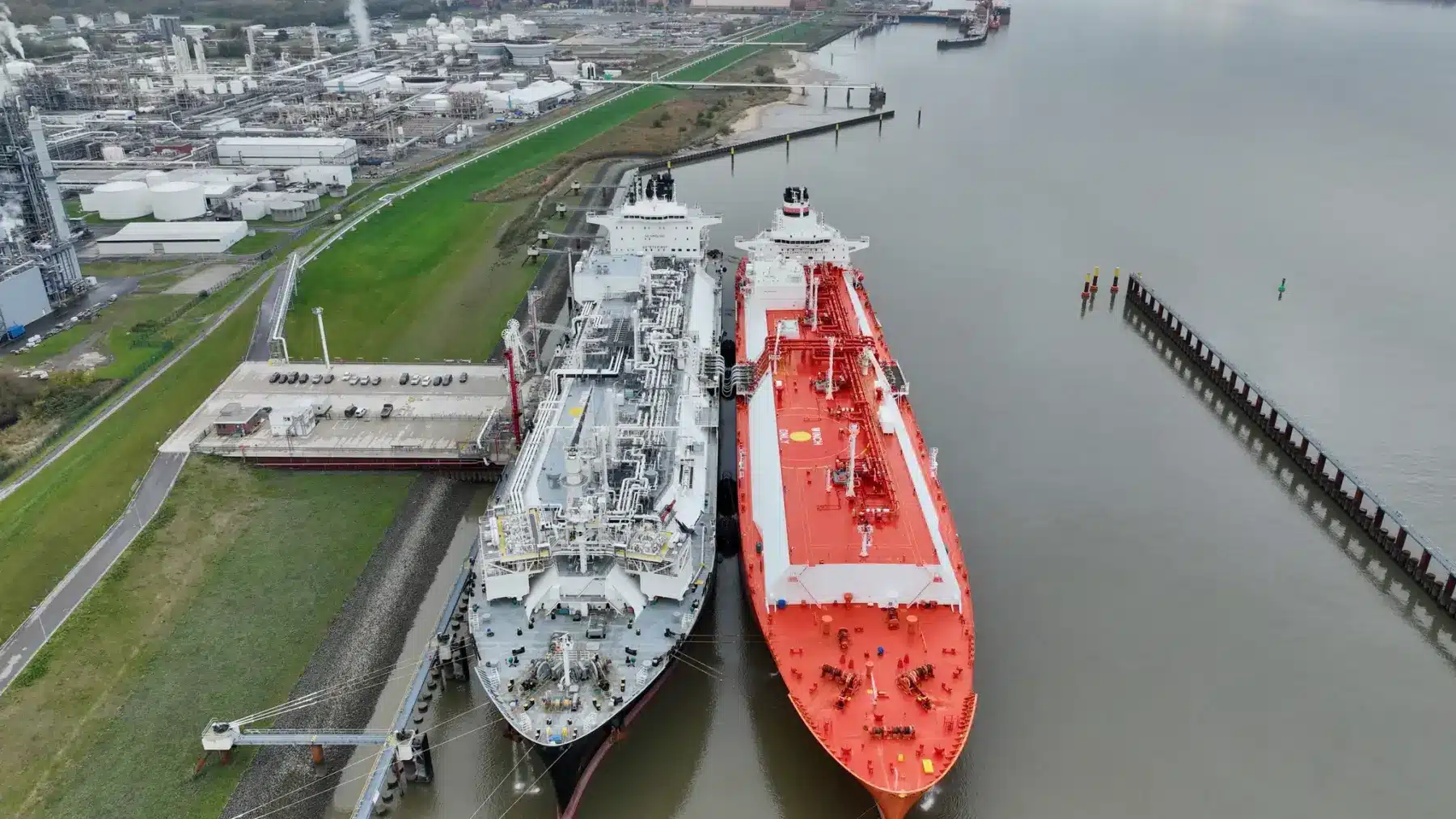
A river pilot eased a 975 foot tanker alongside a squat white hull moored on the Elbe.
For the first time in years, something flowed between them.
The date was November 2.
But the chain behind that routine, from a Louisiana coastline to a German river, is the infrastructure story underneath every winter heating bill in northern Europe.
The place was a brand new energy berth at Stade, west of Hamburg.
The cargo was liquefied natural gas, pumped across insulated hoses into a vessel the length of three football fields after sailing from the Gulf Coast of Louisiana.
What happens next, as that gas warms back into something you can burn, is the part worth understanding.
How a ship full of liquid becomes gas for a furnace
The tanker, named Lech Kaczyński, carried 160,000 cubic meters of liquefied natural gas cooled to nearly 260 degrees below zero. It arrived carrying 160,000 cubic metres of LNG, equal to 93 million standard cubic metres of natural gas once it returns to its gas state, a sizable addition to a region’s winter heating supply.
That gas came from the Plaquemines terminal in Louisiana, one of the newest liquefaction plants on the American Gulf Coast. It did not go into a storage tank on land, but straight into the Energos Force, a floating storage and regasification unit that works as both tanker and processing plant in one hull.
Inside that hull, heat exchangers warm the supercooled liquid back into its gaseous state. In winter the vessel relies on onboard steam boilers running in a closed loop, and in warmer months it draws river water from the Elbe to do the same job, with a daily regasification capacity of up to 750 million cubic feet in that summer setup.
A jetty built for one ship and the river it sits on
The berth did not exist a few years ago. Niedersachsen Ports constructed the jetty specifically for the FSRU and the onshore terminal, which is still under construction.
That kind of marine infrastructure had to be engineered before any gas could move at all. A fixed mooring plus a flexible loading arm capable of handling a vessel this size are not quick builds.
The FSRU itself is no small object. The FSRU Energos Force is 47 m wide and was built in 2021, and it has the largest tank capacity of DET’s four FSRUs, at 174,000 cubic meters.
Before Stade, the ship spent time shuttling between Egypt and Jordan, chartered out while Germany’s own jetty was still under construction. So the hardware had been ready, in one form or another, long before the river finally saw it put to use.
What the operator measured once the hoses opened
According to the operator, the state owned Deutsche Energy Terminal, the transfer of the LNG to the FSRU is proceeding smoothly. That start marked the formal beginning of the terminal’s commissioning phase.
That is the hardest number in this story: a real cargo, a real date, a real volume measured as it crossed from one hull to another, not a projection of what might eventually arrive.
Germany’s economy minister, Katherina Reiche, had stood on the dock months earlier when the Energos Force first arrived to prepare for this moment. With an injection capacity of up to 3.2 billion cubic metres of natural gas per year by 2027, she said the Stade LNG terminal would be an important component of Germany’s security of supply, a comment that anticipated this week’s cargo rather than described it.
The limits this terminal still has to work around
Stade is explicitly a stopgap. A separate, larger onshore import terminal is already under construction at the same site, designed to eventually handle more than double the floating terminal’s throughput.
The FSRU is expected to retire once that plant is finished. Once operational, the Stade facility is expected to have the capacity to feed up to 3.2 billion cubic meters of natural gas into the German grid in 2027, a figure that depends on how many tankers like the Lech Kaczyński keep arriving.
That dependency cuts both ways. European underground natural gas storage facilities were at approximately 68 percent of capacity as of mid September, marking a historically low level heading into the winter heating season, a historically low cushion that explains why a cabinet minister came to the dock, and floating terminals cost more per unit of gas handled than fixed onshore plants.
What one tanker says about a longer supply chain
The gas itself traces a chain that stretches from a wellhead to a liquefaction train to a ship to a regasification vessel to a pipeline, and Stade is simply the newest link added to it. The project’s own history shows how long that chain takes to finish, since the terminal was initially planned to be up and running in the first half of 2024 before it was repeatedly delayed due to project management disputes and unfinished terminal infrastructure, according to a detailed trade press account of the buildup to this week’s delivery.
Elsewhere on that same chain, producers have watched crude prices swing on diplomacy far from any drilling rig, a reminder that gas and oil markets rarely move in isolation from geopolitics. Shipping data on volumes leaving American terminals has also become a business of its own, not unlike how seismic data providers now sell insight rather than barrels.
For the crew that ran the hoses between two hulls on the Elbe this week, the job was mechanical: match pressures, verify temperatures, confirm volumes, log the transfer. But the chain behind that routine, from a Louisiana coastline to a German river, is the infrastructure story underneath every winter heating bill in northern Europe.
The next test is whether more tankers follow the Lech Kaczyński’s wake on schedule, through a winter that will show quickly whether one new jetty was enough.

Hugo is an engineer with strong technical expertise. Multilingual from an early age, his writing combines technical clarity with a strong interest in science and energy.
