
Vattenfall deployed an AI system inside a Swedish fish ladder that now tracks individual salmon for disease, size, and injuries in real time
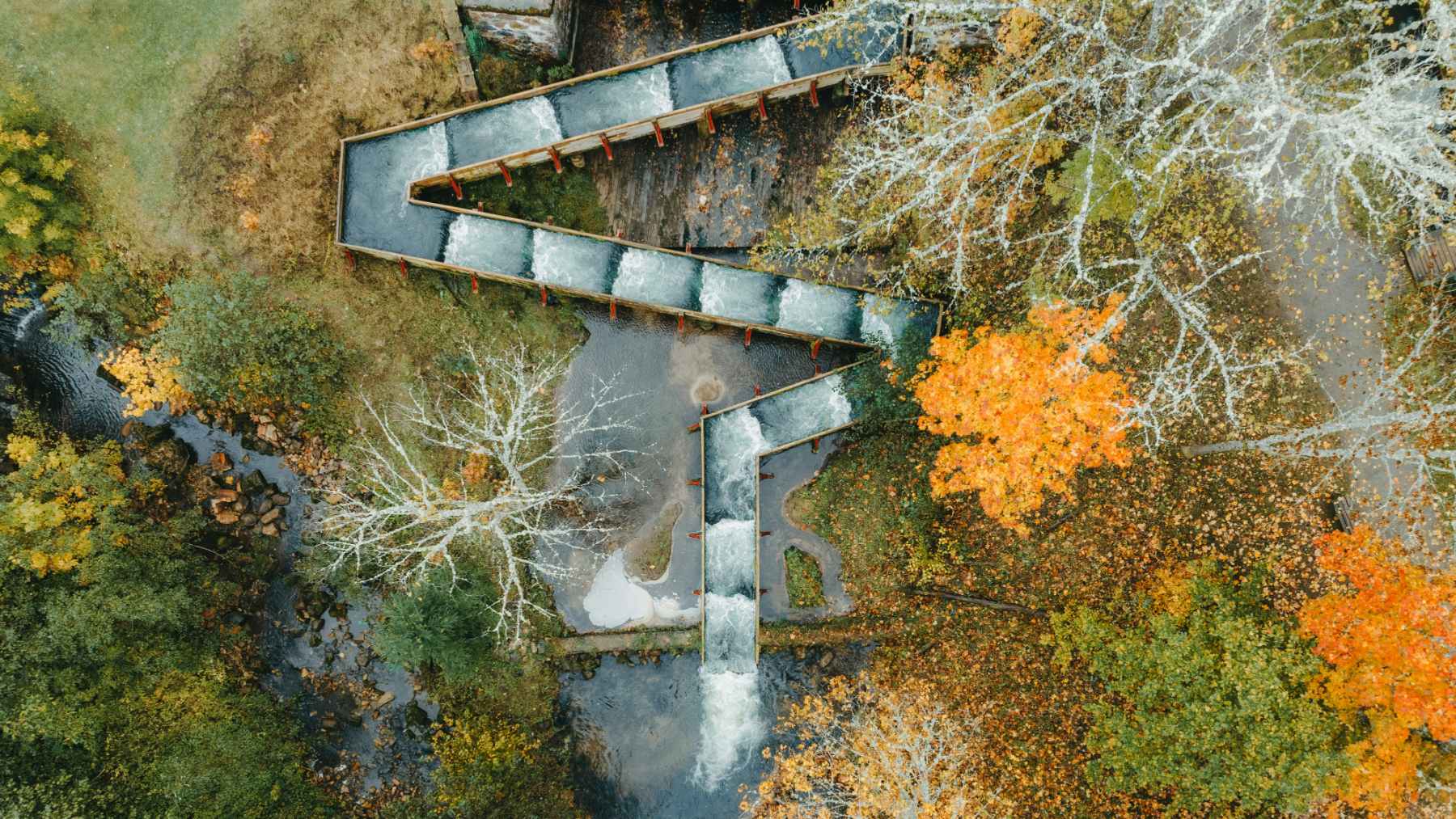
At the Stornorrfors hydropower plant in northern Sweden, thousands of salmon and trout squeeze through a fish ladder each season — a narrow, engineered passage meant to let them migrate past one of the country’s largest dams. For years, operators could count fish moving through. What they couldn’t easily determine was whether those fish were healthy, how large they were, or whether the passage was truly serving the population it was designed to protect.
That gap between infrastructure and ecological reality is exactly what Vattenfall set out to close.
A fish ladder with a data problem
Fish ladders are among the more elegant compromises in hydropower engineering. By creating a stepped series of pools that migratory fish can navigate upstream, they allow salmon and trout to bypass dams that would otherwise block their path entirely. Vattenfall operates fish passage infrastructure at two Swedish hydropower stations — Stornorrfors in the north and Lilla Edet — both designed to keep migratory routes open through heavily managed waterways.
Regulations typically require operators to provide fish passage; they rarely require operators to demonstrate, in granular detail, that the passage is working well.
Building the passage, though, is only part of the challenge. Knowing whether it actually works — and for whom — is another problem entirely.
Historically, monitoring fish ladders meant manual observation, periodic sampling, or basic counting sensors. These methods could tell operators roughly how many fish moved through in a season, but offered little about their condition. Were they arriving injured? Carrying disease? Was the population trending younger or smaller, suggesting stress upstream? Those questions required a different kind of tool altogether.
Training an algorithm to see fish
Vattenfall’s answer was to develop an AI algorithm trained on a large image dataset captured directly at the Stornorrfors fish ladder. Rather than relying on external data or generic wildlife recognition models, the system was built from images specific to this environment — accounting for the lighting conditions, water clarity, and camera angles present at the actual site.
The algorithm identifies individual salmon and trout as they pass through, counts them, and registers physical attributes in real time. That last capability is what shifts the system from a passive counter into something closer to an active observer.
Refinement has happened season by season. Each annual migration cycle provides new data, which has been used to improve accuracy over time — a meaningful advantage for long-term ecological monitoring, where consistency and comparability across years are essential. All of this is surfaced through an online dashboard, giving Vattenfall staff continuous, remote access to fish passage data without requiring anyone to be physically present at the ladder.
From counting fish to reading their health
The most significant recent development is the addition of fish size measurement. Size is a reliable proxy for population vitality — smaller fish across a population can indicate food stress, disease pressure, or degraded habitat conditions. Having that data collected automatically, at scale, across every fish moving through the ladder, represents a qualitative leap beyond what manual monitoring could realistically deliver.
In 2025, Vattenfall began testing pattern recognition capable of identifying individual fish across multiple sightings. This opens the possibility of tracking specific animals through the ladder over time, rather than treating each observation as an isolated data point. The system can also flag signs of disease — fungal infections and parasites — as well as physical injuries from predators including seals and birds, conditions that would previously have required hands-on inspection to detect. Identifying them automatically, from camera footage, transforms the fish ladder monitor into something closer to a population health surveillance system.
Behavioral insights hidden in the data
Health data is only part of what the system captures. The AI also records swimming patterns, group dynamics, and gender identification as fish move through the passage — behavioral signals that were largely invisible at any useful scale before automated monitoring became feasible.
Swimming behavior, for instance, may indicate whether fish are moving through the ladder with ease or struggling against the current. That’s relevant data for evaluating whether the passage design is actually functioning as intended. Group dynamics could reveal whether fish are moving in coordinated pulses or arriving in a more scattered pattern, which may reflect conditions in the river below.
Gender identification adds another layer still. Understanding the ratio of males to females in a migrating population has direct implications for spawning success and, ultimately, for the long-term health of the salmon and trout stocks the ladder is meant to support. Aggregated over multiple seasons, these behavioral data points could meaningfully inform decisions about passage design, water release timing, and broader conservation strategy.
What this means for hydropower and biodiversity
Vattenfall has stated that biodiversity and nature protection are a priority in its environmental policy — not a peripheral concern, but a central part of its environmental work. The fish monitoring project reflects that in practice. Rather than treating ecological compliance as a box to check, the system is designed to generate ongoing, actionable intelligence about the actual impact of hydropower infrastructure on migratory fish populations.
That distinction matters. Regulations typically require operators to provide fish passage; they rarely require operators to demonstrate, in granular detail, that the passage is working well. Vattenfall is going further.
The model developed at Stornorrfors is, in principle, transferable. Other hydropower sites with fish ladders face the same fundamental monitoring challenge — the same gap between infrastructure and ecological reality. As the algorithm matures and the methodology becomes better established, AI-based fish monitoring could become a scalable tool across the industry, turning individual dams into nodes in a much larger picture of freshwater biodiversity.
Daniel García is an Editor-in-Chief with strong expertise in structural work and engineering principles. He combines this technical foundation with deep knowledge of energy, spatial design, and emerging technologies, bringing a forward-thinking and analytical approach to editorial leadership.
