
Ameresco begins rooftop solar construction at Community College of Philadelphia under Solar for Schools grant
 AI-made
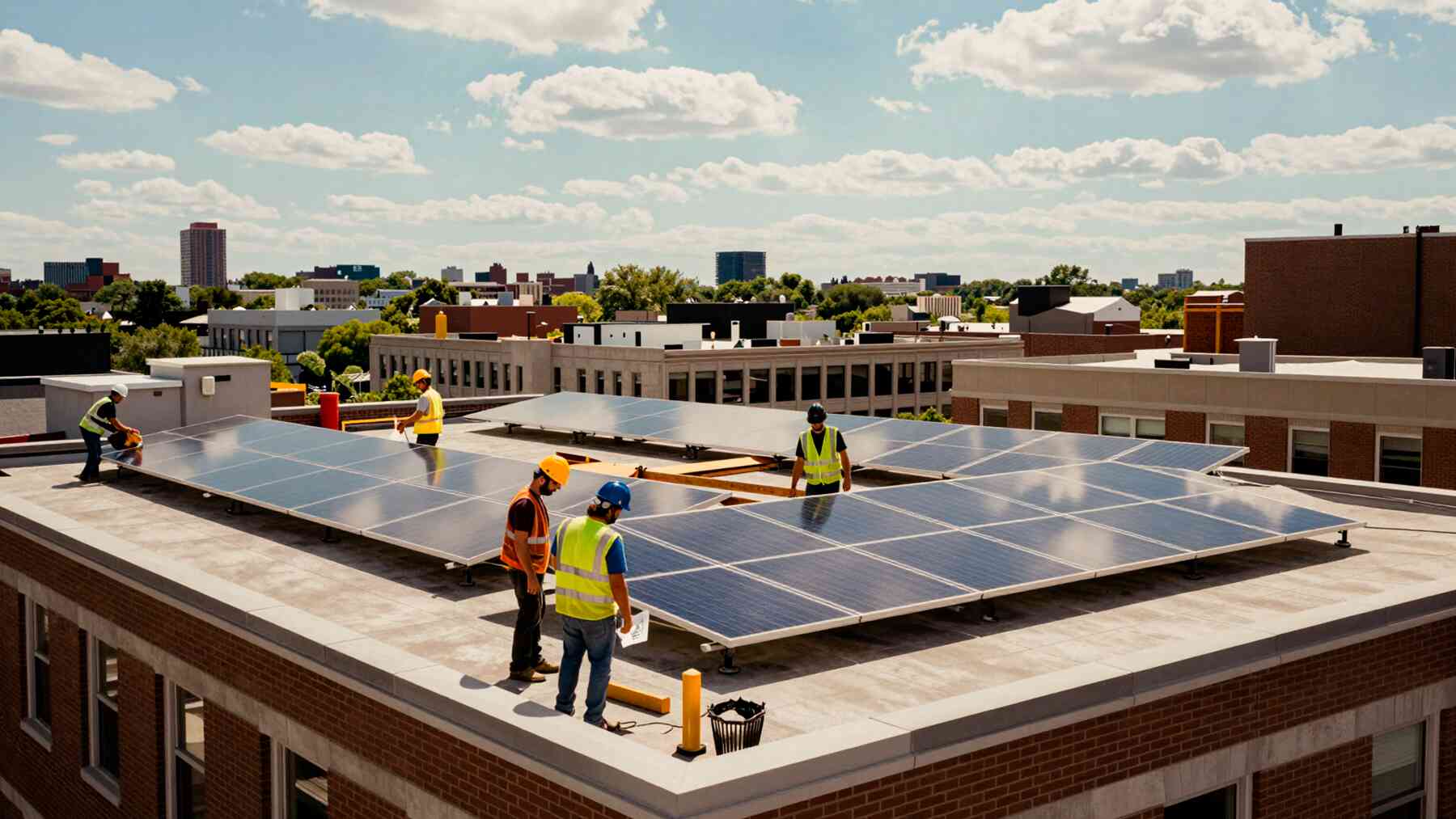
Ameresco has finalized a contract to launch construction of a rooftop solar installation at the Community College of Philadelphia. Before the year is out, construction will be underway at two campuses. Work is scheduled to start this summer of 2026 and is expected to wrap up by the end of 2026 — bringing new solar arrays to CCP’s main campus on Spring Garden and its Northeast regional campus. The Solar for Schools grant program is backing the whole thing.
Ameresco breaks ground on two-campus solar installation
The project covers both CCP locations: the main campus on Spring Garden Street and the Northeast regional campus. Ameresco announced two new rooftop solar arrays, each designed to push the college toward its long-term sustainability targets. Construction kicked off this summer, with completion scheduled before the end of 2026.
Financial backing comes from the Solar for Schools grant program — and that support is a big reason the project moved from planning to active construction. Without it, the upfront capital requirements could have stalled everything.
Students gain access to working solar infrastructure as a learning resource, and the project feeds into Pennsylvania’s broader push toward renewable energy.
Why Ameresco and CCP pursued the project
CCP has made sustainability and campus resilience core institutional priorities. But like a lot of community colleges, it runs into real budget constraints. That’s where Ameresco’s financing model enters the picture.
The company specializes in budget-neutral solutions — Energy Savings Performance Contracts (ESPCs), Power Purchase Agreements (PPAs), and Energy as a Service (EaaS), among others. These approaches cut or eliminate large upfront capital investments, making clean energy projects accessible to institutions that might otherwise get priced out entirely.
The Solar for Schools grant added another layer of support, tipping the balance toward feasibility. Pennsylvania’s ongoing investment in renewable energy also created a policy environment that made this kind of partnership easier to pursue — giving both sides confidence the project aligned with broader regional goals.
Expected outcomes: Energy resilience and reduced grid dependence
Once the arrays are running, both campuses will generate their own renewable electricity on-site. That directly cuts how much power CCP pulls from the grid, lowering costs and giving the college more control over its energy supply.
Energy resilience is a stated goal. For an institution serving thousands of students, that control matters — it reduces vulnerability to grid disruptions and price swings that can strain tight institutional budgets.
Tim Trzaska, Director of Construction Management at CCP, put it plainly: “This project is an important step in our work to build a more sustainable and resilient campus for our students and the broader community. As the Commonwealth of Pennsylvania continues to invest in renewable energy, we’re proud to partner with Ameresco to contribute to that progress.”
Construction is also creating local jobs in the short term — a benefit that adds real community value well before the panels ever go live.
Student learning opportunities and curriculum integration
One of the more interesting aspects of this project is what it offers students academically. The solar arrays aren’t just infrastructure — they’re meant to function as real-world learning tools.
CCP has identified curriculum enhancement as a long-term benefit. With operational solar systems on both campuses, students can study renewable energy in practice rather than purely in theory. That hands-on exposure carries particular weight at a community college, where many students are heading directly into technical and trades careers. The difference between reading about a photovoltaic system and standing next to one that’s actually producing power is hard to overstate.
CCP also framed the project as a contribution to the broader community, not only to the institution itself. That framing reflects the college’s role as a public resource — one that sees its campus decisions as having ripple effects beyond its own enrollment.
Background: Ameresco’s role in U.S. clean energy projects
Ameresco isn’t new to this space. Founded in 2000 and headquartered in Framingham, Massachusetts, the company operates across North America and Europe as an independent cleantech integrator and renewable energy asset developer.
Its core work involves implementing energy efficiency solutions, upgrading aging infrastructure, and developing distributed energy resources for institutional clients. Schools, municipalities, and public agencies make up a significant portion of its portfolio. The CCP project fits a familiar pattern: partnering with educational institutions to deliver clean energy upgrades that wouldn’t be financially viable through conventional procurement, combining grant funding with budget-neutral financing tools to move projects forward without requiring large capital outlays upfront.
Access to infrastructure as a resource
Here’s what this project actually comes down to. Ameresco has started construction on rooftop solar arrays at two CCP campuses — Spring Garden and Northeast — with work expected to finish by the end of 2026. The Solar for Schools grant program is funding the effort, and Ameresco’s financing model helped make the economics work for the college.
Once complete, the system will generate on-site renewable energy at both locations, cutting grid dependence and improving energy resilience. Students gain access to working solar infrastructure as a learning resource, and the project feeds into Pennsylvania’s broader push toward renewable energy. For CCP, it’s a concrete step toward its sustainability goals. For Ameresco, it’s another example of its institutional clean energy model doing exactly what it’s designed to do.
Kelly is an experienced writer with 15 years of experience exploring the big stories that shape our world, from tech breakthroughs and space exploration to climate, energy, and the fascinating quirks of science. She has a talent for turning complex ideas into sharp, memorable insights that stay with readers long after they’ve finished reading.
