
Scientists find that melting Arctic sea ice is quietly seeding clouds overhead and it could reshape how we predict the region’s climate future
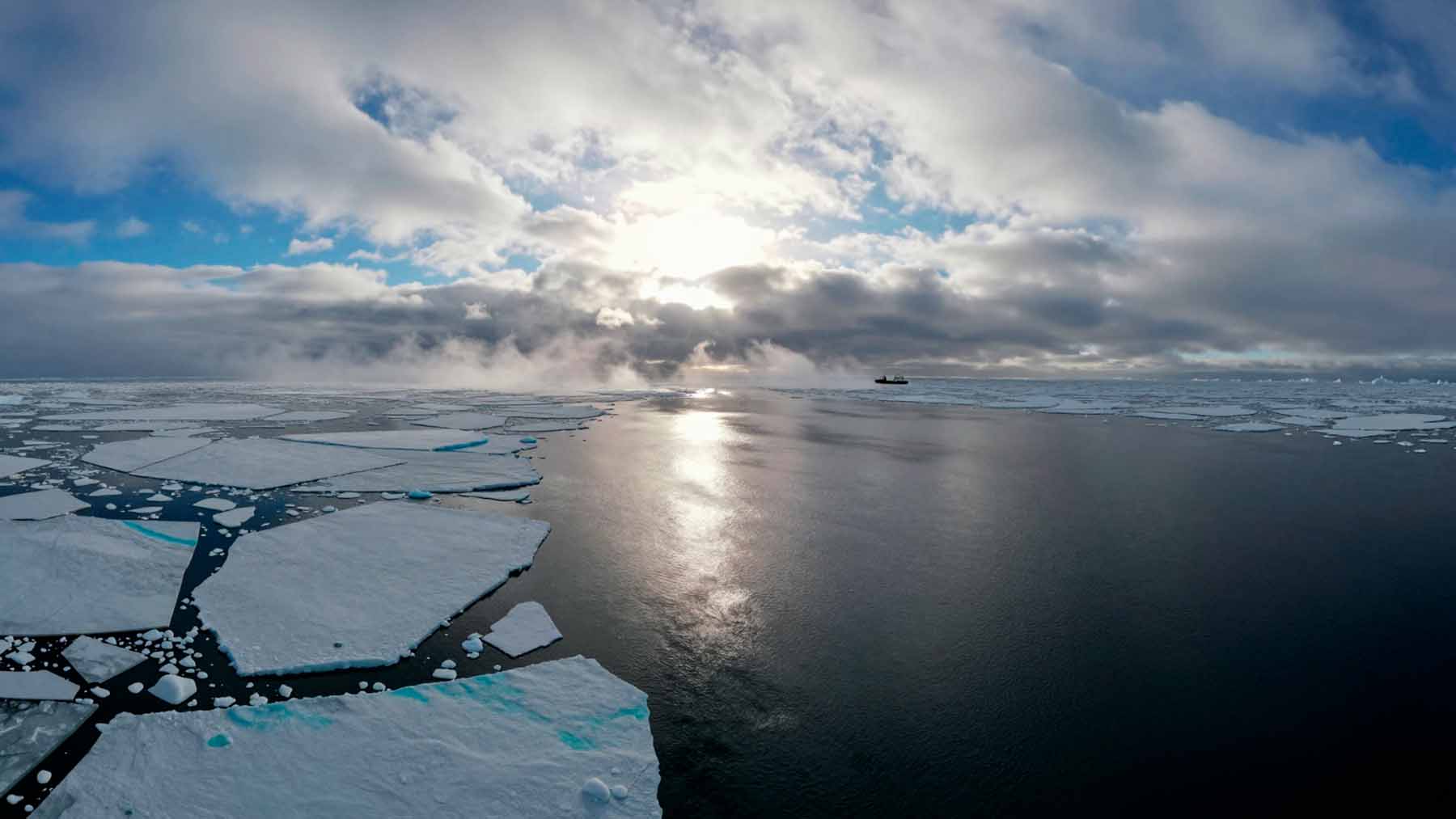 Image generated with artificial intelligence
At the shifting boundary where open ocean meets frozen Arctic sea ice near Greenland, atmospheric sensors recently recorded a startling anomaly. Aboard the Royal Research Ship Discovery during a 2022 expedition through the Davis Strait, researchers watched airborne particle counts suddenly surge from a baseline of 50 up to 1,500 per cubic centimeter (roughly 820 to 24,600 particles per cubic inch) in a single afternoon. The massive spike was driven by reactive iodine, sulfur, and organic vapors rising directly from the water below.
This finding, published in Nature Geoscience, offers the first real-world confirmation of an intricate atmospheric sequence previously observed only inside laboratory test chambers. Because polar cloud dynamics remain one of the least understood variables in global climate forecasting, deciphering this chemical reaction unfolding at the waterline has become an urgent scientific priority.
A chemical factory at the edge of the ice
The marginal ice zone—the dynamic band where open seawater meets retreating sea ice—is operating as a surprisingly active open-air chemical reactor. While tracking atmospheric conditions around Greenland, an international team led by University of Birmingham scientists, alongside partners in China and Spain, recorded new particle formation on over 80% of clear, sunny days.
According to American research data from NASA and NOAA, the Arctic is warming nearly four times faster than the global average, driving historical sea ice loss.
Rather than an isolated anomaly, this rapid atmospheric particle creation is a regular feature of polar life. The constant melting at the ice edge unleashes concentrated biological and chemical emissions, fueling an intense atmospheric factory.
How sunlight and the ocean build particles from scratch
To understand why these microscopic specks carry such heavy significance, consider how clouds form in nature. Water vapor rarely coalesces into droplets on its own; it requires tiny airborne foundations known as cloud condensation nuclei. While dust, smoke, and ocean spray serve this role elsewhere, the Arctic atmosphere often builds them from scratch.
Sunlight provides the spark. Sunlit seawater causes marine microalgae to emit dimethylsulfide gas, while sea ice releases active iodine compounds. In the atmosphere, iodine oxoacids react with sulfuric acid to forge brand-new solid particles. Researchers at the CLOUD chamber at CERN had demonstrated this mechanism in controlled laboratory settings, but this study provides the first field proof that it occurs naturally in polar air.
A newly identified molecule helps tiny particles survive and grow
Forming a particle is only the first hurdle; keeping it alive is another. Most newborn molecular clusters evaporate before reaching the size necessary to seed cloud droplets. Analyzing the airborne mix, researchers discovered a missing piece of the puzzle: an entirely unknown class of chemical compounds called iodine-containing oxygenated organic molecules, or I-OOMs.
These specialized I-OOMs act as chemical growth boosters, rapidly condensing onto fragile new particles to help them reach functional sizes. This discovery uncovers a brand-new branch of iodine chemistry, solving a long-standing mystery regarding how tiny molecular clusters survive to influence weather patterns.
Why retreating ice makes all of this matter more
This chemical process is gaining impact due to rapid environmental shifts. According to American research data from NASA and NOAA, the Arctic is warming nearly four times faster than the global average, driving historical sea ice loss. As frozen cover retreats, the biologically rich marginal ice zone expands across vast new ocean territory.
This transition fundamentally alters Earth’s energy balance. Snow-covered sea ice is highly reflective, bouncing 50% to 70%—and up to 90% for fresh snow—of incoming solar radiation back into space, whereas dark open ocean absorbs over 90% of solar heat. Expanding the exposed waterline creates ideal conditions for sunlit particle synthesis across broader regions.
A missing piece that climate models still lack
Despite its expanding scope, this chemical mechanism is entirely absent from current global climate models. Existing projections evaluate polar warming without accounting for this ocean-ice pathway, creating a major blind spot in climate forecasting.
Untangling the outcome requires updated modeling. Thicker summer cloud cover could reflect sunlight and cool ocean surfaces, yet those same clouds can trap heat and accelerate localized ice loss. Researchers are now incorporating this iodine-driven chemistry into global climate frameworks. In doing so, scientists have uncovered the ultimate revelation: melting Arctic sea ice is quietly seeding clouds overhead, a discovery that could fundamentally reshape how we predict the region’s climate future.
You can find the complete study here: Du, M., Brean, J., Worsnop, D.R. et al. Arctic cloud condensation nuclei enhanced by iodine, sulfur and organic precursors. Nat. Geosci. (2026). https://doi.org/10.1038/s41561-026-02062-6
Kelly is an experienced writer with 15 years of experience exploring the big stories that shape our world, from tech breakthroughs and space exploration to climate, energy, and the fascinating quirks of science. She has a talent for turning complex ideas into sharp, memorable insights that stay with readers long after they’ve finished reading.
