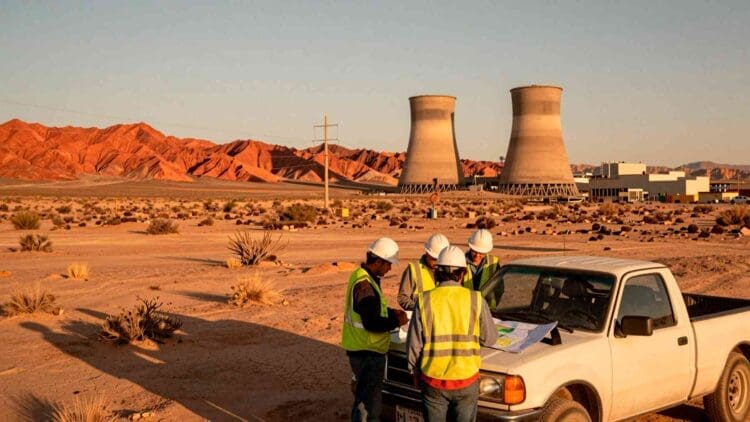

Arizona’s three largest electric utilities are taking a coordinated step toward expanding the state’s nuclear capacity. APS, SRP, and TEP have jointly launched a preliminary siting study to identify potential locations for new nuclear generation in Arizona—a process already underway as of mid-2025.
Three utilities begin joint nuclear siting study
APS, SRP, and TEP have formally launched a preliminary siting study to identify potential locations for new nuclear generation across Arizona. The effort is collaborative by design—three competing utilities working from a shared methodology to evaluate the same candidate sites.
The study uses a phased screening approach, assessing potential locations in successive rounds and narrowing a broad field of candidates down to a short list and eventually a preferred site. Former coal-fired power plant locations are among those under evaluation, partly because they may already carry relevant infrastructure and grid connections. Results are expected within six months — a starting point, not a finish line.



Why utilities are pursuing nuclear now
Arizona’s electricity demand is not standing still. Population growth and economic expansion are pushing consumption higher, and all three utilities set new peak-demand records in 2025. That pressure is making long-term capacity planning more urgent.
Nuclear generation is not a quick fix. New plants require years — sometimes decades — of planning, permitting, and construction before they produce a single kilowatt-hour, which is precisely why utilities argue that early steps like this siting study matter now, even if a final build decision remains far off. Funding has already presented a challenge: the three utilities applied for a U.S. Department of Energy grant in early 2025 to help cover exploratory costs, but that application was not awarded. They say alternative funding sources are being pursued.
Next steps and regulatory pathway
Completing the siting study does not automatically trigger construction. Once results are in hand, the utilities will assess technical, financial, and other factors before deciding whether to pursue an early site permit application.
An Early Site Permit, or ESP, is a formal approval issued by the U.S. Nuclear Regulatory Commission that evaluates whether a specific location is suitable for nuclear generation before any reactor design is finalized. Filing for one would represent a meaningful escalation in commitment — but that decision has not been made yet. Community engagement will run alongside the technical process, with public meetings near potential sites planned for late 2026.
On the regulatory and policy side, Arizona Corporation Commission Chairman Nick Myers and Commissioner René Lopez hosted a workshop on nuclear generation opportunities on June 25, 2026. The session brought together utilities, policymakers, and industry stakeholders to discuss nuclear’s potential role in the state’s resource planning.
Technology choices and project uncertainties
No reactor technology has been selected, and no final decision to build has been made. Both small modular reactors—a newer, more compact design—and larger conventional reactor designs remain under active consideration.
The utilities have been candid about what would need to go right for any project to move forward. Cost and schedule predictability, supply chain readiness, and financing conditions all factor into whether new nuclear generation becomes viable. These are not trivial hurdles; nuclear projects in the U.S. have historically faced significant cost overruns and delays. When it comes to technology selection, the utilities say they will prioritize designs that are commercially proven, safely deployed elsewhere, and backed by suppliers with demonstrated operational track records — a cautious posture toward a high-stakes investment.
Background: Arizona’s existing nuclear capacity and utility profiles
Arizona is not new to nuclear energy. APS already operates the Palo Verde Generating Station west of Phoenix — the largest nuclear plant in the United States by power output — giving the utility a baseline of operational expertise that could inform the broader siting effort.
APS serves about 1.4 million customers across 11 of Arizona’s 15 counties, with an energy mix that is approximately 54% to 58% clean. SRP, a not-for-profit public power utility, serves about 1.2 million customers in the greater Phoenix metropolitan area. TEP provides service to 457,000 customers in Southern Arizona and is a subsidiary of Fortis Inc.
The joint effort also fits a wider national pattern. Utilities across the country are revisiting nuclear as a firm, low-carbon generation source at a time when electricity demand is rising and renewable energy alone may not cover all reliability needs.
What the current announcement actually establishes is fairly narrow: a siting study is underway, results are expected within six months, no technology has been chosen, no construction decision has been made, and the regulatory pathway—including a potential Early Site Permit application—remains a future possibility rather than a commitment.
Kelly is an experienced writer with 15 years of experience exploring the big stories that shape our world, from tech breakthroughs and space exploration to climate, energy, and the fascinating quirks of science. She has a talent for turning complex ideas into sharp, memorable insights that stay with readers long after they’ve finished reading.