
British scientists built a battery that eats CO₂ and recharges itself with an ingredient no one thought to try
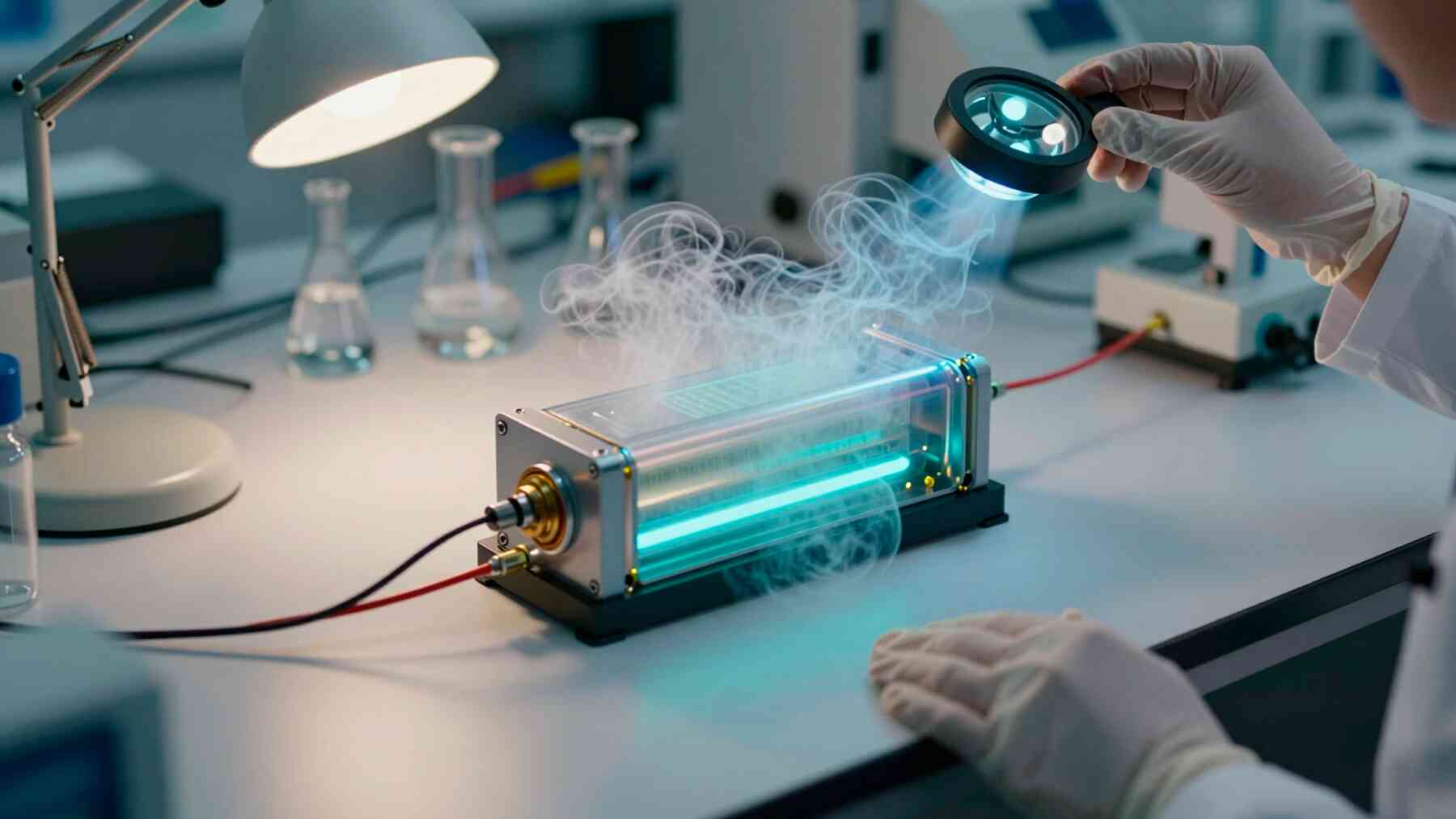 AI-made
A battery that stores energy and pulls carbon dioxide out of the air sounds like a clean-energy fantasy. For years, lithium-CO₂ “breathing” batteries promised exactly that — but kept falling short: wearing out after a handful of cycles, demanding rare and expensive metals, and burning through more power to recharge than they were worth.
Researchers at the University of Surrey suspected the problem wasn’t the concept. It was the chemistry.
A battery that captures carbon while it powers your device
Lithium-CO₂ batteries work by absorbing carbon dioxide from their surroundings as part of the electrochemical reaction that generates power. In simple terms, the battery breathes in CO₂ the way a combustion engine breathes in oxygen — except instead of producing emissions, it locks carbon away as lithium carbonate inside the cell.
A storage technology that actively removes carbon from the atmosphere while storing renewable energy could fill a role conventional batteries simply cannot.
That dual function sets these batteries apart from conventional lithium-ion cells, which store and release energy but do nothing about the carbon in the air around them. A technology that handles both jobs at once has obvious appeal.
Researchers see potential in vehicles, industrial facilities, and environments where CO₂ is abundant. Mars — where the atmosphere is roughly 95% CO₂ — has even been floated as a setting where these batteries could operate without any external carbon source whatsoever.
The problem that kept these batteries on the shelf
For all that promise, lithium-CO₂ batteries have struggled with a fundamental inefficiency called overpotential. Dr. Siddharth Gadkari, a lecturer in Chemical Process Engineering at the University of Surrey, describes it plainly: “You can think of it like cycling uphill before you can coast.”
The battery must consume a significant amount of extra energy just to get its own reaction started — and that overhead eats into any efficiency gains.
Degradation compounded the problem. The batteries recharged poorly, wore out quickly, and depended on expensive materials such as platinum just to function. High material costs and short lifespans kept commercialization out of reach, even as the underlying concept remained theoretically attractive.
An affordable catalyst changes the equation
The Surrey team’s answer was a compound called caesium phosphomolybdate, or CPM — a low-cost catalyst containing no rare metals, which matters enormously for any technology intended to scale beyond a laboratory.
The performance results were notable. Using CPM, the battery stored significantly more energy, required far less power to recharge, and completed over 100 stable charge-discharge cycles. Earlier lithium-CO₂ designs wore out after only a handful of uses, making that last figure particularly significant.
Dr. Daniel Commandeur, a Future Fellow at the University of Surrey and co-corresponding author of the study, summarized it this way: “We’ve shown that it’s possible to build efficient lithium-CO₂ batteries using affordable, scalable materials — no rare metals required.” Performance and accessibility together are what move a laboratory result closer to a manufacturable product.
Two ways of seeing inside the battery
To understand why CPM worked so well, the research team used two complementary methods — neither of which would have been sufficient on its own.
The first was a post-mortem analysis. After running the battery through charge and discharge cycles, researchers dismantled it and examined the chemical changes inside. Lithium carbonate — the compound formed when the battery absorbs CO₂ — built up and broke down reliably with each cycle. That reversibility is essential; a battery that cannot cleanly reset its chemistry degrades fast.
The second approach was computational. Using density functional theory, or DFT, the team modeled how reactions unfold at the material surface.
Simulations revealed that CPM’s stable, porous structure provides an ideal environment for key electrochemical reactions to occur efficiently. Pairing experimental evidence with computational modeling gave the researchers confidence in both the mechanism and the results.
What comes next for CO₂-breathing batteries
The Surrey study, published in Advanced Science, represents a meaningful step, but the researchers are clear that further work remains. How CPM interacts with different electrodes and electrolytes will need to be understood before performance can be optimized across a complete cell, not just at the catalyst level.
The findings also open a broader design opportunity. If CPM performs this well, the same framework could guide the search for even better low-cost catalysts — materials engineered from the start with both efficiency and scalability in mind.
A storage technology that actively removes carbon from the atmosphere while storing renewable energy could fill a role conventional batteries simply cannot. Whether lithium-CO₂ batteries eventually reach vehicles, power grids, or more exotic environments, the Surrey team has shown that the path forward no longer requires rare metals or unrealistic chemistry — and that alone reshapes what the next decade of battery research might look like.

Carlos is an engineer with strong expertise in technical and industrial topics. He previously worked at international companies such as Siemens and is multilingual.
