
Boston is pulling heat from its harbor and rivers to warm thousands of buildings, and the rest of the world’s coastal cities are starting to pay close attention
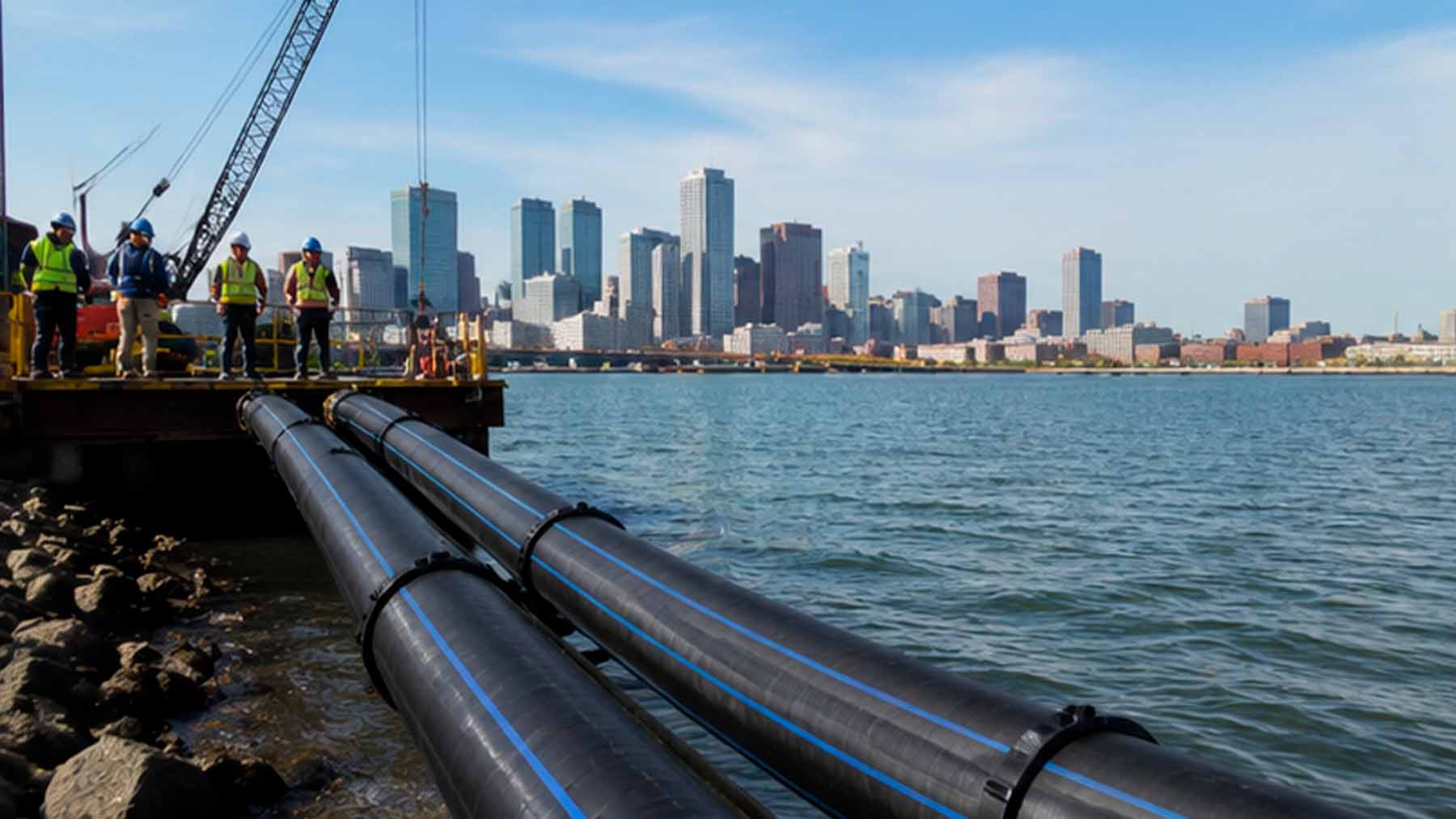 Image generated with artificial intelligence
Boston is pulling heat from its harbor and rivers to warm thousands of buildings, and the rest of the world’s coastal cities are starting to pay close attention.
Beneath the surface of one of America’s oldest urban cores, a transformative energy revolution is quietly unfolding. Urban planners, climate pioneers, and universities are turning away from traditional fossil heating to tap an abundant local resource.
Boston’s dense underground is notoriously congested, crammed with centuries of aging water lines, transit tunnels, building foundations, and landfill. Traditional ground-source geothermal heating is virtually impossible across much of the city. To solve this critical dilemma, strategists are turning outward to the massive liquid thermal reservoir surrounding the metropolis.
Blocked from drilling downward into rock and clay, engineers turned their eyes toward the tidal waters and river channels that have defined the region for centuries.
Why Boston’s underground isn’t the answer
Boston’s complex geology presents a formidable engineering challenge. Much of the modern metropolis sits on low-lying fill land reclaimed from maritime marshes over centuries of urban growth.
This environment creates severe hurdles for deep terrestrial energy projects. Lindsey Butler, executive director of the Boston Green Ribbon Commission, notes that traditional geothermal is “impossible in some places and in others just very expensive.”
Deep drilling rigs require open footprints and clear subterranean access that congested historic districts simply lack. Blocked from drilling downward into rock and clay, engineers turned their eyes toward the tidal waters and river channels that have defined the region for centuries.
Water as a near-infinite thermal battery
Water retains thermal energy far more effectively than atmospheric air. It stays remarkably cool during sweltering summers and reliably warm during frigid winters, making liquid heat exchange far more efficient than standard air-source heat pump systems.
The sheer volume of available energy in local waters is astounding. Rising water temperatures in Boston Harbor—partially accelerated by regional climate trends—have generated what HEET researcher Zeyneb Magavi terms “anthrothermal” energy.
Calculations from HEET indicate the harbor contains enough thermal energy to heat roughly 2.4 million American homes annually. Ocean currents and natural tidal flows replenish this heat every two to ten days, making it a sustainable, long-term energy solution.
Three projects already taking shape
Concrete infrastructure is already proving this concept across the region. On the waterfront, UMass Boston has successfully utilized seawater cooling systems since the 1970s.
The university is now installing advanced heat pumps to extract thermal energy from seawater to warm classrooms, laboratories, and dormitories across 12 campus buildings. This upgrade will cut natural gas usage by 82%, with future phases aiming for 100% elimination.
Nearby, Vicinity Energy is constructing a 35-megawatt heat pump facility along the Charles River—the largest water-source heat pump system in North America. Meanwhile, the BosTEN initiative is actively assessing harbor and river energy extraction, with full technical recommendations expected by mid-2027.
Lessons borrowed from across the Atlantic
Rather than reinventing the wheel, regional planners modeled these initiatives on proven European district energy grids. Vicinity Energy drew direct architectural inspiration from Glasgow’s district heating network on the River Clyde and Malmö’s high-efficiency system in Sweden.
Matt O’Malley, Vicinity’s chief sustainability officer, emphasizes this pragmatic approach: “We are not trying to prove something. We are shamelessly emulating what has worked in leading European sustainability cities.” Adapting field-tested European technology dramatically reduces execution risks while accelerating deployment schedules.
What comes next—and who’s watching
The ultimate vision involves sweeping submarine infrastructure. Advocates envision interconnected thermal loops laid along the harbor floor, anchoring major medical and commercial centers before expanding into broader residential neighborhoods.
This multi-sector coalition—uniting universities, public hospitals, municipal leaders, and environmental non-profits—provides the institutional muscle required to convert ambitious pilots into permanent public utilities. Coastal cities worldwide facing dense urban constraints are watching Boston closely as a prospective playbook for clean urban heating.
And there is a poetic symmetry to this breakthrough. Boston Harbor is historically famous for what went into it—342 chests of tea dumped overboard in 1773 to ignite a revolution. Today, as climate leaders pull clean thermal energy out of those exact same waters, Boston is quietly launching another historic revolution.

Kelly is an experienced writer with 15 years of experience exploring the big stories that shape our world, from tech breakthroughs and space exploration to climate, energy, and the fascinating quirks of science. She has a talent for turning complex ideas into sharp, memorable insights that stay with readers long after they’ve finished reading.
