
Floating “islands” powered by ocean waves could become the data centers of the future and Scotland’s seas are where the idea is being put to the test
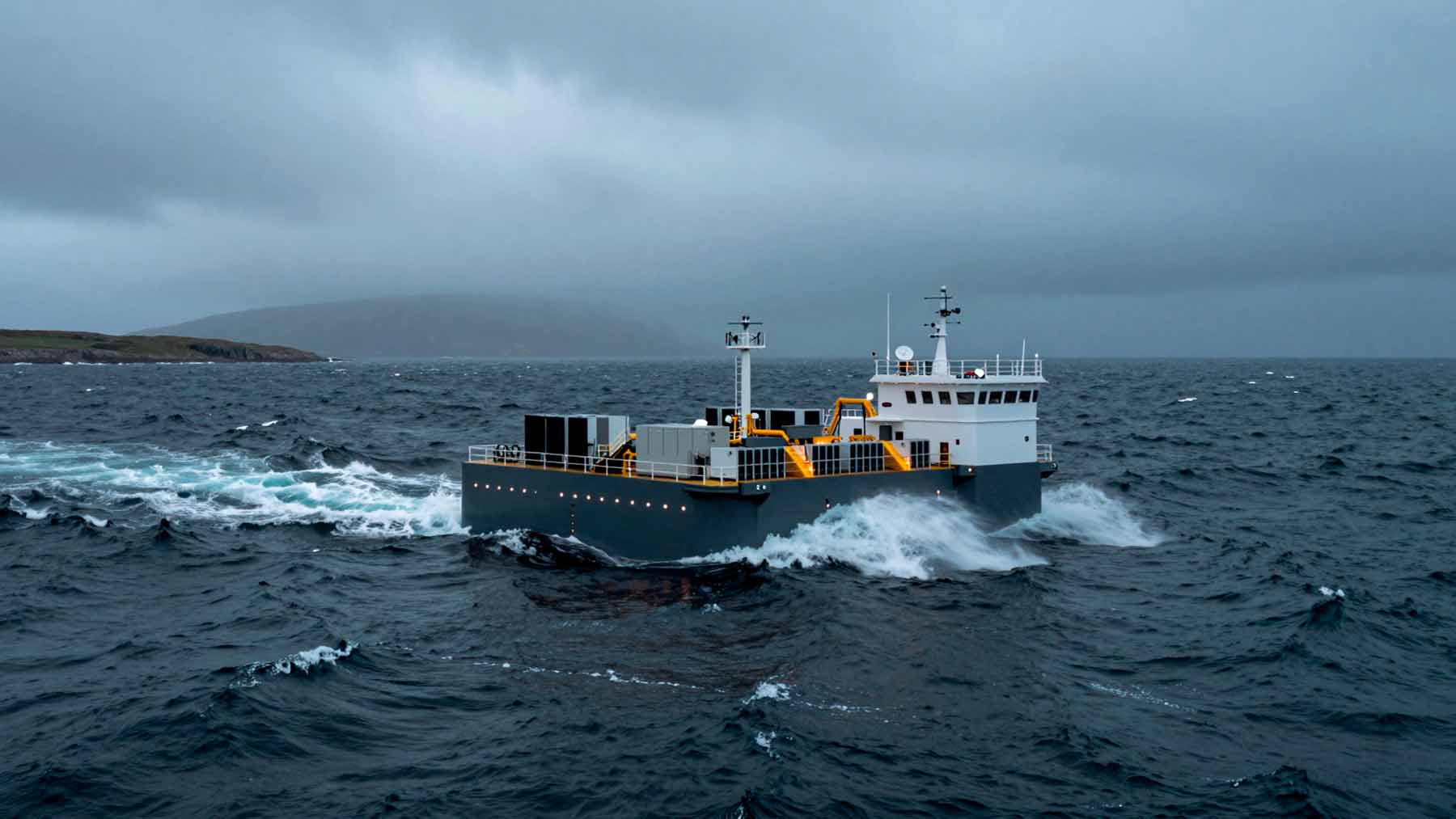 Image generated with artificial intelligence
Artificial intelligence data centers are on track to consume an astounding 1,200 terawatt-hours of electricity annually by 2035. To put that in perspective, that single sector will demand more energy than the total power consumed by over 100 million American homes.
Yet on land, the vital resources needed to support this computing boom — real estate, fresh water, and electrical grid access — are rapidly running out.
From Silicon Valley to Virginia’s Data Center Alley, local opposition to massive computing hubs is hardening.
Mocean’s predecessor system, the Blue Star, completed 18 months of continuous testing in the harsh North Sea alongside international energy supermajors.
One Scottish pioneer believes the solution lies miles off the coast in the relentless surges of the open sea. However, behind this floating concept sits a radical technological paradigm shift that conventional tech giants completely overlooked.
A capacity crisis hiding in plain sight
Global demand for AI-optimized server clusters is projected to quadruple over the next decade. That growth translates into a crushing 1,200 TWh annual power demand that threatens to overload terrestrial utilities.
Yet electricity supply is only the first bottleneck halting new construction.
Securing suitable land and utility grid interconnections in primary US and European markets can now take up to seven years. At the same time, massive fresh water consumption for server cooling is triggering intense regulatory scrutiny and community pushback.
Because power and cooling represent the largest operational expenses for data infrastructure, these environmental constraints are quietly throttling the entire AI industry.
Blue Core: What the system actually does
Scotland-based Mocean Energy designed its “Blue Core” architecture to bypass land-based choke points entirely. Each floating modular unit generates between 500 kilowatts and 1 megawatt of clean power directly from wave motion.
These modular pods link together into scalable offshore farms without occupying a single acre of real estate. Data is transmitted via low-Earth orbit satellite constellations like Starlink, eliminating the need for expensive seabed fiber-optic cables.
To accelerate development, Mocean is securing approximately $6.5 million in pre-Series A funding.
As Managing Director Cameron McNatt notes, the goal is not merely building another facility, but permanently dismantling the land and grid barriers choking technological growth.
The cooling advantage that changes the math
On land, conventional air conditioning and evaporative chillers devour between 15 and 35 percent of a facility’s entire energy budget. Offshore, ocean-based thermal exchange drops that parasitic cooling load down to just 5 percent.
The system uses a closed-loop heat exchanger that transfers server heat directly into seawater without consuming a single gallon of municipal drinking water. Once deployed, the kinetic wave energy driving the platform provides continuous power with zero ongoing fuel costs.
By 2035, this zero-carbon operating model could eliminate over 14 million US tons of carbon dioxide emissions annually compared to traditional coal or gas-backed facilities.
Proven at sea—and what comes next
This floating computing vision relies on hardware that has already survived grueling real-world ocean trials.
Mocean’s predecessor system, the Blue Star, completed 18 months of continuous testing in the harsh North Sea alongside international energy supermajors. A follow-up commercial pilot is locked in, with initial sales anticipated by 2028.
The Blue Core platform follows a parallel commercial roadmap. Mocean plans to launch its first offshore demonstrator before 2030, targeting an ambitious 6 gigawatts of installed capacity within a decade.
Mocean is not alone: A growing field of floating data centers
Offshore computing concepts have simmered for years, led by high-profile corporate experiments. Microsoft explored subsea pods during Project Natick before shelving the commercial effort in 2024. Nautilus Data Technologies has operated a barge-mounted facility on California’s San Joaquin River since 2021.
Meanwhile, Japanese conglomerates NYK and NTT launched a pier-side floating demonstration in Yokohama in 2026.
Yet here lies the core strategic hook that sets Scotland’s wave experiment apart from every rival attempt. Previous floating designs remained tethered to terrestrial power grids via underwater cables or relied on burning imported fuels like ammonia. Mocean’s Blue Core is the world’s first truly autonomous computing platform that harvests its energy directly from the ocean motion beneath it.
By combining endless kinetic wave power with unlimited ocean cooling in a self-contained offshore loop, Scotland is testing an architecture that makes land-based data centers obsolete.
Kelly is an experienced writer with 15 years of experience exploring the big stories that shape our world, from tech breakthroughs and space exploration to climate, energy, and the fascinating quirks of science. She has a talent for turning complex ideas into sharp, memorable insights that stay with readers long after they’ve finished reading.
