
Two large California solar plants cut tiny “doors” into their fences for a five-pound fox, then 102 other uninvited animals started using them too
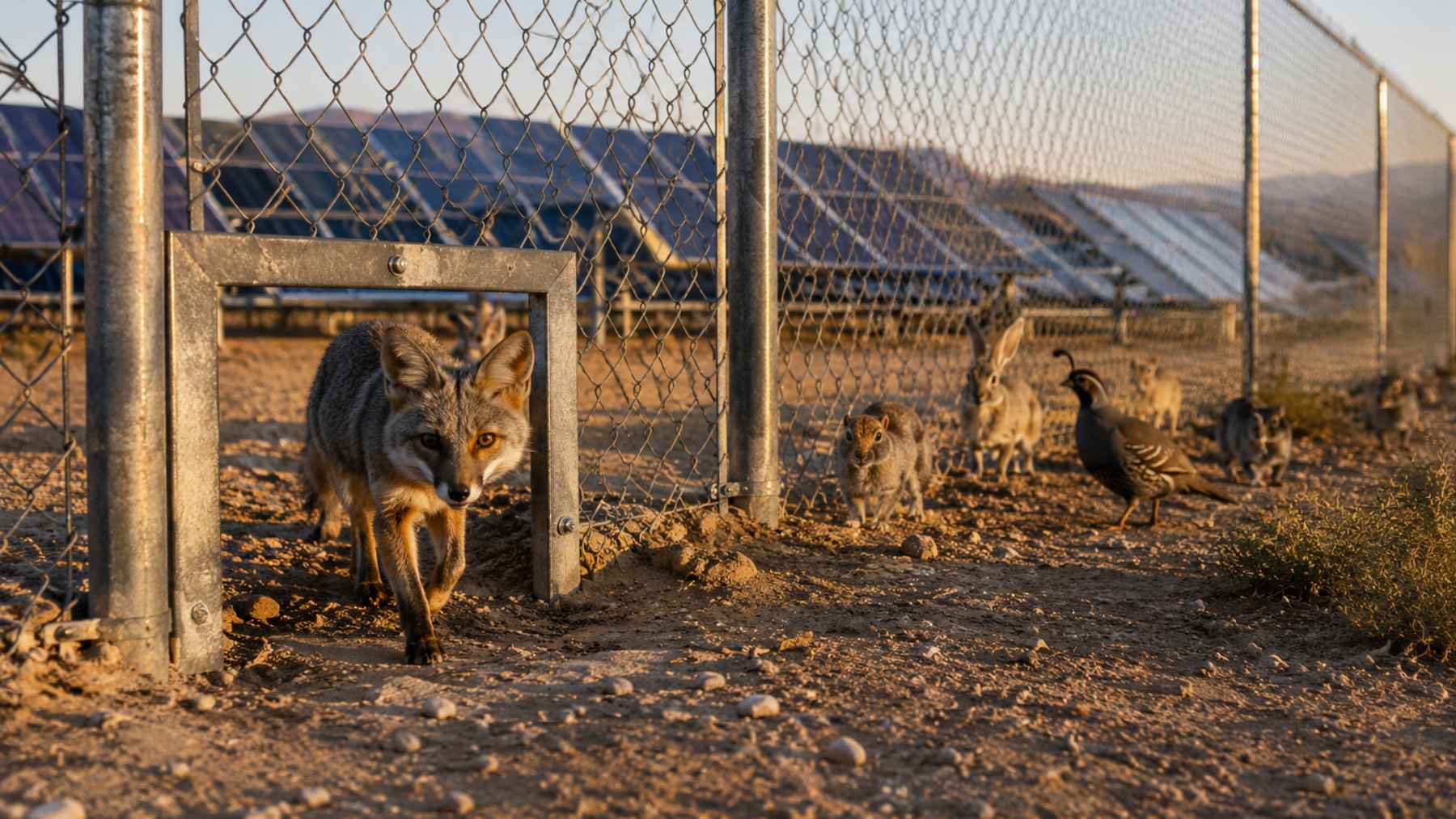 Image generated with artificial intelligence
Two solar plants in California aimed at saving endangered foxes unintentionally attracted other species as well.
Solar power is the leading source in the world’s renewable energy transition.
Now, its capacity is set to expand rapidly to meet rising global electricity consumption.
The Bren School of Environmental Science & Management assessed protective design features at two solar farms aimed at protecting the species.
However, these scaled facilities often disrupt the natural habitats of vulnerable species and require carefully planned interventions.
Will the California plants’ strategies inspire others to follow suit, or are unexpected species unwelcome?
How the leading renewable source evolved in the global green shift
In early 2026, the world’s combined solar photovoltaic capacity exceeded 3 terawatts.
This is a major milestone that was decades in the making.
Several years ago, photovoltaics were an expensive, niche technology that was limited to specialized, off-grid applications.
The tech faced unaffordable manufacturing costs, a high reliance on fossil-fuel grids, and exceptionally low energy conversion efficiencies.
This made photovoltaics economically uncompetitive.
However, as manufacturing modernized and scaled, this quickly changed.
Over the course of fifteen years, the costs of panels dropped by nearly 90%.
This made photovoltaics the most economical source for new renewable power generation.
As a result, worldwide adoption was triggered.
The power source soon became the foundational pillar of modern, clean energy grids.
Currently, it meets over a quarter of all new global electricity consumption growth.
Unfortunately, global demand is rapidly outpacing new green power generation.
Now, solar farms need to scale exponentially to bridge this gap.
The bigger the demand, the bigger the supply must be
The United States is currently the world’s second-largest consumer of electricity.
In some states, the power demand is projected to nearly double.
This surge is driven by major regions transforming into data center hubs to keep the digital economy operational.
Additionally, electric vehicle adoption is growing across urban and coastal states.
As a result, existing power grids are severely strained.
To prevent energy deficits without relying on fossil-fuel plants, high volumes of clean electricity are needed.
Utility-scale solar-plus-storage facilities are key to filling this gap quickly.
Since panels have a lower power density, facilities are scaled by covering vast expanses of land with millions of panels.
This expansion inevitably overlaps with natural ecosystems and wildlife habitats.
In California, a prime example of a vulnerable species is the San Joaquin kit fox.
The Bren School of Environmental Science & Management assessed protective design features at two solar farms aimed at protecting the species.
Solar farm fence doors saving kit foxes and unintentionally 102 other species
California’s Topaz Solar Farms and California Valley Solar Ranch installed perimeter fencing doors to protect the endangered foxes.
Small clearance openings were created by raising chain-link fences between 4 and 6 inches above the ground.
Additionally, anti-digging bottom rails were added to prevent larger predators from entering by burrowing underneath.
The main goal of the design was achieved.
Changes in kit fox numbers and other unintended species
The small five-pound foxes easily navigated the “doors.”
Inside the array zones, the panels were elevated to offer shelter from hunting golden eagles.
From 2014-2017 and 2019-2022, zero kit fox fatalities were recorded in the fenced area.
Survival rates matched or exceeded those in nearby natural habitats.
The foxes maintained healthy weights and steady reproduction rates.
The research also revealed that 102 non-target species used the “doors.”
This includes small mammals, native birds, and reptiles.
They sought shelter, foraged, and navigated between fragmented habitats.
The operators added additional conservation features across the solar sites to support these animals.
Artificial breeding dens, wildlife movement corridors, and sheep grazing to manage vegetation growth were introduced.
Furthermore, exposed food waste, off-leash dogs, and firearms were banned.
Ultimately, these protection strategies have become fundamental in boosting local wildlife numbers. They proved that clean energy can coexist with nature.
Anke Maree is a writer with a clear and engaging editorial style. Her work focuses on making complex topics accessible, informative, and relevant for readers across different areas of interest.
