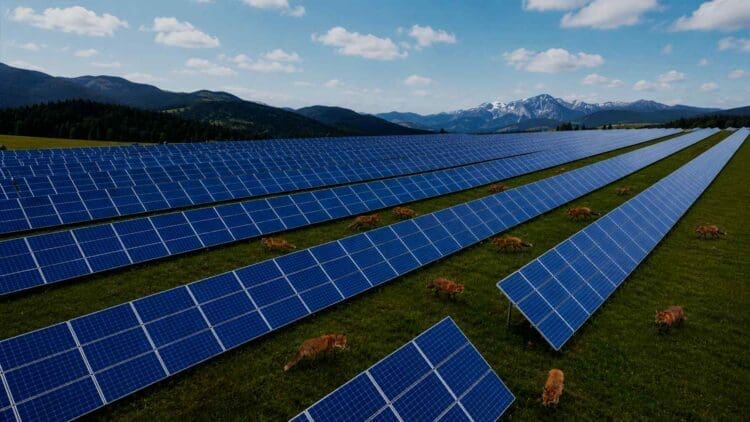

California’s kit foxes can enjoy a triumph over predators thanks to a solar plant.
Utility-scale renewable energy projects are essential to meeting data center and AI power demands.
As these developments’ physical footprint continues to grow, intense conservation concerns are rising. This inspired innovative engineering approaches that transformed the rules of the desert.



Will San Joaquin kit foxes thrive without their California grassland homes, or will more interventions be needed?
How an ever-changing landscape increases conservation fears
The state of California has undergone a significant economic transformation over the years.
The Central Valley served as a global agricultural hub for generations.
Vast orchards and crop fields stretched over the landscape. Unfortunately, hundreds of thousands of acres of native grasslands had to make way for agricultural land.
More recently, a rapid digital boom began to reshape the state.
Major tech companies expanded their presence across the valley.
Soon, farming operations were replaced by giant data centers and AI infrastructure.
As generative AI and cloud computing increased, regional electricity consumption experienced a historic surge.
To address rapidly increasing power demands while adhering to climate mandates, renewable infrastructure had to scale.
Utility-scale solar projects became essential assets in California.
However, the rapid growth of solar capacity has yet again raised urgent conservation fears.
Modern solar progress comes with major costs
The development of large-scale solar sites alters vast expanses of land.
The remaining native vegetation is often cleared to install millions of solar panels. This can permanently disrupt the fragile desert topsoil and increase dust and erosion.
Additionally, these sites require battery systems, which use a great volume of critical minerals.
This leaves nations and developers vulnerable to volatile international supply chains.
Beyond the risk of geopolitical instability, local ecosystems also face severe challenges.
Several species have become endangered due to the state’s ever-changing landscape.
In California, there are over 300 federally and state-protected species. Nearly 122 animal species and over 180 plant species have been listed as endangered.
Conservation experts were specifically worried about the impact of the Topaz Solar Farm on the San Joaquin kit fox.
However, information on the California State Portal was used to develop a mandatory conservation strategy.
The Endangered Species Recovery Program (ESRP) of California State University, Stanislaus, conducted a three-year study analyzing the farm’s impact.
A solar fortress for endangered local fox species
Many were worried that the farm’s construction and installation phases would accelerate the species’ decline. But the university study revealed that the opposite was true.
Instead, the survival rate of the foxes inside the solar facility was higher than expected.
The site management plan transformed the Topaz Solar Farm into a sanctuary.
Creating a solar plant doubling as a modern wildlife fortress
Chain-link fencing was used, and the bottom was raised exactly 4.7 inches off the ground.
This ensured the perimeter fencing was permeable for the tiny, cat-sized kit foxes.
While they could easily navigate their territory, the opening was too small for their natural enemies, coyotes and bobcats.
Implementing responsible site management strategies provides the chance to increase solar capacity without compromising biodiversity.
As the digital age moves forward, species-specific engineering will strike the perfect balance between industrial expansion and preservation.
As more deserts become home to utility-scale solar projects, it does not have to mean ecological ruin. Several solar farms have altered micro-climates, creating green oases in dry, arid regions.
Anke Maree is a writer with a clear and engaging editorial style. Her work focuses on making complex topics accessible, informative, and relevant for readers across different areas of interest.