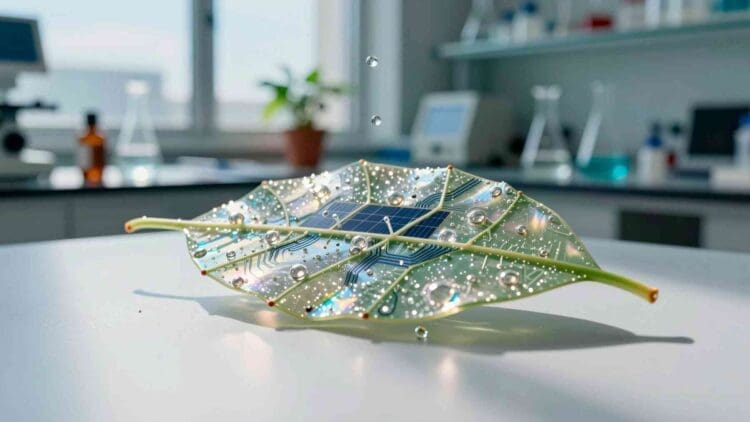

Sitting in a lab at Cambridge, a device roughly the size of a microscope slide does something plants have done for millions of years: it absorbs sunlight, draws in carbon dioxide, and turns both into fuel. No combustion, no fossil inputs — just light, air, and enzymes borrowed from bacteria.
The chemical industry still runs almost entirely on fossil fuels. Changing that has long seemed like a problem too large for any single technology to touch. This artificial leaf may be one quiet place to start.
A chemical industry ripe for reinvention
The chemical sector is easy to overlook in climate conversations. It produces the medicines in your cabinet, the fertilizers that feed billions, the plastics in your phone, and the paints on your walls — and it’s deeply, structurally dependent on fossil fuels, not just for energy but as raw material.




“If we’re going to build a circular, sustainable economy, the chemical industry is a big, complex problem that we must address,” said Professor Erwin Reisner, who led the research at Cambridge’s Yusuf Hamied Department of Chemistry. “We’ve got to come up with ways to de-fossilize this important sector. It’s a huge opportunity if we can get it right.”
Reisner’s group works on artificial leaves — devices that replicate photosynthesis to produce carbon-based fuels from sunlight and CO₂, with no fossil inputs required.
What makes this leaf different
Earlier artificial leaf designs relied on inorganic semiconductors or synthetic catalysts. These materials often degrade quickly, absorb only a narrow slice of the solar spectrum, or contain toxic elements like lead — they work in principle but are difficult to scale cleanly.
The new device pairs organic semiconductors — tuneable, non-toxic, and adjustable — with bacterial enzymes that are highly selective about which reactions they drive. “If we can remove the toxic components and start using organic elements, we end up with a clean chemical reaction and a single end product, without any unwanted side reactions,” said co-first author Dr. Celine Yeung. “This device combines the best of both worlds.”
According to the paper published in Joule, this is the first time organic semiconductors have served as the light-capturing component in a biohybrid system of this kind — opening a design space that sidesteps the toxicity and instability problems constraining earlier generations.
Enzymes, sparkling water, and a sandwich-like design
The device uses enzymes drawn from sulfate-reducing bacteria. These enzymes can split water or convert CO₂ into formate, a simple chemical capable of driving further reactions. Most systems require chemical buffer additives to keep enzymes stable, but those additives break down over time, limiting how long the device can run.
The Cambridge team found a workaround by embedding a helper enzyme — carbonic anhydrase — into a porous titania structure, letting the system operate in a simple bicarbonate solution. Think sparkling water. No unsustainable additives required.
“It’s like a big puzzle,” said co-first author Dr. Yongpeng Liu. “We have all these different components that we’ve been trying to bring together for a single purpose. It took us a long time to figure out how this specific enzyme is immobilized on an electrode, but we’re now starting to see the fruits from these efforts.”
Performance in the lab — and a pharmaceutical proof of concept
In testing, the device produced high photocurrents and achieved near-perfect Faradaic efficiency — meaning nearly every electron generated by sunlight went toward making fuel rather than being lost to side reactions. It also ran continuously for over 24 hours, more than twice as long as previous designs.
The team then took the formate the device produced and fed it into a “domino” reaction to synthesize a pharmaceutical compound, achieving high yield and high purity. The leaf was driving real, useful chemistry — not just producing fuel in isolation.
Road ahead: longer life, broader chemistry
The team is clear that this is a starting point, not a finished product. Solar films are also being developed to compete in the industry. Extending the device’s lifespan beyond 24 hours is the immediate priority, alongside adapting the platform to produce a wider range of chemical outputs.
“We’ve shown it’s possible to create solar-powered devices that are not only efficient and durable but also free from toxic or unsustainable components,” said Reisner. “This could be a fundamental platform for producing green fuels and chemicals in the future.”
Funding came from the European Research Council, UKRI, Singapore’s A*STAR, and the Swiss National Science Foundation — a spread of backers reflecting broad international interest. The artificial leaf won’t decarbonize the chemical industry on its own, but as a proof of concept for cleaner synthesis, it points in a direction worth watching.
Kelly is an experienced writer with 15 years of experience exploring the big stories that shape our world, from tech breakthroughs and space exploration to climate, energy, and the fascinating quirks of science. She has a talent for turning complex ideas into sharp, memorable insights that stay with readers long after they’ve finished reading.