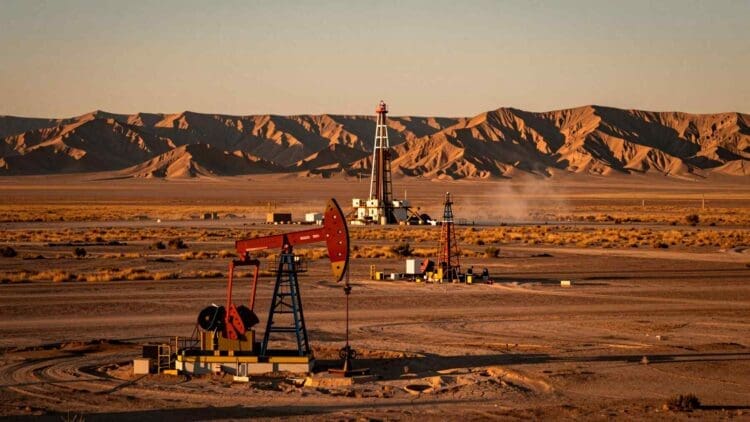

Chevron Corp. filed a $13.8-billion unconventional oil development proposal on June 2, seeking entry into Argentina’s Large Investment Incentive Regime (RIGI) for its El Trapial-Este block in northern Neuquén province. The filing marks the company’s largest individual investment proposal in Argentina since it entered the country in 1999.
Chevron files $13.8-billion RIGI application for El Trapial-Este
The proposal ranks as the second-largest project submitted under RIGI to date. Only YPF SA’s $25-billion LLL Oil development exceeds it in scale. Together, the two filings show how Argentina’s incentive framework is attracting significant capital to the Vaca Muerta formation.
Chevron operates El Trapial-Este with a 100% stake. The June 2 application remains subject to government approval and does not constitute a final investment decision — a distinction that matters. A RIGI filing opens a regulatory process, but it neither locks in spending nor guarantees project execution.

RIGI has attracted roughly $93 billion across 36 projects. Chevron’s $13.8-billion proposal alone represents nearly one-seventh of that total, which says something about how seriously the company views the block’s potential.
Why Chevron is pursuing major expansion at El Trapial-Este
Chevron did not arrive at this filing without groundwork. The company tested El Trapial-Este with a seven-well pilot in 2021, then moved into active development in late 2022. The current phase uses laterals exceeding 3,000 meters and applies techniques transferred directly from the US Permian basin — a deliberate technology bridge between two of the company’s most important operating areas.
The commitment deepened in 2023, when Chevron pledged $500 million to that development phase. The results appear to have built the case for a substantially larger bet.
Argentina’s RIGI provides the policy backdrop. The regime offers incentives designed to attract long-cycle capital, and the numbers suggest it has worked: roughly $93 billion across 36 projects submitted under the framework. For a company weighing capital deployment, those incentives shift the calculus in Argentina’s favor.
Production target of 30,000 b/d hinges on infrastructure availability
Chevron is targeting production of about 30,000 b/d from El Trapial-Este. The block currently produces around 7,000 b/d — meaning the goal would require more than quadrupling output. The company has been direct about what that depends on: takeaway infrastructure.
The critical piece is the Vaca Muerta Oil Sur pipeline, known as VMOS, which was itself approved under RIGI and backed by a $2.9-billion investment commitment. Without sufficient export capacity, additional production has nowhere to go.
RIGI approval, if granted, does not automatically resolve that constraint. Chevron acknowledged this directly: the production target is contingent, not guaranteed. The company is part of the YPF-led VMOS consortium, which includes Pan American Energy, Vista, Shell, Pampa Energía, Pluspetrol, and Tecpetrol, with Neuquén’s Gas y Petróleo del Neuquén holding a Class B shareholder position. That structure means Chevron has a stake in the pipeline’s progress — but its production ambitions are tied to a collective effort, not solely its own decisions.
Vaca Muerta costs and Chevron’s broader Argentina strategy
Economics in Vaca Muerta’s best blocks are competitive on a global scale. According to Rystad Energy, breakeven costs run about $40 per barrel at the wellhead, and normalized well productivity — adjusted for lateral length and fracture intensity — matches or exceeds Permian performance. That comparison carries real weight inside a company that has made the Permian its flagship upstream asset.
The cost structure is not identical, though. Drilling in Neuquén remains 30 to 40 percent more expensive than in Midland, Texas, Rystad notes, reflecting Argentina’s logistics challenges, labor costs, and supply chain constraints. RIGI incentives are partly designed to offset exactly those factors.
During Chevron’s first-quarter 2025 earnings call on May 1, CEO Mike Wirth named Argentina among the sources of equity crude feeding the company’s global refining system, alongside Tengiz, Guyana, the Permian, and Venezuela. The El Trapial-Este filing was not explicitly linked to Chevron’s stated 2030 production targets during that call — Wirth anchored those targets in assets already operating, and El Trapial-Este was not identified as a primary driver.
Key takeaways
Chevron’s $13.8-billion RIGI application for El Trapial-Este is the largest individual investment proposal the company has made in Argentina since entering the country in 1999, and the second-largest filing under RIGI overall. It does not represent a final investment decision and requires government approval before it advances.
The production target of 30,000 b/d — up from the current 7,000 b/d — depends on the VMOS pipeline reaching sufficient capacity. Chevron holds a position in the pipeline consortium, but the outcome remains tied to a broader group effort. Breakeven economics in Vaca Muerta are globally competitive, though drilling costs in Neuquén still run higher than in the Permian.