
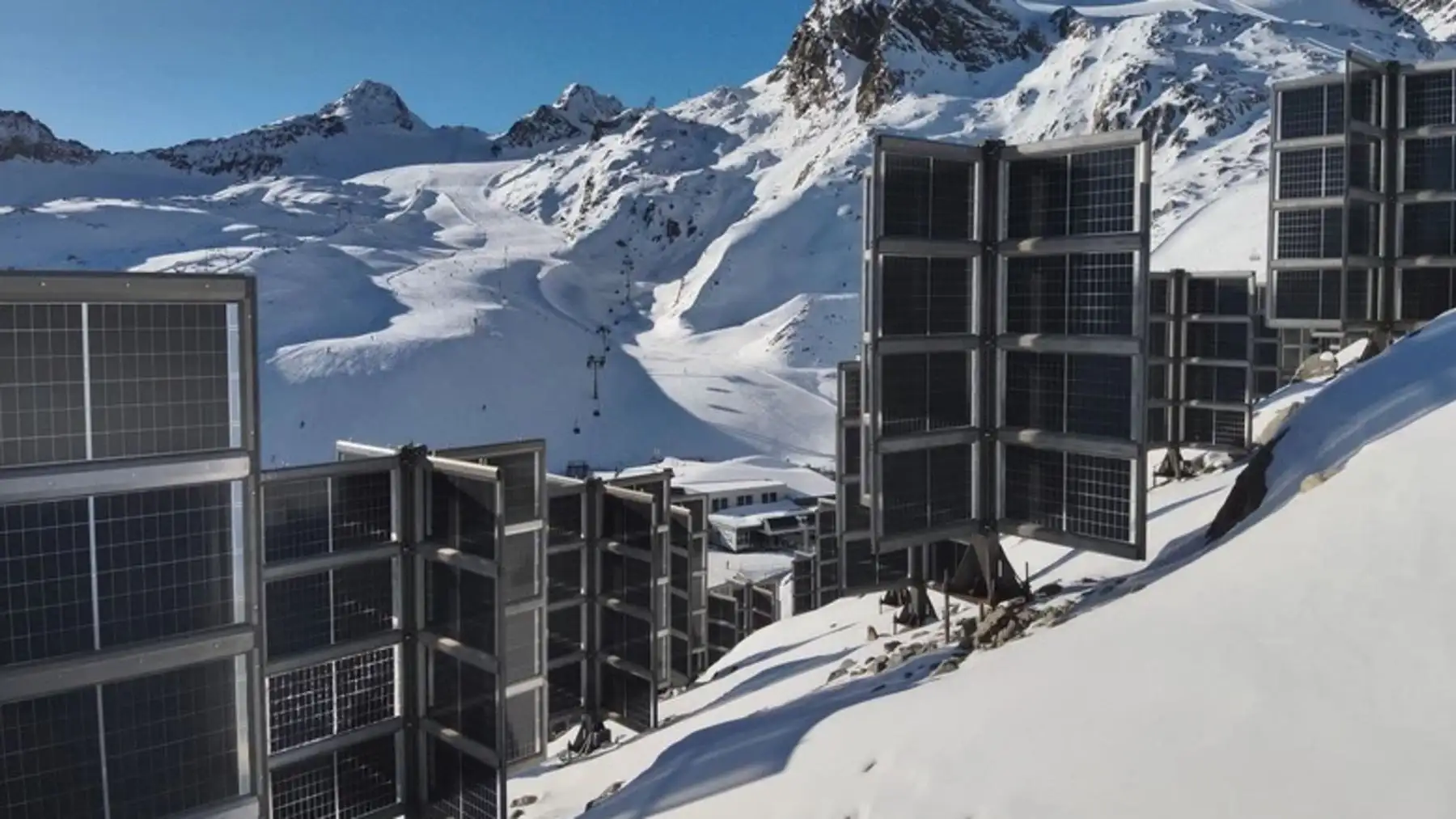
Cross-shaped solar trees on Austria’s Tiefenbach Glacier use wind to clear snow and reflected sunlight to generate electricity
 HELIOPLANT®
New solar designs are unlocking clean energy potential at extreme elevations in Austria.
The nation is heavily reliant on hydropower, yet during freezing winter months, electricity production drops sharply.
Reliable winter power generation is needed, but due to strict climate goals, imported fossil fuels can no longer provide it.
Widespread electric heat pump and electric vehicle adoption, along with expanding data centers and industrial electrification, is straining the grid.
Developers turned to high-altitude alpine regions that offer intense sunlight but first had to overcome harsh conditions.
How do cross-shaped solar trees solve this problem?
How Austria is experiencing increased grid strain and winter power deficits
Austria operates a fleet of 135 major hydroelectric plants and alpine reservoirs.
As the backbone of the nation’s electricity grid, hydropower provides approximately 54% to 67% of the total generation mix.
Seasonal rainfall and snowmelt deliver reliable, clean baseload energy.
Yet during the freezing winter months, hydroelectricity production drops sharply.
Sub-zero conditions lock precipitation into mountain ice and snow.
Run-of-river inflows then decline by more than 50% during peak cold snaps.
Meanwhile, Austria is experiencing major surges in national electricity consumption.
Widespread electric heat pump and electric vehicle adoption, along with expanding data centers and industrial electrification, is straining the grid.
The seasonal gap, combined with rising energy demand, is creating a significant power supply deficit.
To prevent blackouts, Austria usually relies on natural gas and imported electricity during winter.
A continued reliance on fossil fuels directly conflicts with national climate mandates to achieve 100% renewable electricity by 2030.
This makes accelerated green energy deployment urgent.
When standard solar generation fails during winter
Rapid solar power expansion is vital for balancing Austria’s electricity grid.
Photovoltaic arrays complement hydropower by generating clean electricity during the day.
This reduces pressure on mountain reservoirs.
Under Austria’s Renewable Expansion Act, the nation aims to add 11 GW of new solar capacity by 2030.
However, standard solar installations struggle during Austrian winters.
From November through February, low-lying valleys face heavy cloud cover, thick fog, and short daylight hours.
As heavy snowfall increases during the winter months, it buries flat, ground-mounted panels.
This blocks sunlight and stops clean power generation for weeks at a time.
To overcome the challenges of standard installations, developers turned to high-altitude alpine regions.
Above 6,500 feet, mountain peaks sit well above valley fog.
However, the mountain terrain presents extreme conditions that conventional solar racks cannot survive.
That is why Austrian clean-tech company HELIOPLANT created cross-shaped solar trees specifically designed for these harsh landscapes.
Unlock clean energy potential at high elevations
The Austrian Climate and Energy Fund supported this technology due to the distinct benefits offered by high-altitude alpine regions.
These high elevations are well above valley fog and experience intense, uninterrupted winter sunlight.
The cold ambient temperatures also increase photovoltaic efficiency.
Additionally, the surrounding snow reflects extra light onto the panels.
Now, HELIOPLANT’s innovative photovoltaic technology also addresses strong alpine winds, shifting glacier ice, and heavy snow loads.
The pilot system was installed on the Tiefenbach Glacier in Sölden, Austria, at roughly 9,800 feet.
The operational specifications of the cross-shaped solar trees
The elevated installations are anchored directly into the alpine terrain to resist shifting ice and extreme winds.
Aerodynamics help the tree-like structures to stay clear of snow accumulation.
The cross-shaped arms channel winds across the panel surfaces.
This automatically sweeps snow away, eliminating manual clearing.
Double-sided bifacial modules are mounted vertically and at steep angles.
Direct sunlight is captured by the front, while the back absorbs sunlight reflected from the white glacier snow.
These operational advantages have helped the Tiefenbach Glacier installation to deliver peak power output during winter.
From May to October 2026, assembly of the full expansion took place, scaling toward the planned total of 800 units.
Ultimately, the project’s success proves that dual-sided, specialized solar layouts can help Austria bridge its winter power gap sustainably.
Anke Maree is a writer with a clear and engaging editorial style. Her work focuses on making complex topics accessible, informative, and relevant for readers across different areas of interest.
