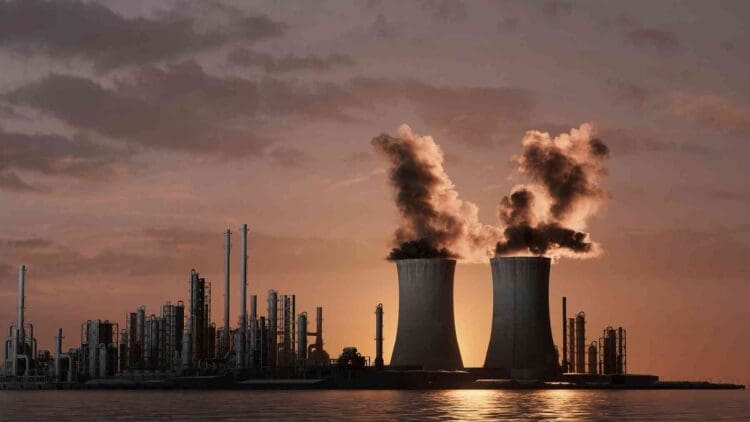

The United States continues to dominate the nuclear energy landscape with no country coming even close to threatening its reign at the top. The nation’s dominance was solidified in the 1970s, and it has continued to be the leading nuclear energy-producing country all the way into the contemporary generation. When a country establishes dominance in the production of a certain energy source, it is incumbent on companies based there to continue executing projects that will enhance its dominance. On that note, Deep Fission expanded its commercial pipeline with customer demand reaching up to 18.5 GW of nuclear capacity.
Analyzing Deep Fission as a leading nuclear energy producer in the U.S.
Deep Fission is an innovative nuclear energy entity that places Small Pressurized Water Reactors (PWRs) a mile underground within standard deep boreholes. As the clean energy transition is fully underway, developers are leaning more into various ways of energy generation that have not been explored in the past.
One of the benefits that contemporary companies get is that they do not need to adapt to the modern ways of energy generation, but rather only need to apply the current strategies.

Deep Fission is well known for its Gravity Nuclear Reactor technology, which combines established pressurized water reactor technology with a novel underground deployment model designed to make construction easier, improve safety, and support scalable commercial deployment.
Reviewing how Deep Fission was able to expand its commercial pipeline
Most energy companies seek to expand their commercial pipeline but this process is not as easy as it may seem. Deep Fission revealed that it has signed Letters of Intent (LOIs) with data centers, co-developers, industrial parks, and strategic partners, amounting to 18.5 gigawatts (GW) of potential generation capacity. This is a massive achievement not just for Deep Fission but for nuclear energy companies as a whole because it shows how much profit there is for them to make from agreements.
With the company only being founded in 2023, it is greatly aware of how huge an achievement the agreement is. Liz Muller, who is the CEO and co-founder of Deep Fission, had the following to say:
“The growing pipeline is a testament to the urgent interest in our mile-deep deployment model. Data center developers and other industrial partners need a solution that can be deployed quickly and then scaled rapidly – and the Gravity Nuclear Reactor is a good fit for those requirements.”
At the moment, Deep Fission is working on progressing its first reactor project at the Great Plains Industrial Park in Parsons, Kansas, as part of the Department of Energy’s Reactor Pilot Program.
Delving deeper into Deep Fission’s current focus in the energy industry
Reports state that Deep Fission has completed the drilling of its first data acquisition borehole to roughly 6,000 feet deep. Its next milestones will show the capability to drill a commercial-scale borehole and then safely deploy a prototype reactor. Deep Fission is focused on delivering reliable, low-carbon baseload power to meet growing electricity demand from utilities, industrial customers, and data centers.
The LOIs that it has signed are non-binding and do not consist of any obligations or commitments to buy electricity, finance projects, construct facilities, grant exclusivity, or deploy a specified number of reactors. This means there is still room for either party to terminate the signed agreements.
Assessing the United States overall nuclear energy landscape in 2026
Deep Fission is still planning to apply for a commercial license with the U.S. Nuclear Regulatory Commission in the first half of 2027. This will be dependent on continued technical progress, financing, regulatory approvals, and other conditions.
As of 2026, the U.S. nuclear landscape consists of 94 operating reactors that generate about 20% of the nation’s overall electricity.
Deep Fission was founded in 2023 by a father-daughter duo of Elizabeth and Richard Muller, with the two aiming to lower deployment costs and enhance reactor safety. It has made massive strides relatively quickly.

Prince is a versatile writer focused on energy, automotive, environmental, and general news topics. He makes complex technical and policy issues clear, engaging, and accessible for a broad audience.