
The International Atomic Energy Agency released a new publicly accessible online tool on June 25, 2026, offering a first-of-its-kind window into the global state of spent nuclear fuel. Called “Spent Fuel Management: The Inventory Status,” it lets users visualize how much spent fuel reactors around the world have produced—and where that fuel currently sits.
IAEA releases spent nuclear fuel tracking tool
The IAEA published “Spent Fuel Management: The Inventory Status” as a freely accessible resource on its website. Anyone with an internet connection can open it, explore the data, and come away with a clearer picture of the global spent nuclear fuel landscape. That kind of open access marks a meaningful shift in how nuclear data reaches the public.
Before this tool existed, assembling a coherent global picture of spent fuel volumes and storage arrangements was genuinely difficult. Data existed, but it was scattered, technical, and rarely presented in a form that non-specialists could use. The new tool changes that by consolidating information within an interactive interface.

The resource covers spent nuclear fuel—commonly abbreviated as SNF—generated by reactors across the world, showing both how much has been produced and how it is currently being managed. Those two questions sit at the center of most public debates about nuclear energy’s long-term footprint.
Why the IAEA developed the tool
Spent nuclear fuel management has long been recognized as one of the nuclear industry’s most persistent challenges—one that policymakers, regulators, and energy planners all grapple with. Yet clear, accessible data on the subject has historically been difficult to compile and even harder to communicate to a general audience.
The information gap is real. Technical reports exist, and national nuclear agencies publish their own figures, but no single easy-to-use resource has ever pulled global data together in one place. That absence has contributed to confusion and, in some cases, to misinformation about how much spent fuel exists and what is actually happening to it.
The IAEA developed this tool specifically to close that gap. By making the data visual and interactive, the agency aims to support evidence-based conversations about nuclear waste management—not only among experts but also among citizens and elected officials who shape energy policy without necessarily holding a technical background.
What the tool shows and how it works
The interactive interface lets users explore SNF inventory data broken down by country and reactor type. That breakdown matters because different reactor designs produce different volumes and types of spent fuel, and storage practices vary significantly from one country to another.
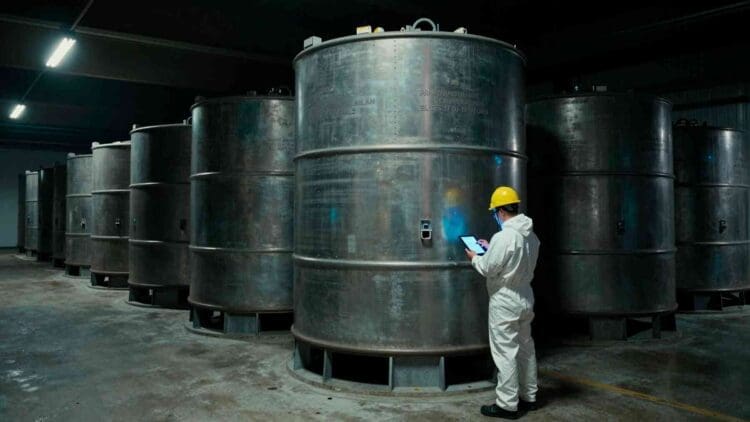
Particularly useful is how the tool distinguishes between the two main forms of spent fuel storage currently in use. Wet storage keeps spent fuel submerged in cooling pools, typically at the reactor site. Dry storage uses sealed casks or vaults after the fuel has cooled sufficiently. Both methods are in widespread use, and the tool makes clear which countries rely on which approach—and to what degree.
The IAEA designed the tool for a broad audience. Researchers can cross-reference national data, policymakers can benchmark their country’s situation against others, and members of the public can get a factual grounding in a topic that tends to generate more heat than light in public discourse.
The broader context of spent nuclear fuel management
Spent nuclear fuel does not become safe quickly. It remains radioactive for thousands of years, which means any storage solution must account for timescales that dwarf recorded human history. That reality underlies every technical and political discussion about what to do with it.
The most widely accepted long-term solution is deep geological disposal—burying high-level waste in stable rock formations far below the surface. As of 2025, no country has yet opened a permanent deep geological repository for high-level nuclear waste. Finland is furthest along, with its Onkalo facility under construction, but it has not yet begun receiving waste.
That gap between the volume of spent fuel accumulating globally and the absence of any permanent disposal site is precisely why the IAEA’s transparency efforts matter. The question of long-term waste management is frequently cited—by critics and supporters of nuclear energy alike—as a key unresolved challenge for the industry. Accessible, accurate data does not resolve that challenge, but it creates a more honest foundation for addressing it.
The timing of the tool’s release is also relevant. Nuclear power capacity is projected to expand in multiple countries over the coming decades, driven by energy security concerns and decarbonization goals. More reactors mean more spent fuel. The IAEA’s new tool contributes to global transparency at a moment when the scale of that challenge is set to grow considerably.
Inventory by country and reactor type
The IAEA’s “Spent Fuel Management: The Inventory Status” tool gives the public, researchers, and policymakers free access to global spent nuclear fuel data for the first time in an interactive format. It breaks down inventory by country and reactor type, distinguishes between wet and dry storage methods, and addresses a longstanding information gap in nuclear waste communication. No permanent disposal site for high-level nuclear waste is yet operational anywhere in the world—making transparent data on current storage arrangements more important than ever.
Kelly is an experienced writer with 15 years of experience exploring the big stories that shape our world, from tech breakthroughs and space exploration to climate, energy, and the fascinating quirks of science. She has a talent for turning complex ideas into sharp, memorable insights that stay with readers long after they’ve finished reading.