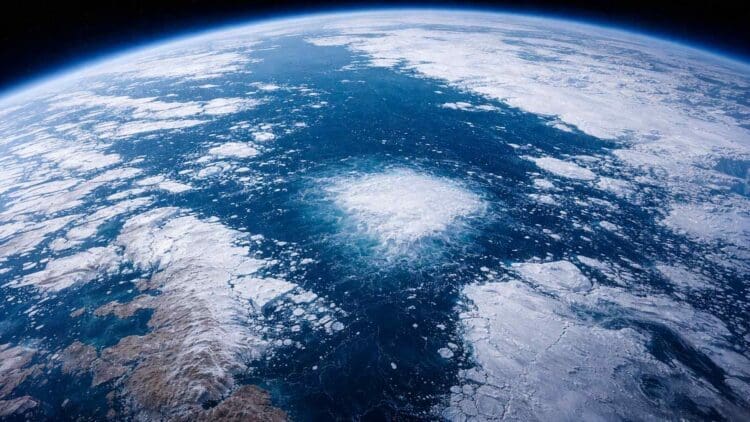

Our planet’s history is unique, yet much remains to be uncovered to understand Earth’s complex workings. However, time does not stand still, and a phenomenon that occurred billions of years ago, twice in fact, is happening again. A new continent is slowly forming, and this time, it is unlikely that the planet will fail again.
It all started with supercontinents
The planet, as seen and known today, looked entirely different compared to nearly four and a half billion years ago. The current number of continents did not exist. Instead, there were several supercontinents, and due to Earth’s complex workings, these supercontinents constantly changed over time, either by assembling or by breaking up.
When we observe the continents as they are today, it is striking that they fit together like a puzzle. Additionally, across different continents, identical rock formations and fossils have been discovered, hinting that Earth’s landmasses once had a different layout. However, this does not mean that this complex phenomenon stopped occurring millions of years ago.


A team of scientists has discovered that Earth tried to form a new continent millions of years ago, but this attempt failed. Now, our planet is attempting this phenomenon once again, but will this attempt be a success?
This would have been a new continent
The geological process that sees continents starting to break away is known as “rifting.” This process is driven by the movement of the planet’s tectonic plates and occurs over the course of millions of years. Some researchers have become increasingly interested in tectonic plate movement, as it plays a key role in the formation of mankind’s “white gold,” or rather, natural hydrogen.
However, others are merely interested in why and how these tectonic plates move, especially after a team of scientists from the University of Derby and Uppsala University discovered why the Davis Strait between Greenland and Canada, which has a width between 200 and 400 miles, had an “oddly thick” seafloor.
In their study published in the scientific journal Gondwana Research, they confirmed it was a “proto-microcontinent” that Earth formed 60 million years ago, all along! This “failed” small continent formed during the rift that separated Greenland and Canada, leading to what is known as a “failed rift zone.” So, while the U.S. is after Greenland and Canada’s resources, these scientists are more interested in this zone, especially as another rift is brewing.
Earth is at it again, slowly but surely
As mentioned, time does not stand still, and evidently, neither do the Earth’s continents. Derby University geophysicist and study co-author, Jordan Phethean, stated the Davis Strait’s failed rift zone is the best place to gain more knowledge about tectonic plate movement, as upper crust features are now factored into the equation as well.
“If we can understand why the plates are moving in the directions that they are, it allows us to understand what’s controlling plate tectonics.” – Phetean
Understanding this phenomenon is crucial, especially now that experts in the field have uncovered that a current continental rifting is underway along the East Africa Rift System, and others predict that another supercontinent will assemble in the future. This means that Earth will have a new ocean (after rifting), and then, after the newly formed supercontinent, the global climate and biodiversity will be altered once again.
Unfortunately, we will not be witnesses to this new planet and its potentially new climate. But we wonder, will the new nations also face the same climate struggles that threaten our very existence today, or will they have entirely new obstacles to overcome? We may not know, but we can only hope for the best.