
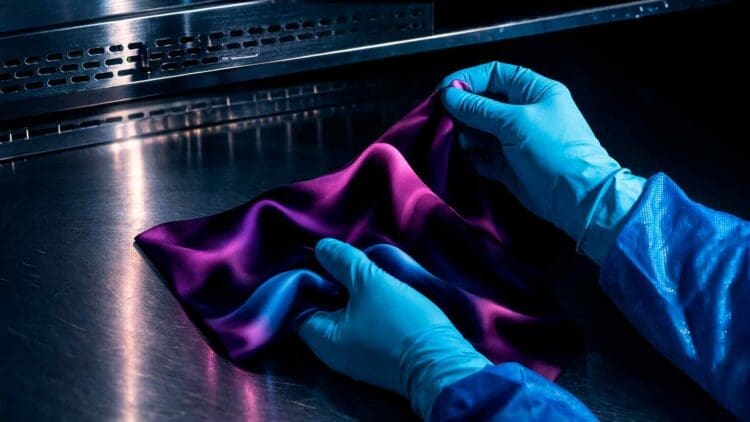

We may no longer have to rely on traditional batteries as a power source.
Clean energy technologies could now get a complete eco-friendly revamp without using critical minerals and with a minimal environmental impact.
In a long-awaited breakthrough, scientists have created a film that instead relies on our bodies as the direct power source.


With a little innovation and development, could this creation end up powering homes in the same way?
How traditional batteries are losing their spark
In the modern world, energy is moving in some of the most unlikely places.
Somewhere, someone is running to the store with a power bank to stay connected.
Civilization is constantly on the move, and yet most are tethered to the wall by a charging cable.
This dependence gradually grew portable energy into a massive global industry. The key to the industry is batteries.
Today, the battery market has significantly expanded to keep up with the world’s insatiable appetite for staying connected.
Interestingly, in 1748, Benjamin Franklin borrowed the term “battery” from the military. The powerful blast of a “battery” of cannons was linked to the energy blast from Franklin’s linked jars.
Unfortunately, that very blast has become a constant, heavy drain on our planet.
While portable power plays a key role at both small and large scales, is it truly worth the cost?
The hidden cost of portable energy scales up
Modern solutions are often linked with bigger modern problems, especially concerning critical minerals.
Batteries require the critical minerals lithium, nickel, and cobalt. These minerals are so high in demand that America had to invest in a mineral “doomsday vault.”
This increases battery prices to record highs. Traditional ones have shorter lifespans, making them more expensive over the long term.
Modern lithium-ion ones present high upfront costs. However, mankind pays the environmental price of batteries long before they ever reach their hands.
While critical minerals are key to the energy transition, their extraction process is resource-intensive. It contributes to:
- Potential soil erosion and local water supply contamination through open-pit mining
- A high global carbon footprint, as most countries rely on imports
- Poor waste management
- Risk of thermal fires
- Risk of toxic leaching
All of this has inspired scientists from UNIST University to explore alternative portable power sources.
Combining thin electric films and bodily heat to light up the world
The UNIST team, led by Professor Sung-Yeon Jang, developed a thin, flexible ionic thermoelectric (TE) film as a viable solution.
The invention consists of tandem films, namely “p-type” that uses protons and “n-type” that uses chloride ions.
When they are linked in ten pairs, they act as tiny generators. When they come into contact with human warmth, 1 volt of power is produced to light up an LED bulb.
This is how a series of tiny, invisible generators powers LEDs
The film comes into contact with skin and detects a small temperature difference between the body and the surrounding air.
A difference as small as 2.7°F causes ions to migrate within the film from the warm side to the cool side. This produces a consistent flow of power.
Presently, these thin films can be attached to the skin or curved surfaces like smart clothing. If the scientists can scale it up, it could one day be the power source behind zero-energy homes.
Its potential in future home-use applications is feasible. Long-term testing showed the material maintained 95% of its performance after two months of continuous operation.
This proves that the future of energy can be equally clean and durable without the hidden costs of batteries.
Energy resilience and self-sustaining homes are no longer a pipe dream. As innovative technologies continue to evolve, the transition to a carbon-free future is becoming easier by the day.



