

Environment 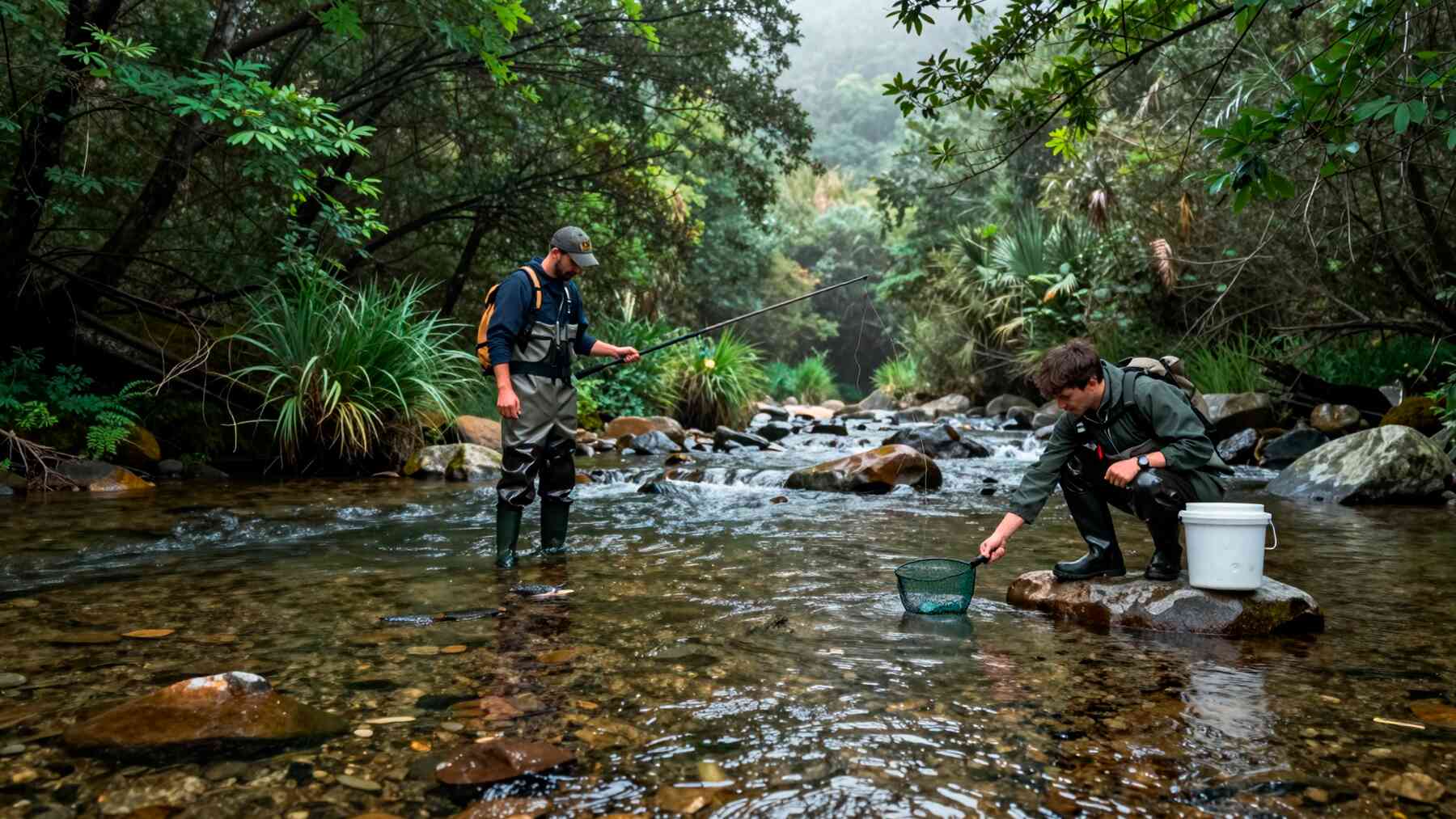 AI-made

Scientists are briefly electrifying rivers to save vanishing fish and their population counts are finally coming into focus
AI-madeIn the Miera River basin in northern Spain, a small team of researchers is wading into clear mountain streams. They are sending brief pulses of electricity into the water.
The scene looks startling, but it’s completely deliberate and carefully controlled. It aims at something most people never think about: finding fish that are quietly disappearing.
The technique is called electrofishing.
Right now, it’s giving scientists their first clear look at two endangered freshwater species.
These fish are difficult to locate, even harder to count, and increasingly at risk.
Why a controlled jolt in the river is actually beneficial
Electrofishing works by generating a localized electrical current in the water. It is strong enough to briefly stun nearby fish, but not strong enough to injure them.
The research team deployed this method across several connected waterways: the Miera River itself, the Tugal stream, and the linked Telyarich and Turkinych waterways. Together, these sites gave researchers a meaningful cross-section of the basin.
Once stunned, fish are netted quickly and placed in oxygenated containers. Each individual is counted and measured before being released back into the same stretch of water. As the researchers put it: “We basically stun them, and then we gently catch them with a net.”
A reasonable question comes up often: Does the current affect fish beyond the target area? It does, but only briefly and within a very limited zone.
That small reach is entirely intentional. The technique disturbs a tight, controlled area so the fish can recover quickly and keep their stress levels minimal.
Two species on the edge
The two fish the team is focused on are the Miro chub and the Southwestern Archmouth Nase.
Both are listed as endangered, living in freshwater systems under mounting pressure. Both are incredibly difficult to study without methods that avoid lethal sampling.
Before any serious protection plan can take shape, researchers need baseline data. They must know where these fish still survive, how many individuals remain, and whether populations are holding steady or shrinking.
Without that foundation, conservation decisions rest entirely on guesswork.
Gathering this kind of information for rare freshwater species is genuinely hard. They are not easy to spot, they do not congregate in predictable places, and traditional survey methods can disturb or kill the very animals you are trying to protect.
Non-lethal techniques like electrofishing exist precisely to close that gap.
There is also a major timing argument here: Intervening while a population is still viable is far less costly—both ecologically and financially—than trying to rebuild one after a total collapse.
What the data can unlock
Field counts and measurements from multiple sites help researchers identify where populations are strongest.
Those strongholds become immediate priorities—places where habitat protection or restoration can have the most immediate impact.
They also reveal which waterways may be deteriorating faster than others.
Fish populations do not exist in isolation. Healthy native fish typically signal healthier rivers overall. It means cleaner water, functioning food webs, and ecosystems that support everything from insects to birds.
When native species disappear from a river basin, broader environmental problems are usually already accumulating underneath.
The connection extends straight to local communities. Cleaner rivers support recreation, tourism, and water quality—benefits that are easy to overlook until they are completely gone.
None of this happens through dramatic, overnight interventions. The fieldwork behind most real conservation decisions is methodical, repetitive, and unglamorous. It means wading through streams, recording measurements, and logging GPS coordinates.
That is what evidence-based protection actually looks like.
Building trust in wildlife research
The comment sections on videos like the one shared by Mossy Earth Field Notes reveal a consistent concern: Are researchers helping these animals, or stressing them unnecessarily?
It is a fair question, and it matters immensely for conservation programs over the long run.
Transparent documentation helps. When teams show exactly what happens—the equipment, the netting, the oxygenated containers, the release—they give the public a way to evaluate the process rather than just react to the scary image of electricity in a river.
Showing the care taken reframes electrofishing from something that sounds harmful into something that functions as a tool of protection.
Public understanding of research methods is not a side issue. Conservation programs depend on sustained support, and that support erodes when people do not trust what scientists are doing or why.
Skepticism, left unaddressed, tends to harden.
As monitoring in the Miera basin continues, the data gathered this summer will likely shape the next phase of work—identifying which sites need intervention first, and what form that intervention should take.
The fish are back in the river. The research, for now, is just beginning.
What happened after researchers electrified rivers? They unlocked the secrets to saving them.
Author Profile
Kelly is an experienced writer with 15 years of experience exploring the big stories that shape our world, from tech breakthroughs and space exploration to climate, energy, and the fascinating quirks of science. She has a talent for turning complex ideas into sharp, memorable insights that stay with readers long after they’ve finished reading.