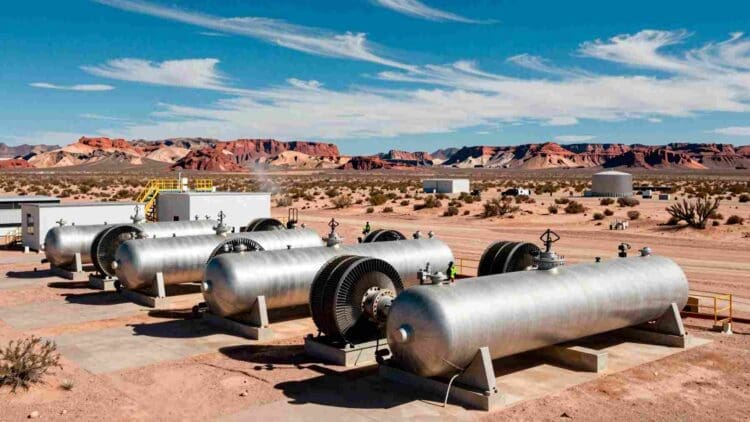

Energy Dome and Salt River Project (SRP) have announced an agreement to deploy a 19 MW, 10-hour CO2-based battery energy storage system at SRP’s Coronado Generating Station in St. Johns, Arizona. The project, expected to come online in 2029, marks a notable step in a broader collaboration that also involves Google, which will co-fund the effort through a cost-sharing arrangement with SRP.
Agreement Details and Project Specifications
The 19 MW system will be sited at SRP’s Coronado Generating Station in St. Johns, Arizona. Under a 20-year tolling agreement, Energy Dome will own and operate the facility while SRP dispatches its output to the grid — a structure that gives SRP access to the storage capacity without taking on ownership responsibilities.
Rated for 10 hours of continuous discharge, the system could power approximately 4,275 homes across that full window. The project is scheduled to come online in 2029.


Why the Project Was Initiated
SRP launched a Request for Proposals for long-duration energy storage pilots in 2024, and Energy Dome was selected through that competitive process. The pressure behind that decision is real: SRP aims to at least double its generating resources by 2035 to keep pace with rising demand across the Phoenix metropolitan area.
Google and SRP already had an existing collaboration focused on advancing non-lithium-ion long-duration energy storage technologies, and this project extends it. Google will contribute funding through a cost-sharing agreement with SRP — making the arrangement a three-party effort rather than a standard bilateral utility deal.
How the CO2 Battery Technology Works
The system relies on a thermomechanical process rather than electrochemical reactions. During charging, grid power compresses CO2 gas into a stored state; when electricity is needed, the CO2 expands through a turbine and generates power that flows back to the grid.
No lithium-ion chemistry is involved, and the process uses readily available materials. Energy Dome states the system is fully dispatchable, meaning operators can call on it when needed rather than waiting on weather conditions. The company also says the technology can be manufactured domestically, which supports supply chain development within the United States.
Effects on Grid Reliability and Energy Storage Portfolio
For SRP, this is primarily a test. The utility wants to observe how CO2 battery technology performs under real Arizona operating conditions — particularly the region’s punishing summer heat — and results from this deployment could shape future procurement decisions.
Independent oversight will come from EPRI, the Electric Power Research Institute, which will monitor performance data throughout the project’s operation. That external review adds credibility well beyond what either party could self-report.
The project is also designed to diversify SRP’s storage portfolio. Most utility-scale battery storage today runs on lithium-ion chemistry, so adding a fundamentally different technology reduces dependence on a single supply chain and gives SRP hands-on experience with an alternative approach. Energy Dome has said the project accelerates its own investment in U.S. supply chain infrastructure.
Background: Growing Demand and Storage Context
SRP serves approximately 1.2 million customers across the greater Phoenix metropolitan area. Sustained population growth has long driven electricity demand in the region, and that pressure is now compounding with new loads from data centers and AI infrastructure — pushing utilities across the Southwest to lock in additional generation and storage capacity well ahead of peak demand periods.
Long-duration energy storage — generally defined as systems capable of discharging for four hours or more — is increasingly viewed as a critical tool for grid reliability. As renewable capacity grows, the grid needs resources that can hold energy for extended periods and release it during evening hours or multi-day low-generation events.
Google’s involvement reflects a broader corporate interest in accelerating non-lithium-ion storage technologies. Lucia Tian, Director of Advanced Energy Technologies at Google, described the project as “an important milestone” in the company’s collaboration with SRP, noting it builds on a long-term partnership with Energy Dome. This is the second project to emerge from that collaboration.
Testing of Alternative Storage Tech
The agreement between Energy Dome and SRP represents a concrete step toward commercial deployment of CO2 battery technology in the United States. The 19 MW, 10-hour system will be co-located at the Coronado Generating Station in St. Johns, Arizona, under a 20-year tolling agreement, with Google co-funding the effort through SRP. EPRI will independently track performance data once the system comes online, expected in 2029. For SRP, the project offers a real-world test of an alternative storage technology as the utility works to meet sharply rising demand across the Phoenix region.
Kelly is an experienced writer with 15 years of experience exploring the big stories that shape our world, from tech breakthroughs and space exploration to climate, energy, and the fascinating quirks of science. She has a talent for turning complex ideas into sharp, memorable insights that stay with readers long after they’ve finished reading.