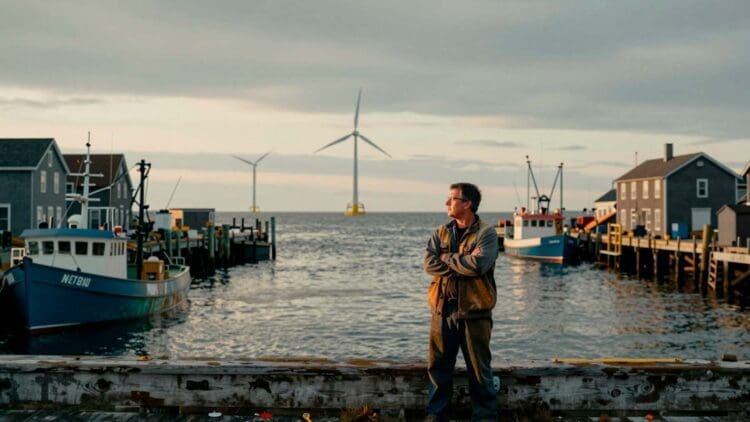

Researchers from Boston University, the University of Rhode Island, and the University of Delaware have published what may be the most comprehensive catalog of its kind: a literature review in Energy Research & Social Science identifying 2,162 indicators used to measure environmental, energy, and climate justice. The study also draws on direct fieldwork in two New England port cities—New Bedford, MA, and New London, CT—where offshore wind development has already reshaped daily life, not always in the ways residents were promised.
Researchers publish first comprehensive catalog of energy justice indicators
The literature review, led by postdoctoral associate Nellie Amosi at BU’s Institute for Global Sustainability (IGS), is the first to collect and present these measurements in a single resource. Guided by IGS director Benjamin Sovacool, the paper catalogs 2,162 indicators drawn from 25 years of academic research on environmental, energy, and climate justice.
Each indicator is classified along three dimensions: complexity (simple vs. complex), data type (quantitative vs. qualitative), and the category of impact it describes—economic, health, or political, among others. The result is an interactive database and structured framework that lets users compare approaches and understand how different metrics capture different dimensions of justice.




“The aim was not to tell users there is one correct way to measure justice,” Amosi said. “Instead, we provided a structured inventory of options showing what metrics already exist, what they measure, and how they differ.”
Study motivated by rapid offshore wind expansion and gaps in community accountability
The research did not emerge in a vacuum. Clean energy deployment is accelerating globally, and in 2025, Science named renewable energy its Breakthrough of the Year after it overtook coal globally. That milestone reflects how quickly new infrastructure is being built—and how urgently communities need tools to assess its local impacts.
No standardized framework existed for measuring whether clean energy transitions were actually delivering justice to the communities they affected. Policymakers, planners, NGOs, and residents were all working without a common vocabulary or a shared set of metrics. By systematizing how justice has been measured across decades of scholarship, the team gives decision-makers something concrete to work with.
Community fieldwork in New Bedford and New London reveals unmet expectations
Alongside the literature review, the research team conducted workshops, interviews, and focus groups in New Bedford, MA, and New London, CT. They partnered with the NAACP’s New London Branch and the Old Bedford Village Development Corp., organizations already deeply involved in port development in their respective cities.
What residents described was a pattern of early optimism followed by disappointment. Many had welcomed offshore wind projects because of promises tied to local hiring, job training, and broader economic investment. “We want the jobs, we want the benefits, we want to be able to train,” said Buddy Andrade, a New Bedford equity activist who helped organize the community meetings.
Those expectations largely went unfulfilled. Development companies frequently brought out-of-state workforces rather than hiring locally—a demographic shift that, Andrade noted, put additional pressure on housing costs. Community members also described being left in the dark about new infrastructure arriving in their neighborhoods, with inadequate communication allowing misinformation to spread.
“There was a lack of understanding of what was happening in their own neighborhood,” said Rebecca Pearl-Martinez, executive director of BU’s IGS.
Catalog reveals analytical gaps, including overreliance on simple economic metrics
The review’s findings go beyond cataloguing—they expose patterns in how justice research has been conducted. Economic indicators dominate the academic literature, while political and health indicators are comparatively underrepresented. That imbalance may reflect data availability as much as deliberate choices, but its consequences are real.
More striking: fewer than 15% of the 2,162 catalogued indicators were classified as “complex,” meaning they draw on multiple variables rather than a single measurement. Amosi described this as a meaningful gap. “If we are leaning more toward the use of just simple indicators, it means that we are not really looking at the integrated, multi-dimensional approaches that help us alleviate these injustices,” she said.
Research team positions catalog as a practical tool for policymakers and communities
The catalog is designed to function as a menu. Researchers can use it to design stronger studies or compare methodologies. Policymakers and planners can select indicators that match their goals, available data, and decision-making scale. Communities, Amosi noted, can use it to translate lived experiences into metrics that institutions are equipped to recognize—a translation that often does not happen without a structured framework to bridge the gap.
Pearl-Martinez said the findings could help New England state governments improve procedures for prioritizing community needs in offshore wind procurement. The collaborative model itself—pairing academic researchers with local organizations—is presented as a template worth replicating, giving residents a stake in the research process rather than simply a role as subjects within it.
Economic promises were broken
The BU-led study offers two distinct contributions. First, it provides the most comprehensive catalog of energy justice indicators assembled to date—a practical resource for anyone working to measure whether clean energy transitions are equitable. Second, the fieldwork documents a concrete case of unmet community expectations, showing how offshore wind development in New Bedford and New London fell short of its economic promises for local residents.
Measuring justice requires better tools. Building those tools requires listening to the people most affected. The catalog is a starting point, not a finish line.
Kelly is an experienced writer with 15 years of experience exploring the big stories that shape our world, from tech breakthroughs and space exploration to climate, energy, and the fascinating quirks of science. She has a talent for turning complex ideas into sharp, memorable insights that stay with readers long after they’ve finished reading.