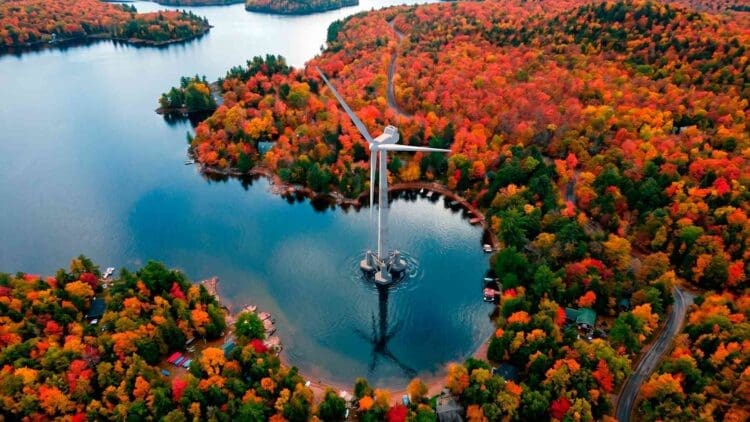

Sometimes, vital wind energy projects are unable to avoid legal obstacles.
The global transition to green power resources is essential to meet strict international climate mandates.
Additionally, utility-scale infrastructure is key to meeting the world’s ever-rising energy demand.


Despite the importance of these developments, many projects frequently face halted construction.
Why do initiatives such as the wind farm on Lake Ontario fail, and what does it mean for the future?
The global push for wind energy infrastructure
International climate mandates are pushing nations to shift toward zero-emission electricity generation.
The Paris Agreement targets are highly ambitious.
To meet them, countries must triple their total renewable energy capacity.
Outdated fossil fuel plants are now increasingly being replaced by variable clean energy worldwide.
However, this major transition requires an unprecedented expansion of utility-scale projects.
The primary anchor for this is wind power.
Recently, global wind capacity surpassed 1,300 gigawatts. It now generates over 11% of the world’s electricity.
The ability to operate through the night and during peak winter seasons makes this resource indispensable.
For grid planners, the reliability of wind power becomes fundamental to meet surging industrial electricity demand.
Consequently, shifting wind developments offshore secures the source as a premium clean energy asset.
Yet, several developers still face major hurdles before a project can be successfully deployed.
Often, many wind initiatives never see the light of day.
Clean grid demands and the Lake Ontario opportunity
Approximately 75% of Canada’s primary energy supply relies on oil and gas.
To meet the nation’s emission reduction goals, Canada requires massive amounts of new clean power.
The country has some of the world’s largest untapped wind resources.
Yet, its domestic green power market is heavily concentrated on land.
For coastal and lakeside provinces, shifting wind to aquatic territories is key to meeting rising electricity demands.
Water-based wind projects offer Canada a direct path toward high-yield, large-scale infrastructure.
The US-based developer Windstream Energy was specifically attracted to this gap in the market.
The company planned to construct the Wolfe Island Shoals project directly in Lake Ontario.
The lake’s northeastern waters offer powerful, consistent wind speeds.
Additionally, the planned site is located near major transmission hubs, ensuring efficient power connection.
Despite the benefits, reports by the Global Arbitration Review highlight that the company ended up in a major legal battle.
Freezing the freshwater wind farm in Canada
While lakes are traditionally used for hydropower, Lake Ontario’s bed is perfect for wind power.
It offers a sprawling, open layout capable of installing dozens of high-capacity turbines.
This overcomes the hurdle of acquiring acreage from multiple private landowners.
The project aimed to supply nearly 300 MW of clean electricity directly to the provincial grid.
Lake Ontario became a highly lucrative, multi-billion-dollar investment frontier.
But in 2011, the Ontario government issued a moratorium, cancelling the project entirely.
A massive, long-running international legal battle
The case was escalated to an international courtroom.
The company sued Canada under NAFTA Chapter 11. It argued that the political freeze destroyed the economic value of its Canadian investment.
In 2016, the international trade tribunal issued the first major ruling. The conclusion was that Canada breached its treaty obligations with unfair and inequitable treatment.
Canada had to pay CAD 28 million in damages and legal costs.
In 2020, the long-running battle ended after Ontario permanently cancelled the project.
Windstream Energy quickly launched a second, multi-million-dollar NAFTA lawsuit against Canada.
However, these new claims were dismissed by an international tribunal. The panel ruled that the main arguments had already been litigated in 2016.
Furthermore, the USMCA treaty replaced NAFTA. This meant the company no longer held valid legacy legal protection.
This legal dispute proves that wind developers face major obstacles that can significantly slow capacity growth.
Disclaimer: Our coverage of events affecting companies is purely informative and descriptive. Under no circumstances does it seek to promote an opinion or create a trend, nor can it be taken as investment advice or a recommendation of any kind.
Anke Maree is a writer with a clear and engaging editorial style. Her work focuses on making complex topics accessible, informative, and relevant for readers across different areas of interest.