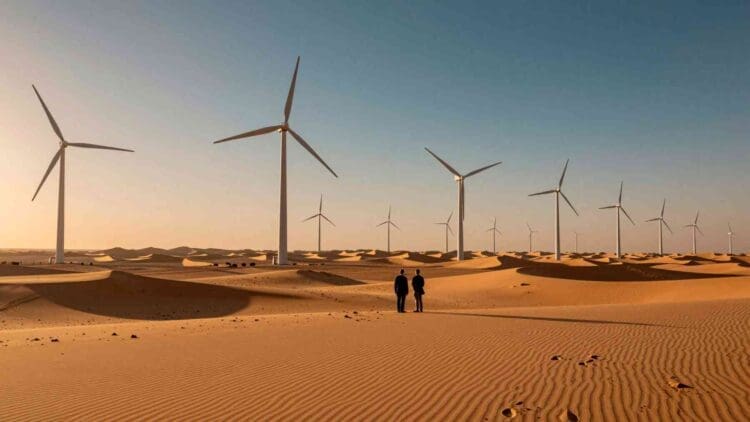

Envision Energy and AMEA Power have finalized an agreement to develop the Amunet II wind project in Egypt — a 500 MW facility that would bring Envision’s total installed wind capacity in the country to 1 GW. The deal was announced at the Africa Energy Forum 2026, marking the second major collaboration between the Shanghai-based green technology company and Dubai-headquartered renewable energy developer AMEA Power on Egyptian soil.
Agreement finalized at Africa Energy Forum 2026
The Africa Energy Forum 2026 served as the backdrop for the announcement, where Envision Energy confirmed its agreement with AMEA Power for the Amunet II project. The forum draws developers, financiers, and policymakers focused on accelerating energy investment across the continent — a fitting venue for a deal of this scale.
Amunet II is the second utility-scale wind project the two companies are developing together in Egypt. That continuity carries weight, signaling the partnership has moved well beyond a single transaction and toward something closer to a repeatable development model.

Kane Xu, Senior Vice President of Envision Energy, was direct about what the deal represents. “The project demonstrates the scalability of our partnership model and the value of global collaboration in advancing the energy transition,” he said. “Today, Egypt is increasingly playing a key role in the global energy transition.” His remarks positioned the agreement not simply as a bilateral deal but as part of a deliberate strategic direction for the company across Africa.
Why the two companies chose to collaborate again
The decision to partner a second time reflects what each company brings. Envision Energy, founded in 2007 and headquartered in Shanghai, focuses on smart wind turbines, battery energy storage systems, and green hydrogen solutions — technical depth that makes it a natural fit for large-scale wind development. AMEA Power, based in Dubai, brings regional relationships and on-the-ground operational experience across Africa that Envision does not replicate on its own.
Together, they share the financial exposure that comes with projects at this scale. Large renewable energy facilities require substantial upfront capital, and absorbing that risk alone rarely makes sense. A partnership structure distributes it while combining strengths neither organization fully owns independently.
What the project means for Egypt’s energy capacity
The numbers are straightforward. Once Amunet II reaches completion, Envision’s combined installed wind capacity in Egypt will stand at 1 GW—placing the company among the most significant contributors to the country’s renewable energy buildout.
Egypt currently ranks second in Africa for installed wind energy capacity, behind South Africa and ahead of Morocco. That position reflects sustained investment in regulatory frameworks, grid infrastructure, and geographic assessment over many years. The country’s wind corridors — particularly along the Red Sea coast — offer consistent, high-quality resources that keep drawing international developers back.
Industry observers expect Amunet II to be followed by additional projects. The partnership has now shown twice that it can move from agreement to execution at scale, and that kind of track record tends to attract further investment while opening doors across the region.
Prior track record: The Ras Ghareb 500 MW wind plant
The groundwork for Amunet II was laid in June 2025, when AMEA Power commissioned a 500 MW wind power plant in Ras Ghareb, Egypt. At the time, it became the largest wind farm in Africa — a milestone that demonstrated what this partnership could actually deliver.
Envision Energy supplied the turbines for Ras Ghareb, giving both companies direct experience working through procurement, installation, and commissioning side by side. By the time Amunet II was announced, neither company was approaching the work as a new relationship.
Ras Ghareb also strengthened investor confidence in the bankability of large-scale wind development across the region. When a 500 MW facility reaches commercial operation on schedule, it tells lenders and equity investors that the risk profile is manageable — and that confidence carries forward into financing conditions for whatever comes next.
Egypt’s position in Africa’s wind energy landscape
Wind energy development across Africa is not evenly distributed. South Africa, Egypt, and Morocco account for the majority of the continent’s installed capacity, and all three offer established regulatory environments, existing grid infrastructure, and geographic conditions suited to utility-scale projects. That concentration makes them the most attractive markets for international developers.
Egypt’s appeal extends beyond its wind resources. The government has set renewable energy targets as part of its broader energy strategy, and international developers increasingly identify the country as a priority market. Policy support, physical geography, and a demonstrated record of project delivery give Egypt a clear advantage over many competing destinations.
The Envision-AMEA partnership may not stop at Amunet II. Both companies have signaled, through their actions and public statements, that the model they have built in Egypt could extend to other markets across the continent.
Total capacity in Egypt will reach 1 GW
The Amunet II agreement marks a concrete step forward for renewable energy development in Egypt. Envision Energy and AMEA Power have formalized plans for a second 500 MW wind project, building directly on the Ras Ghareb facility commissioned in 2025. Once complete, Envision’s total wind capacity in Egypt will reach 1 GW. Egypt holds the second-largest installed wind capacity in Africa, and the Envision-AMEA partnership positions both companies to play a sustained role in the country’s—and potentially the continent’s—ongoing energy transition.
Kelly is an experienced writer with 15 years of experience exploring the big stories that shape our world, from tech breakthroughs and space exploration to climate, energy, and the fascinating quirks of science. She has a talent for turning complex ideas into sharp, memorable insights that stay with readers long after they’ve finished reading.