
This renewable energy technology is a true vision.
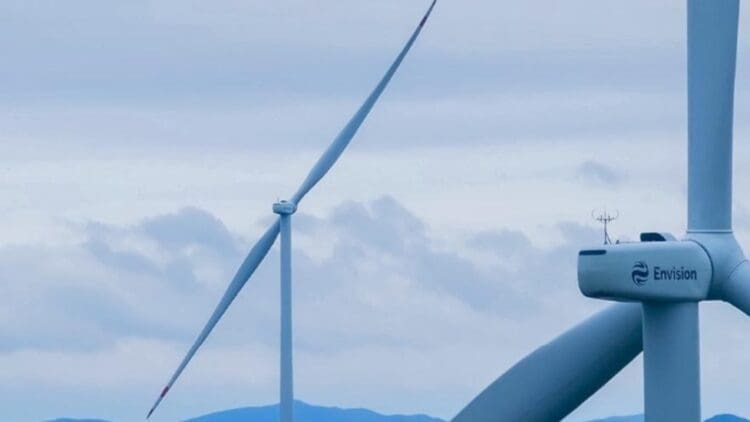
In a historical turn of events, a wind turbine has generated significant power with only two blades. The initial thought of a turbine with one less blade may have seemed absurd, but the numbers do not lie.
A decade of research and development led to its potential as the next-generation technology.
Will it finally become the new norm in the wind industry?
The long journey towards one less blade
Wind energy is pivotal to the global transition to clean energy, being among the top two in installed capacity.
The conventional design of the technology behind the energy source has always been ambivalent. Nonetheless, across the world, there are several wind farms with turbines looming over the land.
The scale is one reason for the technology’s ambivalence.
The production and transportation costs of wind turbines are excessively high, especially considering their blades. While this is the main obstacle, others include their impact on birds and bats, and visual impact.
That is why the Chinese company Envision Energy started dabbling with two-blade turbines years ago. Manufacturing a turbine with one less blade solves the main obstacle of conventional designs.
However, the design has presented challenges of its own. It took years of development and research on the prototype.
Now, it seems the next-generation design could finally be ready for the world.
Two-blade wind turbine: The next generation
Envision Energy’s impact on the wind industry globally has been significant. It has contributed to and supported several wind farms, including the 1GW Mirny wind farm in Central Asia.
Now, the company has taken responsibility for overcoming the challenges of two-blade wind turbines.
Some of these challenges included, but were not necessarily limited to:
- Lower efficiency and torque
- Unstable structure
- High vibration and noise levels
- Increased component wear and tear
- High maintenance costs
- Lower lifespan
To solve these problems, the company turned to its Model X Onshore platform.
Model X has served as the framework for several new technologies developed by Envision Energy. Now, the modular two-blade turbine with the double-fed induction generator (DFIG) technology is turning heads for all the right reasons.
Its performance in the field has proven that it could soon become the new norm in the wind industry.
It could become the new norm in the industry
The benefits of Envision Energy’s two-blade design go beyond practicality.
The design underwent months of in-depth testing and two years of field tests at Envision Energy’s Smart Wind Power Verification Center. Its installation is easier due to its reduced weight, saving costs on transportation and installation.
However, its performance and efficiency are what made the next-generation technology stand out.
Its impressive achievements include:
- Continued stable operation for more than 500 days
- 99.3% availability rate
- An average uninterrupted operation time of 2,444 hours
- Full power production for 3,048 hours annually
As Envision Energy and GES partner to expand Europe’s wind industry, perhaps two-blade turbine installations could expand as well. During a press statement, Envision Energy’s Lu Yimin said the following:
“By overcoming technical challenges that have long existed in two-blade designs, such as excessive system vibration and load imbalance, we have proven that two-blade turbines can now be commercially reliable. This once again redefines wind energy innovations.”
It has been a defining moment for the company and the industry alike. The wind turbine design has the potential to increase accessibility to affordable, efficient renewable energy in remote regions.
Not only that, but it will also be vital to the global transition to clean energy solutions. We are thus one step closer to achieving net-zero.
China plans to add 120GW of new wind capacity annually. Will this technology become the nation’s new norm?