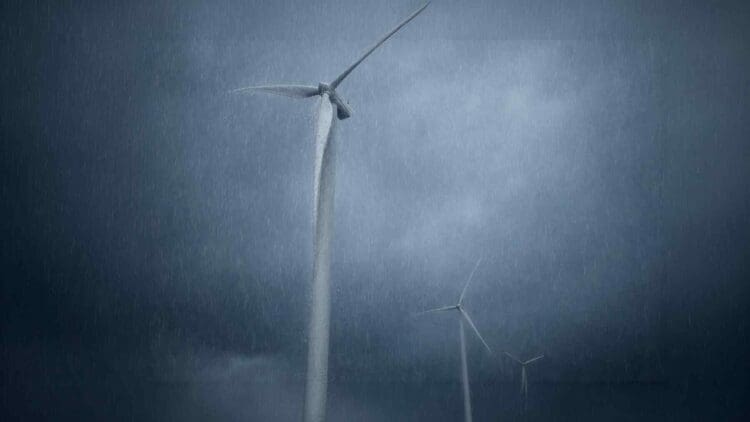

It is wind turbines versus nature in a compelling, silent battle that started closer to the factory than we thought.
Whether high above the plains or far over the ocean, the technology is left vulnerable in the open.
Without proper reinforcements, rain will continue to bombard one of the most important components.



As the storm rages on, what will help the technology withstand the weight of even the smallest droplet?
How wind turbine durability plays a role in power efficiency
Today, the global power grid is facing significant pressure.
Electricity demands are surging, and the existing infrastructure is becoming outdated.
The integration of renewable energy technologies is slow and complex, but once on the frontlines, their role is integral.
Among the most reliable and resourceful additions is wind power. Wind turbines have truly become cornerstones of modern grid stability.
These towering giants are designed to withstand the test of time and the most extreme environmental conditions.
That means maintaining a “factory-perfect” state is key to ensuring the uninterrupted flow of clean power to the grid.
The operators are not the only ones who will feel the blow of compromised efficiency.
Urban regions and major cities will be left to deal with unbalanced loads. This is why it is vital that these giants can withstand the environment’s physical demands.
If not, we will no longer be able to forecast energy yields.
Keeping a watchful eye on the turbine giants
To prevent the worst-case scenarios, engineers and researchers are actively serving as the “medics” on the frontier.
Careful monitoring is necessary to track the moment performance drops. This way, they can ensure that turbines meet or even exceed their 30-year lifetime warranty limits.
One of the most vital combat accessories of a wind turbine is its blades. Experts must guard the high-velocity perimeter to ensure continued operation, despite the lethal rotation physics.
A 100-meter blade’s tip slices through the air with speeds nearing 180 mph.
At such velocities, the relationship between the air and the blade must remain smooth to ensure typical operation.
However, varying weather conditions can significantly impact blade rotation and, by extension, durability.
With the weather predicted to take a turn for the worse in some regions, mechanical resilience is now highly crucial.
This is particularly true, as rain has been identified as blades’ worst enemy.
The “David and Goliath” of wind energy
Just like wind turbines have an impact on nature, nature’s rain has an impact on wind turbines.
One single drop of rain may not appear to do much damage.
However, during a storm, the combined impact of rain striking a blade rotating at 180 mph is powerful.
It has been found that this impact is similar to the abrasive force of an industrial power-washer.
Eventually, raindrops “sand down” the blades, causing Leading Edge Erosion (LEE). This process removes the protective finish from blades, exposing the fiberglass underneath to the elements.
The “armor systems” to counterattack the rain and LEE
Durable, pre-formed covers are used as shields for blades’ perimeters. These covers are called LEP shells, but are extremely heavy.
High-performance epoxies and gel tactical coats can be added during manufacturing to absorb high-speed collisions’ energy.
Specialized, cost-effective LEP tape layers can be retrofitted to older turbines already on the frontlines.
Rain is apparently the David to the turbine Goliaths, battling silently on the frontier.
While there may be ways to improve the “armor” of wind turbines, they all still present flaws.
This means the sharpest blade eventually becomes blunted by the force of raindrops. This raises the question whether these giants would be best suited without any rotating blades at all.