
Offshore wind farms have been running on “best guesses” and a new study finally put those guesses to the test
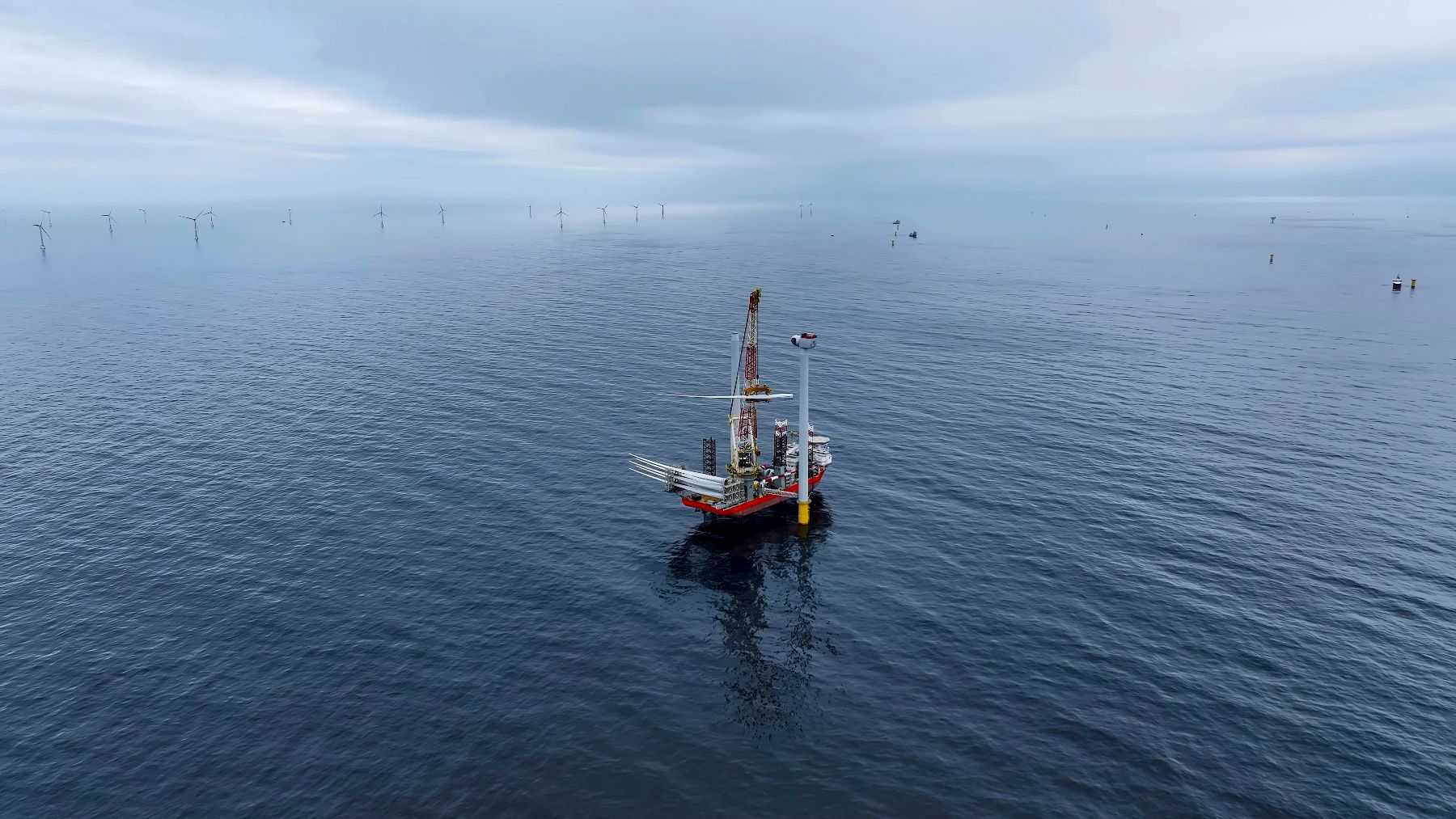
The North Sea is on track to host 300 gigawatts of offshore wind capacity by 2050 — enough to power much of Europe.
Planning every new farm in that buildout depends on software models that predict how much energy a site will actually produce. Those models must simulate how turbines extract momentum from the wind and cast long shadows of slower air across neighboring farms, potentially costing developers millions in lost yield.
Until now, the accuracy of the turbine physics embedded in the widely used WRF weather model had never been checked against years of real production data from multiple offshore wind farms at once.
Wake effects between neighboring farms are well documented — after the Rødsand II wind farm came online, the nearby Nysted farm saw a measurable drop in output.
Why offshore wind models matter more than ever
The North Sea is already crowded, and it’s about to get much more so. EU targets call for 120 GW of offshore wind capacity by 2030 and 300 GW by 2050.
At that density, every new farm will sit in the shadow of several others, and the energy lost to those shadows carries real financial consequences. Wake effects between neighboring farms are well documented — after the Rødsand II wind farm came online, the nearby Nysted farm saw a measurable drop in output.
You can’t anticipate that kind of loss through measurement alone, because the upstream farm doesn’t exist yet when you’re planning the downstream one. Models have to fill that gap. The stakes are high enough that operators have gone to court over them — legal disputes in the UK over so-called “wind theft” show how much money can hinge on wake modeling accuracy.
Yet the mesoscale weather models used to simulate these interactions had never been comprehensively validated against real multi-farm production data.
A 4.5-year experiment using real turbine data
To close that gap, researchers ran WRF continuously for 4.5 years — from July 2017 through December 2021 — over the German Bight, one of the most wind-farm-dense stretches of ocean in the world. Seven different wind farm parameterizations were tested at two grid resolutions: 2 km and a finer 0.67 km.
The benchmark was SCADA data — minute-by-minute power output records from turbine control systems — drawn from six real offshore wind farms, each contributing at least two years of records.
Those SCADA records required careful preparation. Periods of curtailment, maintenance downtime, and abnormal operation were flagged and reconstructed to represent 100% availability, keeping uncertainty in energy yield estimates below 0.5% per farm. After preliminary screening, three parameterizations moved into detailed analysis: the original Fitch scheme (Fitch-O), a physics-corrected variant called Fitch-pAIM, and the Explicit Wake Parameterization (EWP).
What the models got right — and where they diverged
At the broadest level, all parameterizations performed reasonably well — total energy yield estimates fell within ±5% of the SCADA figures. That range sounds acceptable until you consider the billions of euros riding on those numbers. WRF itself systematically underestimated mean wind speed by about 0.25 m/s, translating to roughly a 3% underestimate in gross energy yield — a bias in the background model rather than the turbine physics.
Only Fitch-pAIM correctly reproduced the power curve for undisturbed turbines. Fitch-O and EWP both underestimated power output by ignoring local induction effects — the way a turbine’s own presence slows the wind just upstream of its rotor. Grid resolution mattered too. At the finer 0.67 km setting, estimated energy yield dropped across all three parameterizations, as fewer turbines per cell exposed stronger internal wake losses that coarser grids had averaged away.
Wakes inside and between farms: a mixed picture
For internal wakes, Fitch-O and Fitch-pAIM both performed well at fine resolution. EWP consistently produced wakes that were too weak, likely because its design spreads extracted momentum vertically from the start, pushing the wind speed deficit away from hub height. One limitation proved universal: none of the models could reproduce the sharp power drop from the first to the second turbine row when turbines are perfectly aligned — a fundamental constraint of grid-cell averaging in mesoscale models.
All three parameterizations captured the sensitivity of wake losses to boundary layer height. Under stable, low boundary layer conditions, simulated wake losses were stronger, consistent with SCADA observations. External wakes — one farm’s effect on a distant neighbor — were well reproduced by all three, which makes physical sense. Far from their source, wakes are shaped more by the shared planetary boundary layer scheme than by the specific turbine parameterization.
Fitch-pAIM emerges as the most reliable choice — with caveats
The study’s clearest practical finding is that Fitch-pAIM outperforms the alternatives when grid resolution is fine enough to place individual turbines in separate cells. Its physics-derived correction for free-stream wind speed lets it use the power curve as the manufacturer intended. That advantage comes with a caveat: at coarser resolutions, the induction correction can amplify incorrectly, producing cases where downstream turbines appeared to generate more power than the front row — a physically implausible outcome.
The broader message concerns appropriate use. Mesoscale wind farm parameterizations suit annual energy production estimates at the farm scale, but they’re not a substitute for engineering wake models when turbine-level layout decisions are at stake. As larger turbines and denser clusters define the next generation of offshore wind, these models will need retesting. The German Bight study sets a new standard for how that validation should be done: multi-year, multi-farm, with carefully cleaned production data.
Reference: Sengers, B. A. M., Vollmer, L., and Dörenkämper, M.: Validating wind farm parameterizations with offshore SCADA data, Wind Energ. Sci., 11, 4179–4203, https://doi.org/10.5194/wes-11-4179-2026, 2026.
Daniel García is an Editor-in-Chief with strong expertise in structural work and engineering principles. He combines this technical foundation with deep knowledge of energy, spatial design, and emerging technologies, bringing a forward-thinking and analytical approach to editorial leadership.
