
From a bird, to a plane, to flying wind power! In China, innovation and sustainability have taken flight – literally! This latest innovation has already undergone its first sky-based testing. The results were not what was expected, and may even reshape the global perspective of wind turbines. But first, it must overcome a few obstacles. Will this concept truly take off commercially, or will it become a castle in the sky?
Seeking innovative alternatives for clean power
In a race against time, renewable energy solutions have been key to solving global climate change challenges. Worldwide, mega-projects are proudly generating clean power while testing the course of time. However, at some point, these projects will require complementary clean power sources or even complete alternatives. Wind power has always been a great renewable solution, whether complementary or not.
However, not all nations have the required space to expand this valuable resource. For some, its power output may not be enough to meet demands. This has led several experts in the field to think outside the box to find feasible solutions. The Chinese have proven that they are top dogs when it comes to thinking outside the box. Instead of finding a new resource altogether, a Chinese energy company has sought a new space for wind power.

The answer? Giving wind turbines wings. This design could become a true savior.
Flying wind power: A true test of limitations
China has explored all possible means of expanding wind capacity over the years. Innovations included everything from traditional onshore wind turbines to offshore and floating installations. Now, a not-so-new concept is being tested and tried, namely, flying wind power. Some have been dabbling with the potential of giant wind kites that operate at 16,000 feet high in the sky.
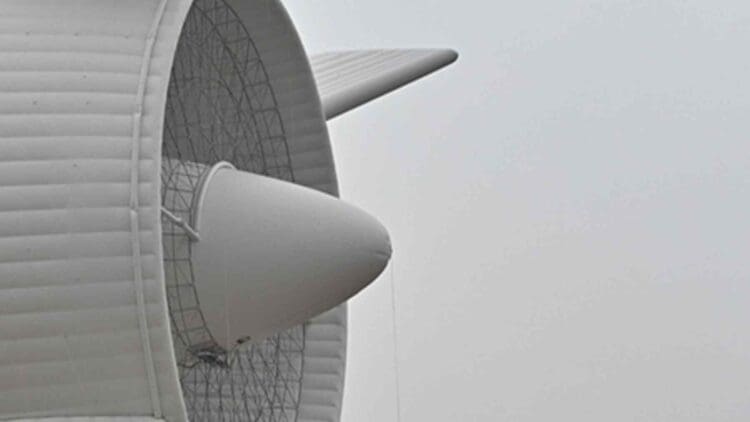
The innovators at Beijing Linyi Yunchuan Energy Technology, on the other hand, have developed a turbine known as the S2000 Stratosphere Airborne Wind Energy System (SAWES). The S2000 not only tests the limits of flying wind power, but also the limits of gravity and design. Its exterior design resembles that of a blimp, and it stays afloat thanks to helium.
This enables it to fly up to nearly 6,560 feet, despite its dimensions. The S2000 is 196 feet long, 131 feet wide, and high. It also recently passed its first test.
Passing the test with flying colors
Unlike other prototypes that never got the chance to spread their wings after testing, there is hope for the S2000. The flying, helium-filled wind turbine passed its first test with flying colors. The test flight took place on January 5, 2026, in Yibin, Sichuan. During the flight, the S2000, with its 12 turbines, produced 385 kWh of wind power at a maximum height.
The result does not come as a complete surprise, as the S2000 SAWES has a capacity of 3 MW. While the testing may have been successful, further testing will be performed. This is necessitated due to safety concerns for other aircraft regarding the S2000’s tether cable. Long-term durability and maintenance must also be analyzed to determine commercial viability.
Nonetheless, this technology opens new doors to great potential applications. According to Weng Hanke from Linyi Yunchuan Energy Technology,
“One is for off-grid settings like border outposts, where it can serve as a relatively stable conventional energy source.”
So far, everything is going according to plan, and the team is excited for what’s in store for the future. Should it be commercially scaled, it could serve as a clean alternative for countries with limited land. The flying wind power could also be useful for countries where offshore installations are not an option. It may have been crazy at first, but now 3MW wind turbines at 6,500 feet prove the sky is the limit.