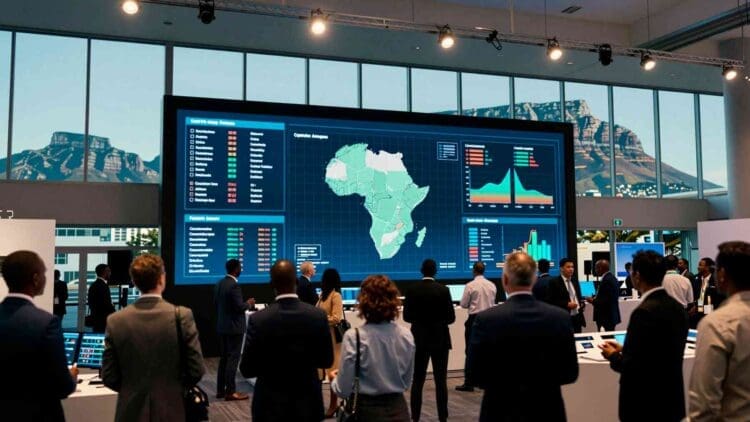

At the Africa Energy Forum in Cape Town on June 17, 2026, GE Vernova put its full portfolio on display—power generation, grid stability, and AI-driven emissions management—all tied to one goal: making Africa’s industrial growth targets actually work in practice.
The centerpiece was CERius™, an AI-powered decarbonization platform built as a practical tool for African industries dealing with tightening international carbon standards.
GE Vernova presents integrated energy portfolio in Cape Town
The Africa Energy Forum runs under the theme “Building Africa’s Industrialized Future,” and GE Vernova structured its Cape Town appearance around exactly that. The company showcased technologies across four tracks: power generation, grid electrification, digital decarbonization, and long-term infrastructure partnership.

The stated goal is straightforward. Energy should be a reliable, affordable, and sustainable foundation for Africa’s economic transformation—not just a utility service but an industrial enabler. That distinction carries real weight when a continent is simultaneously scaling manufacturing, agriculture, and export sectors.
GE Vernova also leaned on its history. Over 125 years of collaboration across Africa position the company as a long-term partner with established infrastructure relationships—not a newcomer arriving with a pitch deck.
Why GE Vernova is targeting Africa’s energy and industrial needs
Africa’s industrialization is accelerating, and that creates a specific energy challenge. It’s not just about adding megawatts—it’s about making sure grids handle load reliably and that the power feeding factories meets the emissions standards export customers actually require.
Many African nations are already scaling renewable energy capacity. Renewables introduce grid variability, though, and variability creates reliability risks. That tension between clean energy ambition and grid stability is the core problem GE Vernova is positioning itself to solve. The EU’s Carbon Border Adjustment Mechanism (CBAM) is reshaping how African exports get priced at the same time, meaning exporters without auditable, real-time emissions data now face direct tariff exposure—which is driving demand for exactly the software-driven monitoring GE Vernova brought to Cape Town.
CERius™ AI platform validated at Tunisian power plant
The most concrete proof point GE Vernova presented was a real-world pilot. Tunisia’s state utility, STEG, tested CERius™ at the Sousse B power plant, and the results were solid enough to anchor the company’s entire digital pitch.
CERius™ combines artificial intelligence, advanced analytics, and digital twin technology to manage emissions in real time. Rather than relying on hardware-heavy monitoring infrastructure, it builds a software-driven framework that produces auditable emissions data continuously. Validation at Sousse B confirmed high consistency in emissions monitoring, and STEG estimates that switching to this approach could cut related investment and maintenance costs by up to 50%—a meaningful figure for a state utility managing aging infrastructure. The platform also gives STEG traceable, CBAM-compliant data to support its strategy of exporting electricity to Europe.
New whitepaper draws grid-stability lessons from Spain’s 2025 blackout
GE Vernova released a whitepaper titled Spain’s 2025 Blackout Experience: Grid Firming Needs for Developing Power Systems with High-Renewable Penetration—using a recent European grid failure as a direct lesson for African infrastructure planning.
The core argument: future grids need to be engineered for resilience, not just energy delivery capacity. Adding renewable generation without addressing stability risks the kind of cascading failure Spain experienced.
Aeroderivative gas turbines, synchronous condensers, and advanced power electronics are recommended to maintain frequency and voltage stability as renewable penetration increases. African planners are advised to prioritize these from the start rather than retrofitting later. A companion whitepaper—Ensuring Power System Stability in an Evolving Electrical Grid—maps a broader modernization roadmap for systems navigating the renewable transition.
GE Vernova’s role in Africa’s energy sector and broader context
GE Vernova (NYSE: GEV) is headquartered in Cambridge, Massachusetts, and employs roughly 85,000 people across about 100 countries. Its African presence spans power generation, transmission, and distribution, built over more than 125 years on the continent.
Joseph Anis, President and CEO of GE Vernova’s Gas Power business for Europe, Middle East, and Africa, kept the Cape Town message grounded. “Building Africa’s industrial future starts with getting the fundamentals right: power that is reliable, sustainable, and ready to scale,” he said, describing the company’s goal as delivering a complete toolkit — from AI-driven decarbonization to grid-stabilizing hardware — in partnership with African leaders.
A few things stand out from the forum. CERius™ offers a validated, cost-reducing path to CBAM-compliant emissions monitoring. The Spain blackout whitepaper gives planners a concrete grid-resilience framework. And GE Vernova is presenting generation, grid, and digital capabilities as an interconnected solution—not a menu of standalone products.
Kelly is an experienced writer with 15 years of experience exploring the big stories that shape our world, from tech breakthroughs and space exploration to climate, energy, and the fascinating quirks of science. She has a talent for turning complex ideas into sharp, memorable insights that stay with readers long after they’ve finished reading.