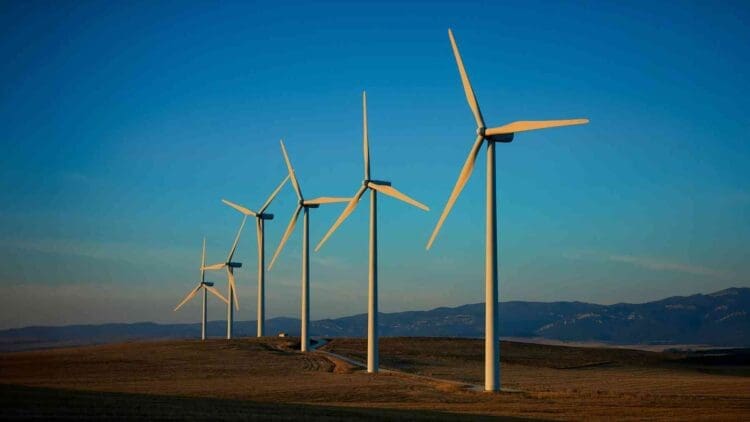

There is tremendous excitement in the wind energy industry as companies are gaining the freedom to break barriers and execute the most outlandish initiatives. Interestingly, there are a number of companies that have assumed the leadership role and are pursuing projects in a wide range of countries. China and the United States remain the leading wind energy-producing nations, but the European landscape is advancing rapidly as it seeks to reach its decarbonization targets. GE Vernova recently won a 100 MW India wind order for a new 3.8 MW Turbine.
GE Vernova maintains strong momentum in wind energy initiatives
One of the most interesting aspects of the energy industry as a whole is that when a company is able to offer something unique, it has the opportunity to offer that unique service within different countries. GE Vernova is an independent energy company that officially launched in 2024.
The company’s main focus is on the global energy transition, as it combines power generation, renewable energy, and digital technology to speed up decarbonization and electrification.


India’s wind energy sector received major positive news as GE Vernova secured a 100 MW wind turbine order from Powerica Limited for the Botad Wind Farm in Gujarat. The agreement reflects the first deployment of GE Vernova’s new 3.8 MW–154m onshore wind turbine in the Indian market.
Reviewing the overall importance of GE Vernova’s 100 MW India wind order
The project has received a massive amount of attention because it emphasizes the company’s growing commitment to local manufacturing and renewable energy development in one of the world’s fastest-growing clean energy markets.
India is currently seeking to greatly enhance its renewable energy capacity by 2030, meaning the agreement puts both companies in a position to play an important role in the country’s energy transition.
The details of the deal demand the supply and installation of 28 GE Vernova 3.8 MW–154m wind turbines at the Botad Wind Farm in Gujarat. The project is a reflection of the Indian debut of the company’s latest workhorse turbine, which has been a worthy addition. It is an upgraded version of the company’s 3.6 MW platform designed to deliver greater efficiency and reliability.
GE Vernova revealed that the turbine has been specifically designed to meet the wind conditions of the Indian environment. Among its advanced features is a projected 30-year operational lifespan, enhanced lightning protection systems, and the company’s AI-powered digital blade certification technology. This design is one that also fosters quicker installation through the use of tubular steel towers and 650-ton crane capabilities.
Analyzing the strategic collaboration expected to strengthen Gujarat
According to reports, deliveries for the project are expected to start during the fourth quarter of 2026, emphasizing GE Vernova’s efforts to expand its portfolio in the country’s continuously growing wind sector. The Botad Wind Farm is the fourth wind energy project developed together by GE Vernova and Powerica.
The partnership has contributed to the advancement of renewable generation capacity in Gujarat, which is one of India’s leading states for wind energy development. In this instance, Powerica secured the project’s power purchase agreement through an auction organized by Gujarat Urja Vikas Nigam Limited (GUVNL).
India has set a target of 500 GW of non-fossil fuel energy capacity by 2030, including 100 GW from wind power. This target is achievable if it continues at this rate.
Reviewing the anticipated future of India’s wind energy industry
Deepak Maloo, who is the General Manager of GE Vernova’s Onshore Wind business in India, said:
“We are thrilled to partner with Powerica once again as we launch our newest workhorse turbine in India. The 3.8 MW–154m turbine is designed to deliver efficiency, reliability, and strong performance for India’s wind conditions.”
A noteworthy aspect of the announcement is GE Vernova’s focus on local manufacturing. The turbines for the Botad project will be produced at the company’s Pune manufacturing facility. It is anticipated to support up to 1,500 MW of annual production capacity when fully operational.
Prince is a versatile writer focused on energy, automotive, environmental, and general news topics. He makes complex technical and policy issues clear, engaging, and accessible for a broad audience.