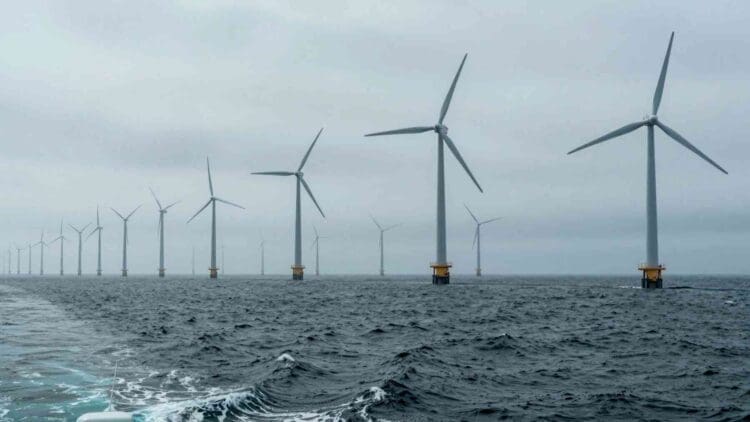

Mesoscale weather models are the standard tool for estimating energy losses from wind turbine wakes at offshore wind farms — but a new peer-reviewed study suggests they may be missing a critical piece of the picture.
Published in Wind Energy Science, the study compared mesoscale Weather Research and Forecasting simulations against large-eddy simulations for three planned US East Coast offshore wind farms: South Fork, Sunrise Wind, and Revolution Wind, off Rhode Island and Massachusetts. The two modeling approaches told notably different stories about how much power turbines lose to wake effects from their neighbors.
Study Compares Two Modeling Approaches for Offshore Wind Wake Effects
Researchers at the National Renewable Energy Laboratory and collaborating institutions ran two types of simulations for three planned offshore wind farms: mesoscale Weather Research and Forecasting (WRF) runs using the Fitch wind farm parameterization, and large-domain large-eddy simulations (LES) capable of resolving individual turbine wakes. South Fork, Sunrise Wind, and Revolution Wind together carry a combined nameplate capacity of 1.76 GW.




The geographic setup made these sites well suited for the comparison. South Fork and Revolution Wind sit roughly 10 km downwind of Sunrise Wind under prevailing southwesterly winds — conditions where both cluster wakes and internal wakes could be studied together. The former describes one farm’s wake reaching a neighbor; the latter, one turbine’s wake reaching the next within the same farm.
The team simulated five representative days spanning a range of atmospheric stability conditions. Seventy-five percent of cases showed stable stratification across the turbine rotor layer, consistent with the long-term climatology of the US East Coast — making the results broadly representative of typical operating conditions in the region.
Mesoscale Models Accurately Track Broad Wake Velocity Deficits
On the question of overall wind speed deficits, the mesoscale simulations held up well. Mean root-mean-square errors between WRF and LES results were near 5 percent downstream of both single and multiple wind farm clusters — a level of agreement consistent with earlier validation studies using aircraft measurements and lidar data in the North Sea. WRF also correctly captured how atmospheric stability shapes wake behavior: under unstable conditions, wakes were narrower and recovered more quickly, while under stable conditions they broadened and persisted over longer distances.
Agreement was strongest for long-range cluster wakes, where individual turbine wakes had already merged into a broader farm-level signal before reaching downstream arrays. There, the coarse grid of the mesoscale model was not a limiting factor.
Internal Wake Power Losses Are Substantially Underestimated by Mesoscale Models
The picture changed sharply when researchers examined power losses within individual wind farms. Under aligned wind conditions — where turbines sit directly downwind of upstream neighbors — LES showed that internally waked turbines generated on average 37 percent less power than front-row turbines. The mesoscale simulations estimated only a 16 percent reduction.
The gap has a clear structural cause. The mesoscale domain uses a grid spacing of approximately 1 km, while the turbine rotor diameter is about 206 m. The model simply cannot resolve the narrow velocity deficit a single turbine leaves behind — the feature that drives within-farm power losses. A second source of error compounds this: numerical discretization of turbine positions displaces them by up to 700 m from their actual locations, altering effective alignment directions between turbines and introducing additional uncertainty into internal wake estimates.
Under stable atmospheric conditions, individual turbine wakes persist over long distances and reach downstream turbines within the same farm. The mesoscale model, unable to resolve the localized velocity deficits responsible, fails to capture the phenomenon.
Combined Wake Loss Estimates Can Be Accurate in Some Wind Direction Sectors
Despite the internal wake gap, the mesoscale simulations produced accurate combined wake loss estimates — internal plus cluster — for certain wind direction sectors. The reason is partial error cancellation: in some sectors the model overestimates losses, in others it underestimates them, and those errors offset each other in the aggregate.
For wind directions between approximately 215 and 230 degrees, the difference in average normalized power between LES and mesoscale simulations stayed within 2 percentage points. Around 225 degrees — where turbines are most closely aligned at roughly 13 rotor diameters of spacing — the mesoscale model underestimated combined power losses by about 4 percentage points.
The authors caution that this error cancellation is specific to the layout and wind rose of the farms studied. It cannot be assumed to hold elsewhere, and the direction and magnitude of the errors will likely shift with different grid spacings or turbine arrangements.
Findings Carry Implications for US Offshore Wind Energy Planning
Mesoscale simulations are the standard tool in both industry practice and federal assessments for estimating energy production and wake losses across the US East Coast, where more than 40 GW of offshore wind capacity is planned or under development. Prior mesoscale studies of that region estimated combined internal and cluster wake losses ranging from 11 to 38 percent.
The new study suggests those figures may carry significant uncertainty, particularly for internally waked turbines. Importantly, the limitations identified are not specific to offshore conditions — they stem from grid resolution and apply equally to onshore mesoscale wind modeling.
The authors recommend future research into hybrid approaches pairing the long-range propagation strengths of mesoscale models with the turbine-level resolution of LES. The study’s data and code are publicly available via Zenodo. For planners and developers relying on mesoscale outputs to project energy yields, the core takeaway is straightforward: these models may reliably capture broad wake patterns across a wind farm cluster, but they are likely to underestimate the power losses that closely spaced turbines impose on each other.