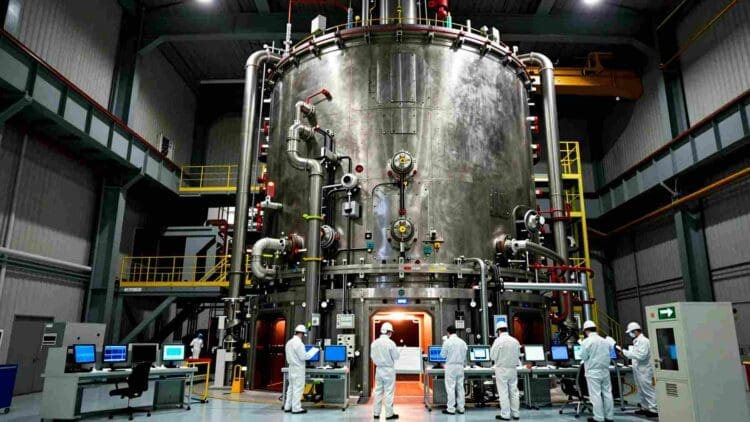

General Atomics and the Department of Energy have launched the development of design concepts for a facility that would do something fusion research has never done before: test a full-scale breeding blanket.
The Fusion Blanket Component Test Facility, or BCTF, represents a first attempt to validate one of fusion power’s most critical — and least tested — components at the scale an actual power plant would require.
General Atomics and DOE Announce BCTF Design Development
Following their joint announcement, General Atomics is working with the Department of Energy to develop design concepts for the BCTF, which will be sited at GA’s Magnet Technologies Center in San Diego, California. The collaboration marks a formal step toward building infrastructure the fusion industry has long needed but never had.




The facility’s core purpose is straightforward: test full-scale fusion breeding blankets under conditions that reflect what a real power plant would demand. No facility capable of doing that currently exists anywhere in the world. That gap is not a minor oversight — it is one of the most significant unresolved challenges standing between fusion science and fusion power.
The project is backed by an initial seed investment from the DOE provided to the Idaho National Laboratory (INL) to launch preconceptual designs, alongside collaborators including Kyoto Fusioneering and UC San Diego.
Why Full-Scale Breeding Blanket Testing Is Needed
Breeding blankets sit at the heart of any practical fusion reactor, serving two functions: generating tritium fuel from lithium using neutrons produced in the fusion reaction and capturing the heat energy released by that reaction to drive electricity generation. Without a functioning blanket, a fusion plant cannot sustain itself or produce usable power.
Despite decades of research, blanket technology has never been tested at the scale a commercial reactor would require. Smaller experiments and component-level studies have advanced the field, but they cannot replicate the fluid dynamics and immense thermal environment a blanket faces inside an operating plant. The BCTF is designed to close this gap by validating heat removal and fuel extraction at scale before advancing to full neutron testing.
Testing at full scale lets engineers validate performance, identify failure modes, and gather the safety data that regulators and developers will need before any commercial deployment moves forward. Without it, blanket designs remain theoretical—promising on paper, unproven in practice.
Implications for Fusion Energy Commercialization
The BCTF would not serve a single company’s reactor program. It is positioned as shared infrastructure, available to multiple fusion developers who need validated blanket performance data before advancing their own designs. That model could accelerate progress across the broader fusion industry rather than forcing each program to duplicate expensive testing efforts independently.
Dr. Anantha Krishnan, senior vice president of the General Atomics Energy Group, put the significance plainly. “No one has tested a fusion blanket at this scale,” he said. “While there are more research and development challenges ahead, a BCTF brings us closer to turning fusion from proven science into practical, sustainable power.”
That acknowledgment of remaining challenges matters. The BCTF is not a claim that fusion is solved—it is a recognition that the pathway to commercial fusion requires infrastructure that does not yet exist and that building it is now a concrete goal rather than a distant aspiration.
Background: The Role of Breeding Blankets in Fusion Power
Tritium, the fuel most fusion reactor designs rely on, is extraordinarily scarce in nature. Unlike deuterium, which can be extracted from seawater, tritium must be produced artificially. Breeding blankets accomplish this by surrounding the fusion plasma with lithium-containing materials. When neutrons from the fusion reaction strike the lithium, tritium is produced, collected, and cycled back into the reactor as fuel.
This self-sustaining fuel cycle is what makes fusion potentially viable as a long-term energy source. A reactor that consumes tritium without producing it would quickly exhaust available global supplies.
Blankets also convert the kinetic energy of fusion neutrons into heat, driving a turbine to generate electricity — the same basic process used in conventional thermal power plants. The blanket functions, in effect, as both a fuel factory and a power converter. Research into blanket technology has continued for decades across multiple countries, but reactor-relevant testing at full scale has stayed out of reach because no facility has been built to provide the necessary environment.
The BCTF announcement reflects a broader shift in the U.S. fusion landscape. Private investment has grown substantially in recent years, and public-private collaborations like this one signal that the industry is moving from long-range research toward the engineering and validation work that commercial deployment will actually require.
Kelly is an experienced writer with 15 years of experience exploring the big stories that shape our world, from tech breakthroughs and space exploration to climate, energy, and the fascinating quirks of science. She has a talent for turning complex ideas into sharp, memorable insights that stay with readers long after they’ve finished reading.