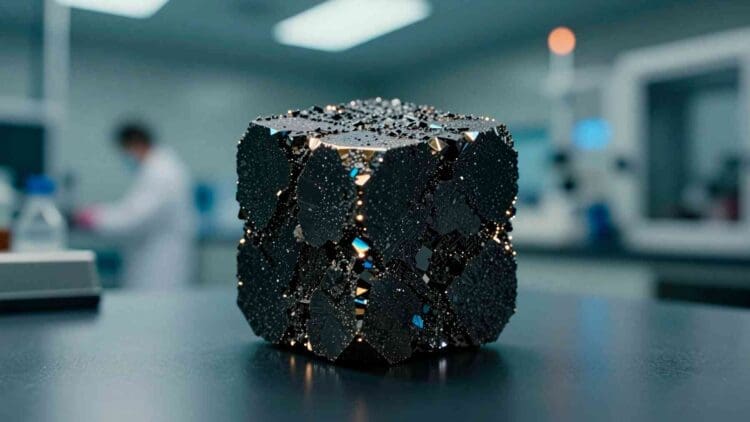

Scientists at Idaho National Laboratory have published findings identifying an unusual quantum behavior in plutonium hexaboride, a compound known as PuB6. The material, they report, is neither a conventional conductor nor a standard insulator—its surface readily carries electrical current while its interior blocks it entirely.
INL Scientists Identify Unusual Quantum State in PuB6
Researchers at Idaho National Laboratory confirmed in June 2026 that plutonium hexaboride exhibits a topological Kondo insulating state. INL is a U.S. Department of Energy national laboratory and one of the country’s primary centers for nuclear materials research.
The discovery places PuB6 in a narrow category of quantum materials whose electrical behavior resists simple classification. It marks a meaningful advance in understanding how plutonium—one of the most complex elements on the periodic table—behaves at the quantum level.




What the Topological Kondo Insulating State Means
A topological Kondo insulating state is a quantum property in which a material’s surface conducts electricity while its interior blocks it entirely. That dual behavior sets it apart from conventional conductors, which carry current throughout, and from insulators, which block it everywhere without exception.
The Kondo effect arises from interactions between freely moving conduction electrons and localized magnetic moments in heavy-element compounds—interactions that produce unusual low-temperature behavior and have occupied physicists for decades.
PuB6 is classified as a heavy-fermion compound. In such materials, electrons behave as though they carry far greater mass than normal, a consequence of strong correlations between electrons as they move through the material’s structure. That increased effective mass reflects how much the electrons slow down and interact, not any change in physical weight. Together with the Kondo effect, these conditions create the basis for topological surface conduction: the interior stays insulating while the surface hosts conducting states protected by the material’s underlying quantum symmetry.
Implications for Nuclear Materials Science and Quantum Research
Adding PuB6 to the topological Kondo insulator category matters beyond plutonium research. This class of materials draws broad interest across physics and materials science, and its membership is still growing.
Topological insulators have attracted considerable attention for potential roles in quantum computing and advanced electronics. Their surface states, protected by quantum symmetry, are considered promising for building robust, low-error quantum systems—and extending that class to an actinide compound opens genuinely new research directions.
For nuclear materials science, understanding the quantum behavior of actinide compounds like plutonium could inform approaches to future nuclear fuel development and materials characterization. Plutonium’s electronic structure directly shapes its physical and chemical properties, with relevance in both energy and defense contexts.
Background on Plutonium Research at INL
Idaho National Laboratory is among the very few U.S. facilities authorized to conduct research on plutonium-bearing materials. That authorization, combined with specialized infrastructure, makes INL one of the rare institutions capable of performing fundamental quantum characterization on actinide compounds.
Plutonium’s electronic structure has long made it exceptionally difficult to study. It sits near the boundary between localized and delocalized electron behavior, causing its properties to shift substantially depending on temperature, pressure, and chemical environment — a complexity that has challenged researchers for generations.
The concept of a topological Kondo insulator was established largely through earlier work on samarium hexaboride, or SmB6, a lanthanide compound that served as the foundational model for this quantum state. PuB6 is a heavier actinide analog: structurally similar, but involving an element with considerably more intricate electron interactions. The INL findings contribute to a broader effort to map quantum properties systematically across the actinide series, with each new data point helping researchers build a more complete picture of how heavy elements behave under quantum conditions.
New Fundamental Quantum Findings
The central finding is direct: plutonium hexaboride displays a topological Kondo insulating state, meaning its surface conducts electricity while its interior does not. This behavior stems from the Kondo effect and the heavy-fermion nature of PuB6’s electrons.
The discovery expands the known membership of topological Kondo insulators and connects actinide physics to the wider field of topological materials research. It also demonstrates something worth noting—that fundamental quantum findings can emerge from materials historically examined for nuclear applications rather than basic science.
INL’s work, announced in June 2026, adds a significant data point to the ongoing effort to understand how quantum mechanics operates in some of the heaviest and most complex elements known.
Kelly is an experienced writer with 15 years of experience exploring the big stories that shape our world, from tech breakthroughs and space exploration to climate, energy, and the fascinating quirks of science. She has a talent for turning complex ideas into sharp, memorable insights that stay with readers long after they’ve finished reading.