
Harbour Energy just kicked off gas production from its Dvalin North project in the Norwegian Sea—ahead of schedule and under its NOK 8 billion budget. The company announced the milestone alongside partners Petoro and DNO, adding another entry to its growing track record on the Norwegian Continental Shelf.
The field sits roughly 168 miles (270 kilometers) north of Kristiansund, and all three of its subsea wells are already producing.
Dvalin North begins production with all three wells online
Harbour Energy confirmed a safe start-up at Dvalin North, with all three subsea wells actively online from day one. That last part matters—it’s not just technically running; it’s already at full well capacity.

The project is structured as a three-well subsea tie-back, connecting to existing infrastructure through Harbour-operated Dvalin field. That setup kept complexity down and costs in check. Coming in under budget while also beating the schedule isn’t luck — it reflects solid project management and a well-defined development concept from the very start.
For Harbour Energy, this is more than one good result. It fits a pattern the company has been building on the Norwegian Continental Shelf: lean on existing infrastructure, keep capital discipline tight, and deliver. Dvalin North is the latest proof that the model works.
Why Dvalin North was developed: Resource utilization and infrastructure efficiency
The logic here is straightforward — make the most of what’s already in place. By tying back to the Dvalin field and routing production through the Heidrun platform, the project sidesteps the cost and complexity of building new surface infrastructure from scratch. In offshore development, that’s a big deal. New platforms carry enormous capital commitments.
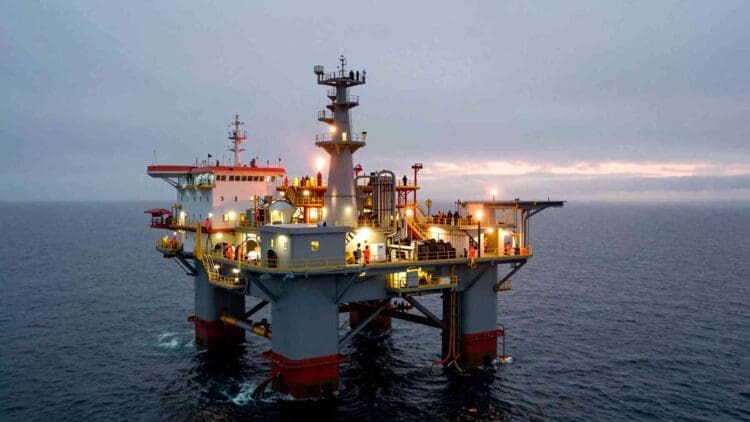
Heidrun is a semi-submersible production platform already operating in the Norwegian Sea. Tapping its spare capacity is exactly what makes satellite fields like this one economically viable, and the development solution was specifically noted for enabling better use of Heidrun’s existing capacity.
From Heidrun, gas travels through the Polarled pipeline to the Nyhamna processing plant on the Norwegian coast, then on to market. Polarled is a major export artery in Norway’s gas infrastructure network. Dvalin North plugs into an established supply chain rather than building a new one—a meaningful distinction when you’re weighing project economics.
Norway’s Ministry of Energy approved the Plan for Development and Operations in 2023. From that approval to first gas in roughly two years, and ahead of schedule, is a strong execution timeline by any standard.
Impact: New gas volumes for Europe and value creation in Norway
The numbers give you a sense of the field’s scale. Dvalin North is expected to produce approximately 84 million barrels of oil equivalent over its life—the vast majority being gas, specifically 13.4 GSm³ of rich gas on a gross basis. That’s a substantial volume, especially given where European energy markets currently stand.
Since the supply disruptions that followed Russia’s invasion of Ukraine, Europe has been working hard to diversify and secure its gas supply. Norwegian gas has become a bigger part of that picture, and projects like Dvalin North add new volumes through a proven, reliable export route.
Michael Zechner, Managing Director of Harbour Energy in Norway, put it plainly: the project “adds new gas volumes that support reliable energy supply to Europe while also creating value in Norway.” That dual focus — European supply security alongside domestic value creation — reflects the broader case Norway has made for continued development on its continental shelf.
Dvalin North is also the second of five Harbour Energy projects in Norway scheduled to come online in 2026. A lot of activity packed into a single year, and it signals a broader growth strategy at work — not just a string of one-off wins.
Project background: Partners, location, and investment
Harbour Energy operates Dvalin North with a 55% working interest. Petoro — the Norwegian state’s direct financial interest vehicle — holds 35%, and DNO, the Oslo-listed operator, holds the remaining 10%. That structure is typical on the Norwegian Continental Shelf, where Petoro regularly takes a stake as a way for the state to participate directly in upstream production.
The field sits around 168 miles (270 kilometers) north of Kristiansund in the Norwegian Sea, a mature but still productive basin that keeps generating new developments alongside its longer-established fields. The subsea tie-back model fits that environment well—existing infrastructure is close enough to make satellite developments commercially attractive.
Total project investment came in at NOK 8 billion. Delivering under that figure while also beating the schedule makes Dvalin North a solid benchmark for how Harbour Energy approaches development work in Norway.
The bigger picture is the company’s infrastructure-led strategy on the Norwegian Continental Shelf—a deliberate focus on projects that leverage existing assets rather than requiring greenfield builds. Dvalin North is a clean example of that template: a new gas resource unlocked through smart use of installed capacity and disciplined execution across every phase. With four more Norwegian projects still expected online this year, there’s no sign of the pace letting up.
Kelly is an experienced writer with 15 years of experience exploring the big stories that shape our world, from tech breakthroughs and space exploration to climate, energy, and the fascinating quirks of science. She has a talent for turning complex ideas into sharp, memorable insights that stay with readers long after they’ve finished reading.