
Hawaii is testing a giant buoy as heavy as five blue whales that turns ocean waves into electricity
 Credits: Ocean Energy
A giant buoy is making wave energy a commercially feasible source of electricity.
The world’s oceans are filled with high volumes of predictable energy waiting to be harnessed.
Yet, the harsh marine environment has made it difficult to tap this green source.
Her work focuses on making complex topics accessible, informative, and relevant for readers across different areas of interest.
Climate mandates have tightened while global electricity consumption has risen.
Will this massive floating device achieve commercial validation and help the world be powered by reliable, clean energy?
How the ocean is full of the promise of power
Earth’s vast seas are full of hidden phenomena, waiting to be uncovered.
Many researchers study the unique beings deep within the water.
However, others are more focused on the ocean as an excellent source of uninterrupted, renewable energy.
Its power is locked within the mesmerising movements of the waves on the open water.
The movement can create a far more predictable source of electricity than solar or wind infrastructure.
For coastal regions, tapping into this giant resource can unlock energy independence.
Isolated communities inshore are typically more challenging to decarbonize.
For them, the shift toward green power is usually slow due to geographic, economic, and climate challenges.
By advancing wave energy technology, these regions could finally break their reliance on fossil fuels for good.
Yet, past projects have often failed due to the inability to withstand the harsh marine environment.
Oceanic challenges that have stalled commercial progress
For decades, harnessing marine power has been the greatest challenge for engineers.
The open ocean is a highly hostile environment for any mechanical infrastructure.
Metal frames and delicate systems are vulnerable to rapid corrosion triggered by saltwater.
Marine wildlife, such as barnacles, often attaches to underwater surfaces. Over time, the biological buildup jams moving components and weighs down floating hulls.
Furthermore, the frequency of extreme ocean storms is rising.
As a result, the storms generate violent forces and fifty-foot swells that easily destroy heavy machinery.
Machines can be designed to withstand these harsh conditions, but fabrication becomes immensely expensive.
Regular maintenance by specialized diving teams drives up expenses further.
High technical risks and low investment have stalled the industry for years.
Fortunately, Ocean Energy Europe believes that OceanEnergy’s giant buoy is key to addressing both.
The $12 million project was co-funded by the Department of Energy.
A big buoy to generate even greater energy
Wave energy converters in the ocean may not be a new technology, but none are as durable as the OE35.
It measures 125 x 59 feet and is over five stories tall. It was built in a shipyard in Oregon.
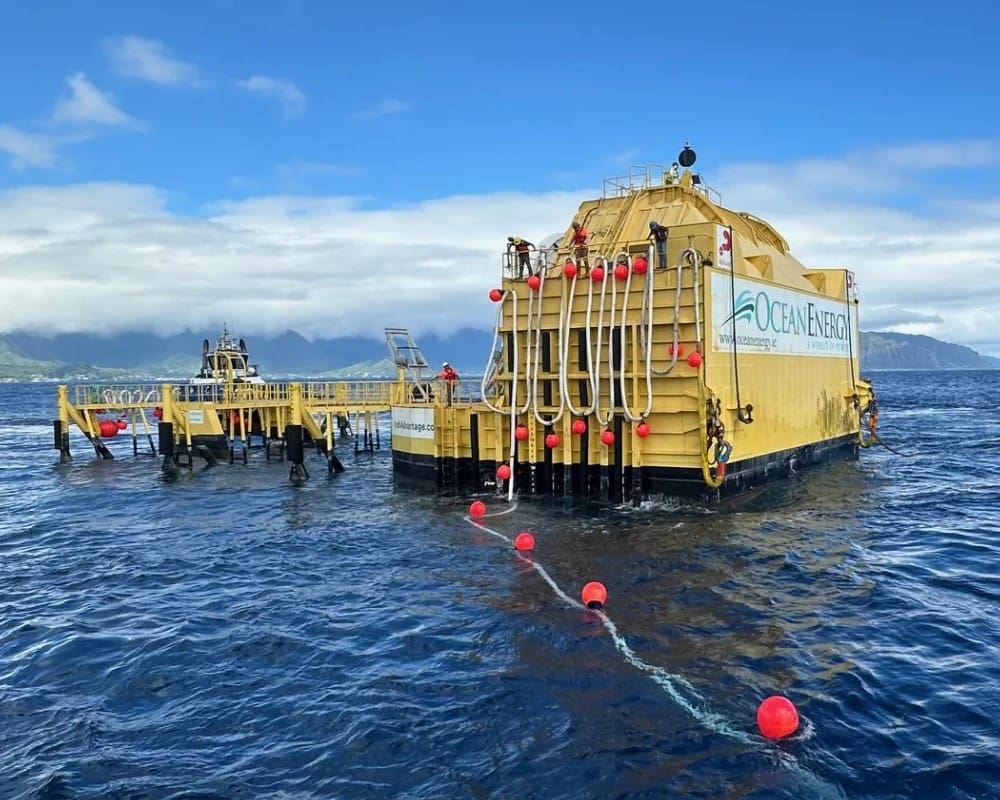
This giant machine weighs 826 tons.
It has a significantly robust design that relies on an oscillating water column.
The mechanics of the OE35 giant wave energy converter
At the bottom of the hull, water moves through a submerged chamber.
The waves rise and fall, acting like a piston. Trapped air is forced up and down a specialized pipe.
Atop the pipe is a heavy turbine, which is entirely above the waterline. A specialized, self-rectifying Wells turbine with only one moving component is used.
It spins only in one direction, regardless of the air’s movement.
This substantially lowers mechanical breakdowns and biofouling.
Additionally, the entire innovative design ensures protection against the corrosive saltwater.
The OE35 has moved beyond being a laboratory theory.
The prototype was tested in Ireland’s Galway Bay and survived Force 11 storms.
Now, it is shifting toward full commercialization. It has been deployed in the U.S. Navy’s Wave Energy Test Site in Hawaii.
It will directly feed clean power to the Hawaiian Electric Company’s local grids and the Marine Corps Base.
Subsea cables are actively converting the ocean swells into local electricity.
The highly efficient 70% power take-off proves that wave technology could soon deliver reliable, green energy worldwide.
Anke Maree is a writer with a clear and engaging editorial style. Her work focuses on making complex topics accessible, informative, and relevant for readers across different areas of interest.
