
Portugal is testing a buoy that disappears beneath the waves during storms and resurfaces when the sea can power a city the size of Miami
 Credits: CorPower Ocean
A new buoy design has the potential to survive storms and generate significant power from waves.
The world requires high-volume, highly predictable clean electricity.
Despite the growing urgent demand, conventional renewables fall short due to intermittency.
The world has become hyper-interconnected, which requires stable, high-speed networks and seamless Internet of Things (IoT) integration.
In Portugal, a new technology is being tested to help overcome weather dependency and meet rising consumption.
What is this unique buoy, and how will it endure the harsh marine environment to ensure efficient power generation?
How predictable power has become a necessity
A highly technologically advanced and digitized society has emerged over the past few years.
The world has become hyper-interconnected, which requires stable, high-speed networks and seamless Internet of Things (IoT) integration.
Several sectors have also incorporated generative AI to streamline their operations.
All of this, combined with the push for industry electrification, has significantly increased global electricity consumption.
Consequently, regional grids worldwide are experiencing immense pressure to remain operational.
In many cases, operators have no choice but to turn back to fossil-fuel plants to stabilize the grid.
While it prevents failures and the risk of blackouts, it is in direct conflict with international climate goals.
To prevent global warming from accelerating, nations must urgently phase out carbon-heavy resources.
Substantial amounts of clean electricity will be needed for this, or else the world risks delaying net-zero.
Renewable energy capacity has expanded rapidly, but it soon reached a critical structural bottleneck.
Meeting rising demand while navigating intermittency restrictions
The greatest issue faced by traditional renewable energy sources is their weather dependency.
As climate change has made weather patterns more volatile, solar and wind infrastructure has become highly affected.
During extreme heat waves, solar panels become less efficient. In prolonged overcast weather, solar output drops significantly.
Similarly, during stormy weather with dangerous wind speeds, turbines are shut down.
This high and more frequent fluctuation does not guarantee the urgently needed baseline of electricity.
Large-scale battery energy storage systems overcome intermittency, but only to a certain point.
Batteries lack long-term storage capacity and cannot sustain regions through seasonal weather changes.
The ocean has always been seen as a highly untapped source of power.
Waves offer distinct benefits over wind and solar, but reliable technology has been limited.
The Swedish company CorPower Ocean decided to address the shortcomings of this particular green energy source.
The resulting product was a highly durable buoy.
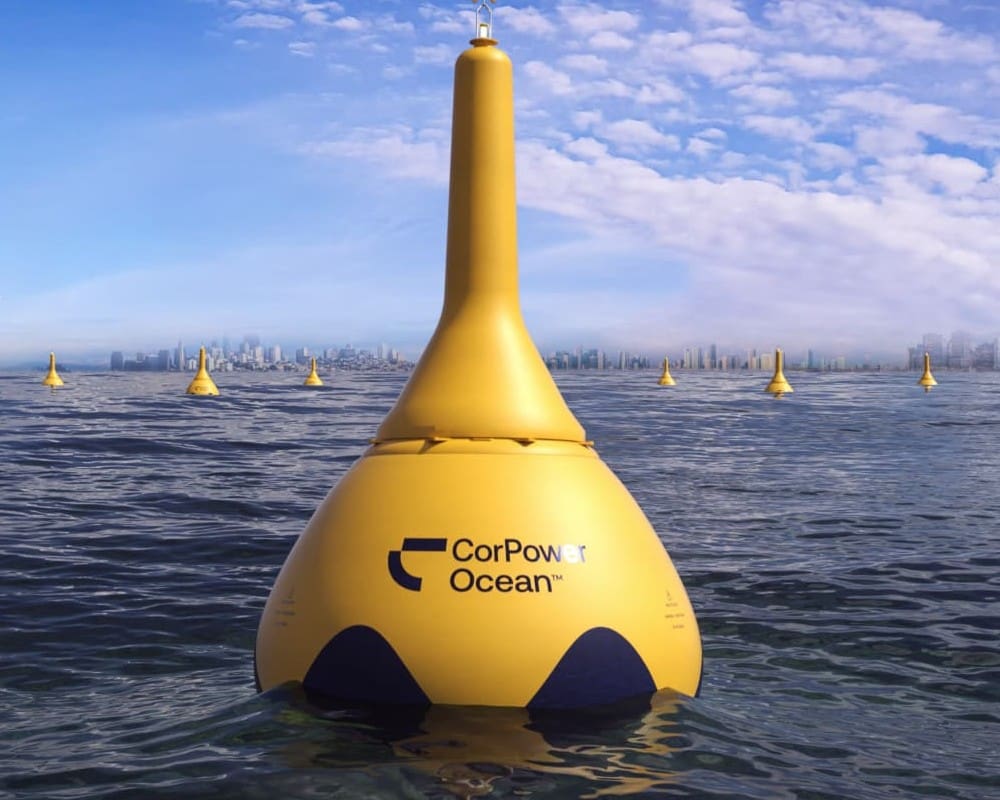
A durable buoy that rides out storms and generates wave power
Wave energy has the potential to generate highly reliable, clean electricity to power a low-carbon world.
CorPower Ocean has engineered a lightweight, spherical buoy that could make this potential a reality.
The Wave Energy Converter (WEC) is tethered to the ocean floor and utilizes a high-strength composite hull.
The system is based on biomimetic principles, imitating the natural pumping cycles of the human heart.
This maximizes energy transfer.
The WEC’s highly specialized mechanical system
Wavespring, a pneumatic “negative spring” technology, is used to manage immense wave forces.
It enables the WEC to match the frequency of incoming waves with a magnified up-and-down motion.
Compared to standard wave systems, this amplifies the total energy harnessed by 300%. Power conversion efficiency is between 96% and 99%.
The motion is converted into high-speed rotation with a durable rack and pinion system. Bolted joints are secured with tension-based Nord-Lock washers.
Its cascade gearbox minimizes mechanical stress across 100 million load cycles.
CorPower Ocean combined biomimetic engineering with industrial structural durability. This resulted in a technology that effectively unlocks the power of the sea.
The first commercial 300 kW WEC is now fully operational off northern Portugal. This model can survive stormy waves nearly up to 28 feet.
By providing reliable, steady baseline clean wave power, it paves the way to a decarbonized future.
Anke Maree is a writer with a clear and engaging editorial style. Her work focuses on making complex topics accessible, informative, and relevant for readers across different areas of interest.
