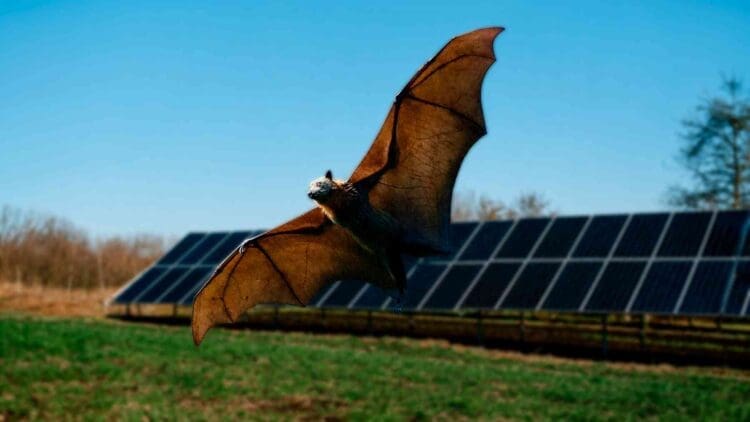

Certain bat species are starting to avoid areas near solar plants.
Renewable energy capacity is rising to new record highs worldwide, driven by tight climate goals.
Solar power is leading this massive surge, ensuring high-capacity electricity for digital economies.

However, researchers are growing deeply concerned about the unintended impacts of these installations on local biodiversity.
Why are bats suddenly disappearing near these facilities, and how can this issue be resolved?
How renewable energy sources evolved into more than a climate strategy
Years ago, researchers and global leaders identified a transition toward green energy as key to mitigating climate change.
Several legally binding targets were set, with several nations committing to the 2015 Paris Agreement.
Solar and wind infrastructure deployment formed part of the primary framework for achieving these climate goals.
Today, this narrative has shifted.
Renewable energy capacity has become the dominant, scaled driver of the global economy.
Governments now value it as a strategic investment in:
- Economic stability
- Commercial viability
- National defense
The International Renewable Energy Agency highlights that 692 gigawatts of new green capacity were recently installed.
Solar energy represented 75% of this historic surge, offering distinct advantages.
Large-scale facilities significantly deflate levelized costs. After initial capital expenses have been paid, the ongoing electricity costs become predictable for years.
Furthermore, it bypasses the risks of the global industrial gas shortage.
Despite these benefits, it still presents hidden ecological impacts.
The physical footprints of solar plants
Large-scale solar and battery storage systems have become central to the evolving digital age.
These combined facilities overcome the intermittency issues of sole solar installations.
Not only do they stabilize global grids, but they also generate high-capacity, uninterrupted power for AI and data centers.
However, as data centers continue to expand exponentially, the need for more solar plants increases.
This rapid deployment necessitates large stretches of land.
As open fields transform into industrial energy zones, local ecosystems pay the price.
Their physical footprint leads to a significant loss of local vegetation.
Furthermore, it also triggers habitat fragmentation, as mammals lose hunting, foraging, and breeding grounds.
These are all common impacts that have raised significant concerns over the years.
Yet, researchers from the University of Bristol have recently observed a more surprising ecological impact.
A report from the University of Bristol details how bats have started avoiding solar plants.
The avoidance behavior of bats
It turned out that bats would rather disappear than fly over solar plants.
The researchers conducted a widespread field study across southwest England to understand why.
The study monitored 19 operational solar farms to see how they alter nocturnal behavior.
A fixed baseline was established by pairing each solar installation with a nearly identical, solar-free control field.
Static acoustic monitoring equipment was deployed at both boundaries and open centers of all fields.
Over 50,000 distinct echolocation passes were captured. This enabled the researchers to determine the exact changes in bat activity levels.
Six of eight species showed significant declines:
- Common pipistrelle dropped 40% at field edges and 86% in the center
- Soprano pipistrelle significantly declined in the center
- Plecotus experienced a major reduction in the center
- Myotis species experienced a significant decline at field edges
- Serotine also showed a great reduction at field edges
- Nyctalus had major reductions at field edges and in the center
The University of Bristol’s research proves that solar plants cause avoidance behaviors in bat species.
However, why they trigger avoidance remains a mystery.
One theory suggests solar panels create “acoustic camouflage,” which scatters echolocation calls, impacting navigation.
Another states that panels alter local microclimates, causing insect shortages that lower bats’ food supply.
Finally, others believe that power inverters’ electromagnetic noise may disrupt bat senses.
Nonetheless, developers are now tasked with adapting solar developments for the safety of local wildlife.
Anke Maree is a writer with a clear and engaging editorial style. Her work focuses on making complex topics accessible, informative, and relevant for readers across different areas of interest.