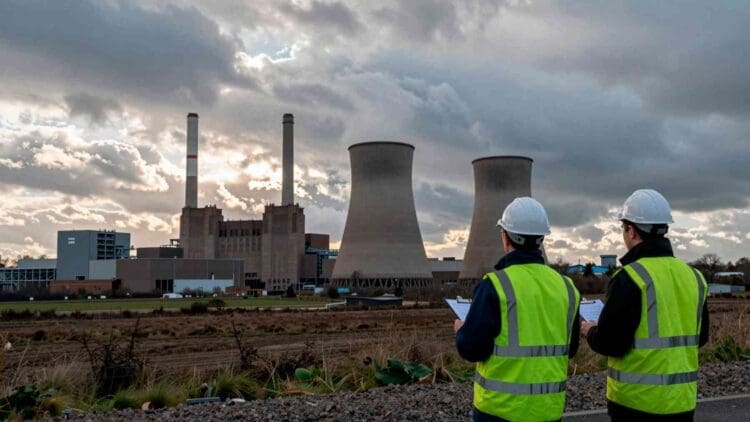

Holtec International and EDF Energy have jointly submitted a proposal to the UK government to deploy Holtec’s SMR-300 small modular reactors at Cottam, Nottinghamshire. The two companies announced the submission on June 29, alongside news that they’ve formed a joint venture to advance the project at the East Midlands site.
Holtec and EDF file joint SMR proposal with UK government
Both companies — Holtec International, headquartered in Jupiter, Florida, and London-based EDF Energy — made the submission on June 29 and confirmed they’d set up a dedicated joint venture to push things forward. This isn’t a loose handshake deal or a memorandum of understanding. It’s a formal structure built specifically to get SMRs deployed at Cottam.
The joint venture combines two very different kinds of expertise. Holtec brings the reactor design; EDF brings decades of nuclear operations experience in the UK market. Together, they’re positioning themselves as a ready-made team for whatever evaluation process the UK government runs next.

Why Cottam was selected for the SMR project
Cottam sits in England’s East Midlands, in Nottinghamshire — not a random patch of land. The site currently hosts a gas-fired power plant, and before that it ran a large coal-fired station for decades. That history matters more than it might seem at first.
Former fossil-fuel power sites come with something genuinely hard to build from scratch: grid connections. Getting electricity from a generation facility onto the national grid requires serious infrastructure—transformers, substations, and transmission lines. Sites like Cottam already have that in place, or at least the foundations of it. Nuclear facilities also need significant space and distance from dense population centers, and a former coal or gas plant checks those boxes almost by definition.
Regulators and developers tend to view brownfield energy sites as logical candidates for new nuclear development rather than breaking ground somewhere entirely new. Cottam’s existing infrastructure, its location, and its industrial character all point in the same direction—a practical choice, not just a symbolic nod to repurposing old fossil-fuel land.
What the SMR-300 reactor involves
The SMR-300 is Holtec International’s small modular reactor design. The name is fairly self-explanatory: SMR stands for small modular reactor, and the 300 refers to its approximate electrical output — around 300 megawatts. A conventional large-scale nuclear plant might generate 1,000 megawatts or more from a single unit, so the SMR-300 is intentionally smaller.
That’s not a limitation — it’s the whole point. Smaller output means a reduced physical footprint, lower upfront capital costs per unit, and more flexibility about where a plant can go.
The “modular” part refers to how these reactors get built. Rather than constructing everything on-site over many years, components are designed to be manufactured in a factory and assembled at the deployment location. Factory production is meant to improve quality control, cut construction timelines, and bring costs down across multiple builds as the process gets more standardized. SMRs as a category are still working to prove that out in practice, but the design concept has attracted serious investment and government interest across multiple countries, including the UK.
Context: UK nuclear ambitions and SMR policy
The UK government has been vocal about its support for small modular reactors as part of its clean energy strategy. Nuclear is positioned alongside renewables as a low-carbon source capable of providing reliable baseload power — the kind of steady, always-on generation that wind and solar can’t consistently deliver on their own.
That policy stance has created a competitive landscape. Several SMR proposals are now vying for UK government backing, and Cottam has entered that field with the Holtec–EDF submission. No public commitment to any single design or developer has been made at this stage, so the proposal joins a broader race for support and, eventually, contracts.
EDF Energy’s existing role in UK nuclear gives the joint venture a real advantage. EDF already operates nuclear power stations in Britain, which means it knows the regulatory environment, has relationships with the relevant authorities, and carries a track record the government can point to. That’s not nothing when you’re asking policymakers to back a technology still proving itself at commercial scale. Holtec contributes the reactor design itself and the US-based engineering capability behind it—American reactor expertise paired with British operational experience and local market knowledge.
Boosting the UK’s nuclear capacity
The core facts here are straightforward. Holtec International and EDF Energy have submitted a joint proposal to the UK government to deploy SMR-300 reactors at Cottam in Nottinghamshire, backed by a formal joint venture. The site was chosen in part because of its existing energy infrastructure as a former fossil-fuel power location. Producing around 300 megawatts of electricity using a factory-built, modular approach, the SMR-300 enters a competitive field of bids as the UK government works to expand nuclear capacity under its clean energy strategy. No government decision on backing has been announced.
Kelly is an experienced writer with 15 years of experience exploring the big stories that shape our world, from tech breakthroughs and space exploration to climate, energy, and the fascinating quirks of science. She has a talent for turning complex ideas into sharp, memorable insights that stay with readers long after they’ve finished reading.