
In a world driven by trends, it can be difficult to stand out from the mainstream crowd, if not somewhat risky. However, some believe you have to risk it to get the biscuit, especially when it comes to achieving national and international climate goals. Hydrogen blending was once seen as risky in the energy world, but now, it has gone mainstream as Taiwan is flooding its gas grid. Plans of targeting massive scale by 2028 have also been announced. Discover what this new trend will have in store for Taiwan.
Once seen as risky, but hydrogen blending just went mainstream
Another year has flown by, which means there is one year less for nations to achieve their respective climate targets, as well as the global target of zero emissions by 2050. While some are actively focused on boosting their installed renewable energy capacities, others are focusing on less typical solutions. For example, one of the approaches that Taiwan is focused on is hydrogen blending.
Now, this approach is quite risky, but Taiwan is making it mainstream. According to the Clean Energy Group, this approach presents significant safety risks and operational and performance challenges, including:

- Higher flammability and lower explosive limit
- High flame velocity may cause flashback into the burners
- Material degradation, particularly in older infrastructure
- Increased risk of permeation and leaks
- Decreased energy efficiency
- Potential increase in nitrogen oxide emissions
- Potential appliance malfunction
Yet, Taiwan believes hydrogen blending is the future and is flooding its gas grid, with plans on targeting massive scale by 2028.
Taiwan is flooding its gas grid
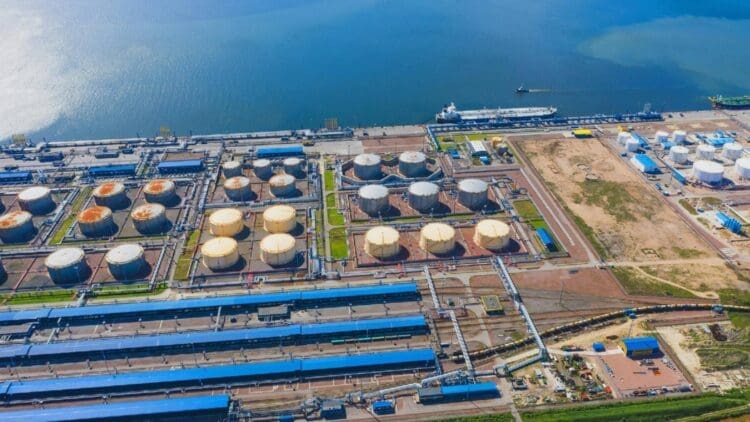
The utility called Taipower has announced that its research institute has commenced trial testing at the Kaohsiung thermal power plant, which will focus on hydrogen blending with natural gas for electricity production. The efforts at the Kaohsiung thermal power plant will reportedly reduce carbon emissions while ensuring the stability of the power grid.
This facility is a significant change from Taiwan’s primary focus on increasing its regional wind capacity, where its Hai Long wind farm is expected to connect to the grid this year. Taipower has already received significant blend levels and is targeting even higher levels by 2028. This may be easily achieved, as according to Kaohsiung Times, a hydrogen energy storage system will also be developed in addition.
The storage system will utilise electrolysis and renewable energies to generate green hydrogen, and plans for field testing in 2027 are being made at a southern solar power site.
Targeting massive scale by 2028
According to Taipower, its trial testing presently comprises 5 MW of production capacity. The first hydrogen co-firing testing commenced at the Kaohsiung thermal power plant in September 2023 with the use of modified gas turbines. The current hydrogen blend level is up to 15%, but Taipower is aiming to achieve hydrogen blend levels of 20% by 2028.
Taipower added that a 20% blend level can reduce carbon emissions by approximately 90 kg/hour (0.099 tons per hour). The utility has also shown great initiative with other projects, which include:
- Taiwan’s first micro-grid
- Maintains power supply during disasters such as typhoons
- A monitoring system that studies optimal power dispatch patterns
- An AI-assisted drone that conducts inspections with image recognition and 5G connectivity
- Identifies structural risks at power facilities
The Taipower chair, Tseng Wen-sheng, stated that balancing energy security with decarbonization is becoming increasingly difficult, especially as power demands are skyrocketing, particularly as a result of AI data centers. As the utility continues the trial tests at Kaohsiung thermal power plant, what was once seen as too risky may truly become mainstream afterall, especially if all the challenges of hydrogen blending can be addressed. Naturally, as the future of natural gas changes, pipeline networks must soon change as well.

